
The best ergonomic chair for a home office in 2026 is the Steelcase Series 1 (~$499): it pairs commercial-grade build quality and a 12-year warranty with the adjustments that matter — height-adjustable lumbar, 4D arms, and seat depth. On a tight budget, the SIHOO M57 (~$200) covers the same basics, while the Herman Miller Aeron (~$1,295) remains the premium benchmark.
As an Amazon Associate I earn from qualifying purchases.
Best Ergonomic Chairs for Home Offices (2026)
TL;DR — The 6 best ergonomic chairs for home offices:
- Best overall: Steelcase Series 1 (~$499) — 12-year warranty, 4D arms.
- Best budget: SIHOO M57 (~$200) — adjustable lumbar, 3D arms.
- Best mid-range alternative: Branch Ergonomic Chair Pro (~$329) — 14 adjustments, 5D arms.
- Best premium design: Herman Miller Sayl (from $795 direct) — frameless elastomer back.
- Best premium all-rounder: Herman Miller Aeron, Size B (~$1,295 direct) — PostureFit lumbar, 8Z Pellicle.
- Best premium value: Steelcase Leap V2 (from ~$659 on Amazon) — lumbar dial, 4D arms.
| Chair | Price (Nov 2026) | Capacity | Warranty | Standout feature |
|---|---|---|---|---|
| SIHOO M57 | ~$200 | 330 lbs | 3 years | Adjustable lumbar, 3D arms |
| Branch Ergonomic Chair Pro | ~$329 | 275 lbs | 7 years | 14 adjustments, 5D arms |
| Steelcase Series 1 | ~$499 | 400 lbs | 12 years | LiveBack flexor, 4D arms |
| Herman Miller Sayl | From $795 | 350 lbs | 12 years | Frameless elastomer back |
| Herman Miller Aeron, Size B | ~$1,295 | 350 lbs | 12 years | PostureFit SL, 8Z Pellicle |
| Steelcase Leap V2 | From ~$659 | 400 lbs | 12 years | Height-adjustable lumbar dial |
What makes a chair ergonomic?
An ergonomic chair adjusts to your body instead of forcing your body to adjust to it. The four adjustments that matter most are seat height, lumbar support height, armrest height, and seat depth.
Mayo Clinic’s office ergonomics guide recommends a chair that supports your spine, set so your feet rest flat on the floor with thighs parallel to the floor, and armrests positioned so elbows stay close to your body with relaxed shoulders. Mayo Clinic also notes that sitting in one position for hours strains the body even in a good chair, so movement through the day matters as much as the chair.
OSHA’s Computer Workstations eTool gives the same baseline: feet flat, knees at or slightly above seat level, lower back supported by the chair’s lumbar curve. Our how to choose an ergonomic office chair guide covers measuring your body before you buy.
How much should you spend on an ergonomic chair?
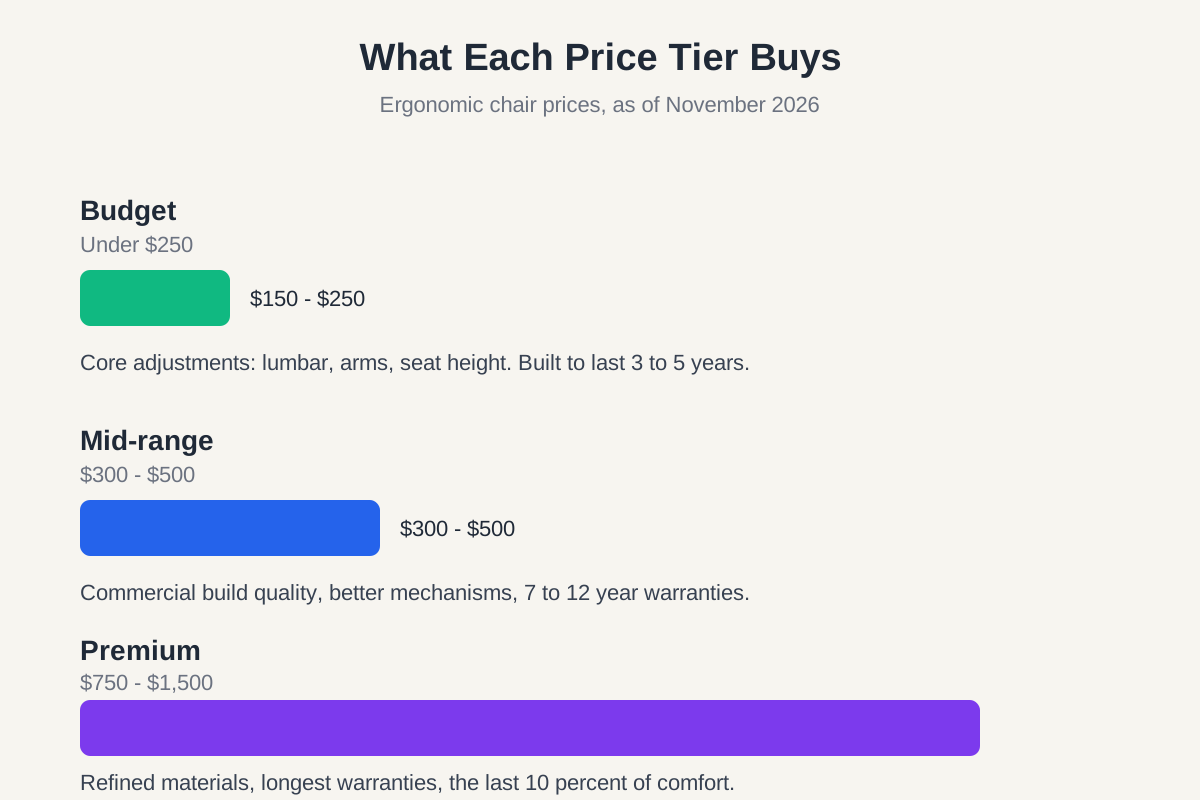
Under $250 buys the core adjustments — lumbar, arms, seat height — in a chair built to last three to five years. The $300–$500 band buys commercial-grade build quality, better mechanisms, and warranties of seven to twelve years. Above $750 you pay for refined materials, the longest warranties, and the last 10% of comfort.
A $200 chair that fits you beats a $1,300 chair that does not. Seat height, seat depth, and lumbar position are body measurements, not luxury features, so check the spec sheet against your height before checking the price tag.
Timing matters too. If you’re not in a hurry, Black Friday week (Nov 27–30) is when chair prices hit their yearly floor — our Black Friday ergonomic chair deals guide tracks the discount bands to expect, and premium chairs from Herman Miller and Steelcase typically see their steepest cuts of the year then. A $1,295 Aeron at 25% off is a $970 chair.
Best Budget: SIHOO M57 (~$200)
The SIHOO M57 is the cheapest chair here that still gives you real ergonomics: an adjustable lumbar pad you can actually move, 3D armrests, a mesh back, an adjustable headrest, and a tilt lock. At ~$199.99 on Amazon as of November 2026, it covers every adjustment in the checklist above.
The M57 is rated for 330 lbs, and the tilt locks at three positions between 110 and 130 degrees. It holds a 4.3-star average across roughly 7,800 Amazon ratings.
The trade-offs are where the price shows. Seat depth is fixed, so very tall or very short sitters cannot fine-tune thigh support the way they can on the Branch or Steelcase picks. The warranty is three years rather than seven to twelve. For more options in this price band, see our best ergonomic office chair under $300 roundup.
Best Mid-Range Alternative: Branch Ergonomic Chair Pro (~$329)
The Branch Ergonomic Chair Pro is the sweet spot for buyers who want a chair that adjusts like a premium one without the premium price. At ~$329, it offers 14 points of adjustment — seat height, seat depth, 5D arms, lumbar height, recline tension, and forward tilt.
The forward tilt is the detail that sets it apart. Most chairs in this price band only recline backward; the Pro also tilts the seat pan slightly forward, which opens the hip angle and takes pressure off the lower back when you lean into focused work. The chair fits users from about 5’2″ to 6’4″. The seat-depth adjustment — a full 4 inches of travel — makes the Pro feel custom-fit.
The 275 lb capacity is the one limit to note: heavier users should look at the 330–400 lb ratings of the SIHOO, Series 1, or Leap instead.
Best Overall: Steelcase Series 1 (~$499)
The Steelcase Series 1 is where this guide’s recommendation lands. At ~$499 from the Steelcase Store on Amazon, it is a commercial-grade task chair with the LiveBack flexor system, a 12-year warranty, and BIFMA Level 3 certification.
The LiveBack backrest flexes with your spine as you shift posture, so lumbar support stays in contact. The lumbar pad adjusts in height, the 4D arms move in height, width, depth, and pivot, the seat slides 2.25 inches for depth, and the weight-activated recline sets its own tension based on your body weight. Seat height runs 16 to 21 inches, and the 400 lb capacity matches the Leap V2.
The chair fits users from about 5’4″ to 6’2″ and ships mostly assembled. The standard configuration pairs a 3D Microknit mesh back with a foam seat; a full-mesh Air Back version costs less but drops the lumbar support, so we recommend the standard model. The one real gap is the headrest: it must be selected at order time and cannot be retrofitted later. A 12-year warranty on a $499 chair is about $42 a year.
Best Premium Design: Herman Miller Sayl (from $795)
The Herman Miller Sayl is the most distinctive chair in this guide. Designed by Yves Béhar, its frameless back is a web of elastomer strands across a Y-shaped tower, tensioned by zone so the lower back gets firmer support than the shoulders.
The Sayl starts at $795 at the Herman Miller store, and Amazon listings for the same chair typically run $1,020–$1,075 depending on configuration, so check both before buying. The 12-year Herman Miller warranty applies either way, and the chair is rated for 350 lbs. The elastomer back breathes better than foam and keeps its support for the life of the chair, since there is no foam to compress and no fabric to sag.
The Sayl is also the most configuration-sensitive chair here. Arms range from none to fully adjustable 4D, and lumbar support and seat-depth adjustment are optional extras. Confirm the listing includes the adjustments you need. It suits smaller to average frames best; owners over 6 feet often find the backrest short.
Best Premium All-Rounder: Herman Miller Aeron, Size B (~$1,295)
The Herman Miller Aeron, Size B has been the reference ergonomic chair since 1994. Size B (medium) fits most adults; the fully loaded configuration adds PostureFit SL lumbar, fully adjustable arms, tilt limiter, and forward tilt.
Its 8Z Pellicle mesh has eight zones of varying tension that distribute pressure instead of concentrating it. Its PostureFit SL pads support the sacrum and lumbar region independently — the feature owners with lower-back trouble mention most. The chair is rated for 350 lbs and carries Herman Miller’s 12-year warranty.
Pricing needs care. The Aeron lists at ~$1,295 direct from Herman Miller, but Amazon marketplace sellers list the same Size B PostureFit configuration at widely varying prices — camelcamelcamel records third-party new listings as low as ~$632 — so verify the seller, the condition, and the exact configuration before ordering. Our best back support office chair guide covers lumbar systems in depth.
Best Premium Value: Steelcase Leap V2 (from ~$659 on Amazon)
The Steelcase Leap V2 is the chair for buyers who want Aeron-level adjustability without the Aeron price. List price is ~$1,399, but Amazon listings have run as low as ~$659 as of November 2026 — the best premium value in this guide when the discount is live.
Its signature is the height-adjustable lumbar dial — a thumbwheel that moves lumbar support up and down while you sit. With LiveBack contouring, 4D arms, adjustable seat depth, and a 400 lb capacity, it is the most adjustable chair here.
The trade-off is looks and availability. The Leap is a corporate workhorse, not a design object, and Amazon pricing swings with stock — the same listing can jump hundreds of dollars between weeks. If you see it under $800, buy it; at full list, the Series 1 at $499 covers 90% of the same ergonomics.
Which ergonomic chair should you buy?
Match the chair to your budget and your body, in that order. Under $250, buy the SIHOO M57. Between $300 and $500, buy the Branch Pro for adjustability or the Series 1 for longevity — our overall pick, at only $170 more than the Branch. Above $750, buy the Sayl if you are petite or average height and want design, the Aeron if you type all day and run warm, or the Leap V2 if you catch it under $800.
One rule applies at every price: measure before you buy. Check the seat-height range against your leg length, the seat depth against your thigh length, and the weight rating against your body weight. A chair with the wrong seat depth will hurt no matter what the brand name says.
How do you set up your new chair in 5 minutes?
Run through this checklist the day your chair arrives:
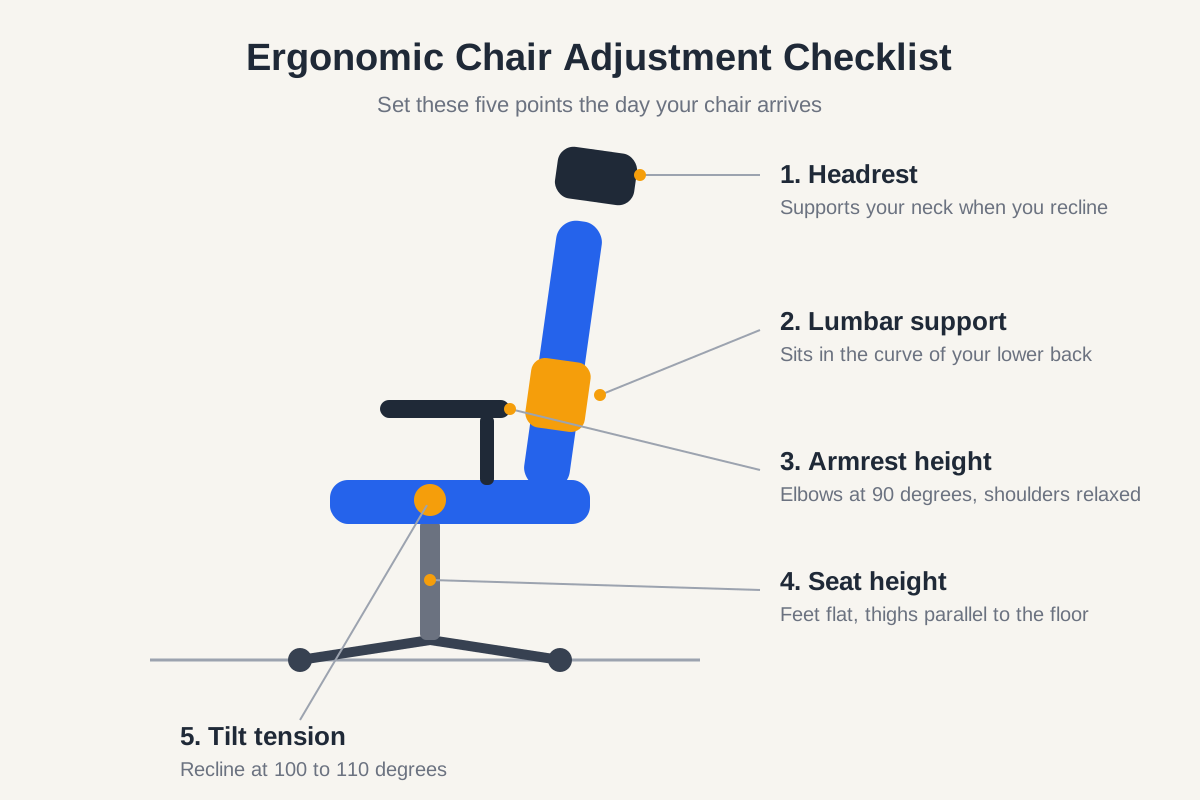
- Set seat height first. Raise or lower the seat until your feet rest flat on the floor and thighs are parallel to the floor.
- Position the lumbar support. Slide the lumbar pad until it sits in the curve of your lower back, just above your belt line.
- Adjust the armrests. Set them so elbows rest at roughly 90 degrees with shoulders relaxed.
- Set the seat depth. Slide the seat until two to three fingers fit between the front edge and the back of your knees.
- Dial in the recline. Unlock the tilt and set the tension so the chair supports you at about 100–110 degrees. Mayo Clinic’s guide puts the monitor top at or slightly below eye level, about an arm’s length away.
Revisit step 2 after a week of use — most people set their lumbar too high on day one and lower it once their back settles in.
Frequently asked questions
What is the best ergonomic chair for a home office?
The Steelcase Series 1 (~$499), because it combines commercial-grade build quality, a 12-year warranty, and the four key adjustments at a mid-range price.
How much should I spend on an ergonomic chair?
Spend $200–$500: $200 buys the core adjustments, $300–$500 adds commercial build quality and a 7–12 year warranty, and above $750 you pay for materials and warranties rather than better ergonomics.
Is a mesh back better than a foam back?
A mesh back is better for warm rooms and long sessions because it breathes and keeps its shape; foam feels softer at first but traps heat and compresses over years.
Can an ergonomic chair fix back pain?
No chair can fix back pain on its own, but adjustable lumbar support that fits your body reduces aggravating strain. Mayo Clinic recommends pairing a supportive chair with regular movement and seeing a clinician for persistent pain.
The bottom line
The best ergonomic chair is the one that fits your body, adjusts where it matters, and lasts long enough to justify its price. For most people in 2026, that is the Steelcase Series 1 at ~$499. If $499 is too much, the SIHOO M57 at ~$200 covers the same fundamentals. The Herman Miller Aeron waits at the top of the ladder — preferably bought on sale.