
The best office chair for tall people in 2026 is the COLAMY Big and Tall 5309 (~$139 as of October 2026): its 23-inch-deep seat, 29.5-inch backrest, and 400-lb capacity fit users 6’2″ and up where standard chairs fail. Ergonomics-first buyers should get the Hbada E3 Air (~$369) with adjustable seat depth, 3-zone lumbar support, and a retractable footrest.
As an Amazon Associate I earn from qualifying purchases.
Best Office Chairs for Tall People (2026)
TL;DR — The 6 best office chairs for tall people:
- Best overall: COLAMY Big and Tall 5309 (~$139) — 23″ seat depth, 29.5″ backrest, 400-lb capacity.
- Best ergonomic pick: Hbada E3 Air (~$369) — adjustable seat depth, 3D headrest, 3-zone lumbar, footrest.
- Best comfort / leather: Serta AIR Executive (Bryce) (~$209–249) — 28.5″ backrest, patented AIR lumbar, bonded leather.
- Best corporate 400-lb pick: Lorell LLR67004 (price varies) — 400-lb rating, 48″ overall height, executive styling.
- Best commercial task chair: basyx by HON Exposure (HVL721) (~$230–280) — adjustable seat depth, 18–21.5″ seat height, mesh back.
- Best premium ergonomic: SIDIZ T50 (~$419–449) — 21.6″ adjustable seat depth, 3D armrests, forward tilt.
The quotable rule: seat depth is the spec tall people should check first — a 23-inch seat changes the experience more than any lumbar gimmick.
| Model | Seat depth | Seat height range | Backrest height | Weight capacity | Price (Oct 2026) |
|---|---|---|---|---|---|
| COLAMY Big and Tall 5309 | 23.03″ | 19.3–23.2″ | 29.52″ | 400 lbs | ~$139 |
| Hbada E3 Air (w/ footrest) | 16.9–18.9″ (adj.) | 18.3–20.7″ | 44.3–52.4″ overall | 330 lbs | ~$369–399 |
| Serta AIR Executive (43807) | 19.5″ | Adjustable | 28.5″ | 275 lbs | ~$209–249 |
| Lorell LLR67004 Big & Tall | Not published | Adjustable (pneumatic) | 48″ overall | 400 lbs | Varies (~$460+ resellers) |
| basyx by HON Exposure (HVL721) | 17.5–19.5″ (adj.) | 18–21.5″ | 22″ | 250 lbs | ~$230–280 |
| SIDIZ T50 | 21.6″ (adj.) | ~21.5″ | 20.5″ | 275 lbs | ~$419–449 |
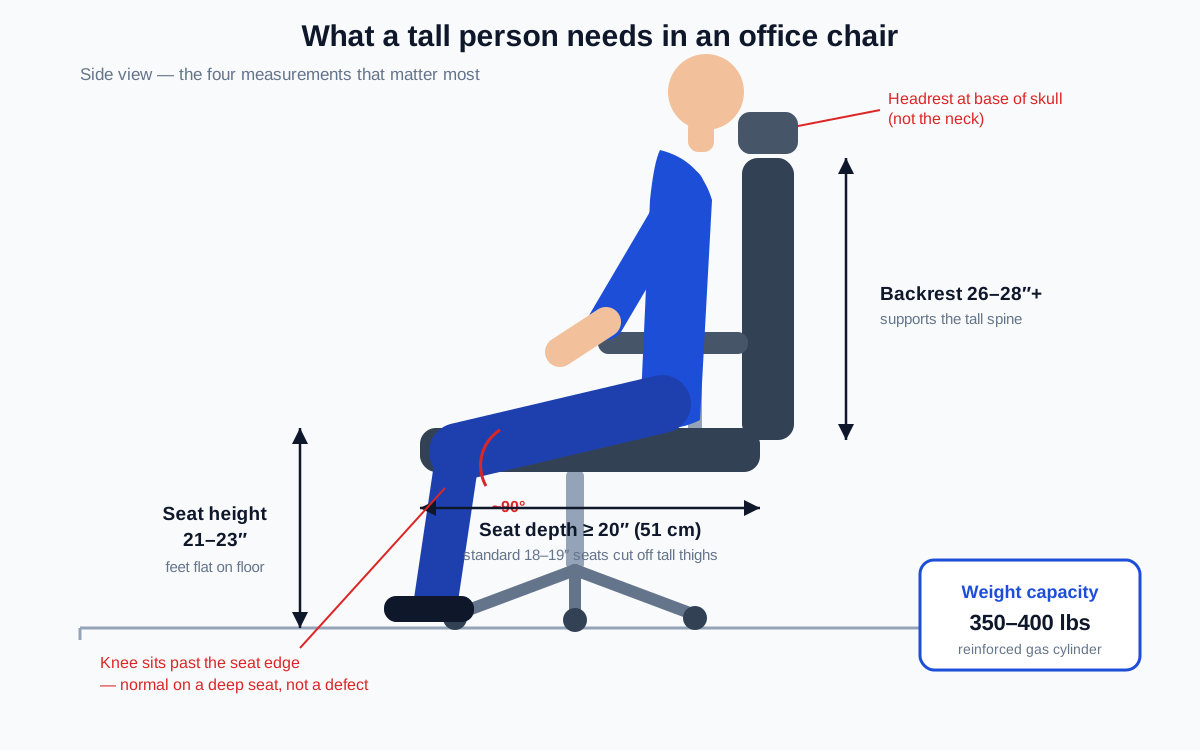
What Should Tall People Look for in an Office Chair?
Four numbers: seat depth of at least 20 inches, a backrest of 26–28 inches or more, a seat-height range that tops out above 21 inches, and a weight capacity of 300 lbs or more.
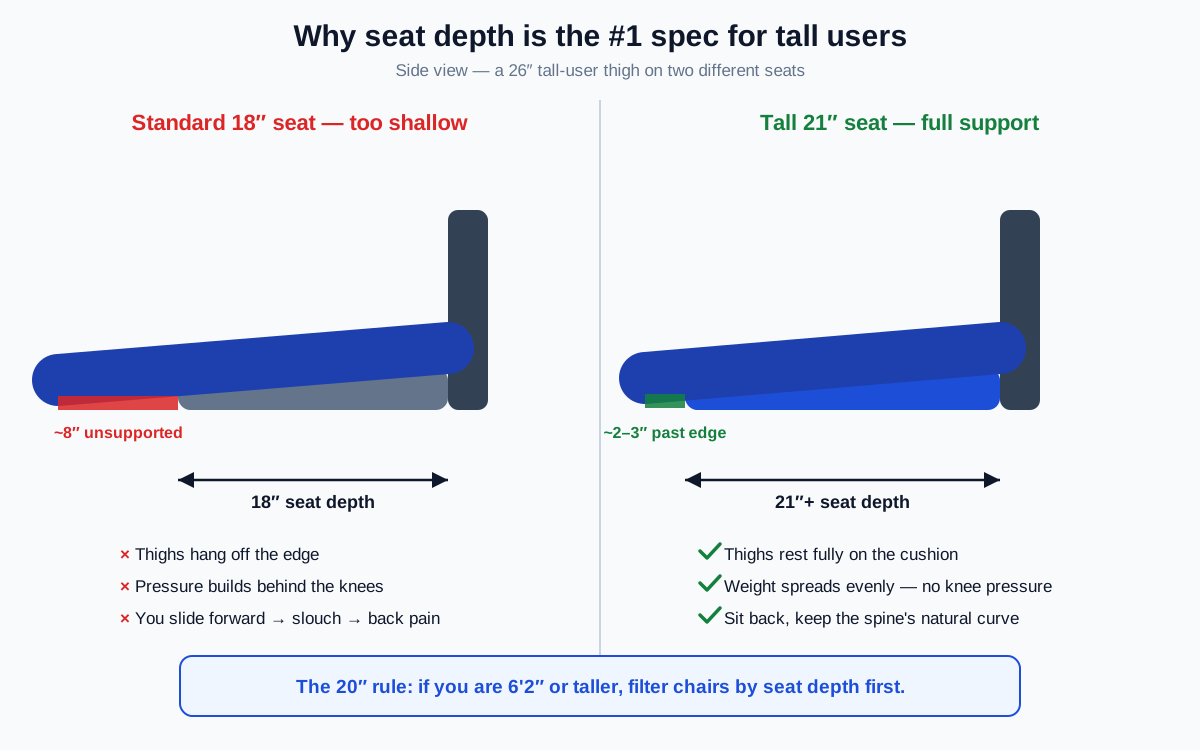
Seat depth is the one most brands hide. A standard 18–19-inch seat leaves a tall user’s thighs hanging off the front edge, concentrating pressure behind the knees and pushing you into a slouch within an hour. (Source: Mayo Clinic) At 6’2″ or taller, you want 20 inches minimum, and 21–23 inches is the sweet spot.
Backrest height matters because a short back ends mid-torso on a tall person, forcing the shoulders to do the stabilizing work the chair should do. Look for a backrest of 26–28 inches or more, or a headrest that genuinely reaches the base of your skull — many “high-back” chairs put the headrest at neck level for tall users, which is worse than none.
Seat height is simple physics: feet flat on the floor, knees at roughly 90 degrees. Most budget chairs top out around 20–21 inches, which is borderline over 6’2″. And weight capacity is a proxy for build quality — a 400-lb-rated chair feels planted and lasts years longer under a tall user than a 250-lb chair stressed near its limit.
Best Overall: COLAMY Big and Tall 5309
The COLAMY Big and Tall 5309 wins on the numbers that matter: a 23.03-inch seat depth (the deepest here by far), a 29.52-inch backrest, a 19.3–23.2-inch seat-height range, and a genuine 400-lb capacity. No other chair under $150 comes close.
The high-back executive design has flip-up arms for sliding under a desk, and the 23-inch-wide padded seat leaves room to shift during long sessions. The trade-off is refinement — basic lumbar support and bonded leather that breathes poorly in summer. For the core tall-person requirements, it over-delivers at ~$139.
Best Ergonomic Pick: Hbada E3 Air
The Hbada E3 Air is the most adjustable chair here, and that adjustability is what tall people actually need. The seat slides 5 cm to fit your thigh length, the backrest lifts 3.15 inches to position the 3-zone dynamic lumbar against your real lumbar curve, and the 3D headrest moves in three dimensions to reach a tall skull.
The standout is the retractable footrest — tall users often struggle with leg circulation, and this fixes it without a separate footrest. The trade-off: 330 lbs of capacity and a seat depth topping out at 18.9 inches. Fine for most 6’2″–6’4″ users with the slide extended, but very tall buyers should prefer the COLAMY’s 23 inches.
Best Comfort / Leather: Serta AIR Executive (Bryce)
The Serta AIR Executive (model 43807, “Bryce” gray bonded leather) is the plush pick. Serta’s patented AIR lumbar zones flex as you move, the 28.5-inch backrest is genuinely tall, and the 19.5-inch seat depth beats the standard 18 inches. At ~$209–249 it’s the cheapest route to an executive look.
The honest caveat: the 275-lb capacity means this isn’t a big-and-tall chair in the weight sense. Tall but under that limit? The tall backrest and deep-ish seat serve you well. Tall and heavy? The COLAMY or Lorell are safer bets.
Best Corporate 400-Lb Pick: Lorell LLR67004
The Lorell LLR67004 is the chair offices buy when they need a real 400-lb-rated seat: 48 inches tall overall, 23-inch-wide seat, bonded-leather executive styling, and a reinforced base with chrome arms built for multi-year commercial use.
The trade-off is price and information. Office-supply resellers list the same chair at $460–600, and Lorell doesn’t publish seat depth. This is the pick when your employer is buying and wants a contract-furniture brand; for your own money, the COLAMY delivers similar capacity for far less.
Best Commercial Task Chair: basyx by HON Exposure (HVL721)
The basyx by HON Exposure (HVL721) is the commercial-grade task chair here: mesh back, leather seat, seat depth adjustable from 17.5 to 19.5 inches, and an unusually wide 18–21.5-inch seat-height range — all at ~$230–280, built to ANSI/BIFMA standards for 8–10-hour days.
The trade-off: a 250-lb capacity (the lowest here) and a 22-inch backrest that tops out just under the tall-user threshold. Right for a tall-but-not-heavy user who wants commercial build quality and a breathable mesh back; over 250 lbs, skip it.
Best Premium Ergonomic: SIDIZ T50
The SIDIZ T50 is the premium play: a 21.6-inch adjustable seat depth (the deepest adjustable seat here), 3D armrests, forward tilt, and a high-performance mesh back, at ~$419–449.
The seat-slider plus forward-tilt combination is the standout: dial the seat depth to your exact thigh length, then tilt forward a few degrees to open the hip angle — the most effective posture fix for tall people who type all day. (Source: OSHA) The trade-off is the 275-lb capacity and the price: tall-but-average weight with no budget constraint? This is the best fit mechanism in the roundup.
Is a 20-Inch Seat Deep Enough If You’re 6’4″?
For most 6’4″ users, 20 inches is the minimum and 21–23 inches is the comfort zone.
Thigh length (hip to back of knee) at 6’4″ is typically 21–23 inches. A 20-inch seat supports most of the thigh with 1–3 inches of knee overhang — the healthy ideal, since you want a small gap so the seat edge never presses behind your knees. A standard 18-inch seat leaves ~8 inches of thigh unsupported; a 21-inch seat leaves the ideal 2–3 inches.
The COLAMY’s 23.03 inches fits even 6’6″ users. The SIDIZ T50’s 21.6-inch adjustable seat is the precision option — slide it until you get that 2–3-inch gap.
Can Tall People Just Use a Regular Office Chair?
For a few weeks, yes — then the compromises compound.
A regular chair’s 18–19-inch seat forces tall users to perch on the front half or slouch to reach the backrest. Either way, the lumbar support misses your actual lumbar curve (it sits too low), the headrest hits your neck instead of your skull, and the budget gas cylinder starts sinking within a year. Our ergonomic chairs guide covers general fit; the tall-specific version adds seat depth and backrest height to the checklist.
Do I Need a 400-Lb Capacity Chair If I’m Just Tall?
No — but treat 300 lbs as the floor.
Capacity correlates with cylinder diameter, base strength, and frame stiffness, and a tall person puts more leverage on every joint than a short person of the same weight: longer thighs mean more force on the seat front, more height means more torque on the backrest. A 250-lb chair under a 200-lb, 6’3″ user is effectively stressed harder than the number suggests.
The COLAMY and Lorell at 400 lbs will feel rock-solid for years. The Hbada at 330 lbs is fine for most tall users. The Serta, HON, and SIDIZ at 250–275 lbs work for tall-but-average-weight users — heavier tall users should pass. And if your chair creaks on hard floors, see our desk mat guide before the casters do damage.
How High Should the Backrest and Headrest Be?
Backrest: 26–28 inches or more from the seat. Headrest: at the base of your skull, not your neck.
The backrest should reach at least your shoulder blades. The COLAMY’s 29.52 inches and the Serta’s 28.5 inches clear that bar for most 6’2″–6’5″ users. The HON Exposure’s 22-inch mesh back is shorter, which it compensates for with lumbar precision rather than height. For headrests: sit all the way back and check where it lands — if it presses your neck forward, it’s too low. The Hbada’s 3D headrest and the SIDIZ’s adjustable headrest are the most forgiving here.
Frequently Asked Questions
What’s the best office chair for a 6’5″ person?
The COLAMY Big and Tall 5309 — its 23-inch seat depth and 29.5-inch backrest are the largest dimensions in this roundup, sized for users up to about 6’6″.
How deep should a chair seat be for tall people?
At least 20 inches, ideally 21–23 inches. A 6’2″+ thigh is 21–23 inches long, so a 20-inch seat leaves the healthy 2–3-inch knee gap while a standard 18-inch seat leaves ~8 inches unsupported.
Are big-and-tall chairs only for heavy people?
No — “big and tall” is two categories: big (weight capacity) and tall (seat depth, backrest height). A 6’4″, 190-lb person needs the tall dimensions but not the 400-lb rating, though the extra capacity never hurts durability.
Will a headrest work if it sits at neck level on me?
No — it pushes your head forward and causes the posture problems headrests should fix. Adjust it to the base of your skull or remove it; the Hbada E3 Air’s 3D headrest has the most vertical range here.
Do tall people need a footrest with an office chair?
It helps if your chair’s minimum seat height leaves your feet dangling. The Hbada E3 Air includes one; otherwise a standalone footrest costs under $40.
How much should a good office chair for tall people cost?
$139–$450 covers the real range. The COLAMY (~$139) is the value floor with genuine big-and-tall specs; $200–$280 buys commercial-grade options like the HON Exposure or Serta AIR; $369–$449 buys precision adjustability from the Hbada E3 Air or SIDIZ T50.
The Bottom Line
Buy the chair that fits your measurements, not the one with the most features.
The COLAMY Big and Tall 5309 (~$139) is the default answer: 23-inch seat, 400-lb capacity. For adjustability, the Hbada E3 Air (~$369); for premium ergonomics, the SIDIZ T50 (~$419). Leather lovers get the Serta AIR Executive, corporate buyers the Lorell LLR67004, mesh-back fans the HON Exposure.
Sit all the way back, set the seat height so your feet are flat with knees at ~90°, and give it two weeks — a chair that fits stops being something you notice. If you’re still shopping the category, our best ergonomic office chairs under $300 covers the budget end.