21 Small Home Office Ideas on a Budget
You can build a fully working small home office for under $300: an IKEA LAGKAPTEN/ADILS desk (~$29), a secondhand ergonomic chair ($50–$150), and a used 24-inch monitor ($50–$75). The biggest savings come from buying used furniture, storing vertically instead of outward, and DIYing risers and cable management. All 21 ideas below cost $70 or less each.
As an Amazon Associate I earn from qualifying purchases.
Prices as of October 2026.
What’s the Cheapest Way to Get a Good Desk?
The desk is the worst place to overspend. A $29 IKEA top holds a laptop exactly as well as a $300 one — stability matters, brand doesn’t. Spend the savings on your chair instead.
1. IKEA LAGKAPTEN + ADILS legs (~$29). The classic budget combo: a 39⅜×23⅝-inch LAGKAPTEN tabletop on four ADILS legs. It’s light, flat, and deep enough for a laptop plus a notebook. Total cost is about $29, and you can unscrew the legs in two minutes when you move. The top is hollow-core, so mount heavy monitor arms near a leg, not the middle.
2. A wall-mounted folding desk ($40–$70). If your “office” is a hallway or bedroom corner, a drop-leaf wall desk folds flat against the wall when you’re done — your office disappears in five seconds. Amazon and Wayfair list sturdy options from about $40; look for one rated to at least 50 lbs and at least 30 inches wide so a laptop and a drink fit.
3. Buy your desk secondhand ($20–$40). Desks are the easiest win on Facebook Marketplace and Craigslist. People move, and solid wood or IKEA desks go for a fraction of retail — often $20–$40, sometimes free if you can pick up today. Search “desk” and sort by newest; good ones sell within hours.
4. A door slab on sawhorses (~$40). A hollow-core interior door from a home center (~$30) laid across two folding sawhorses (~$5 each used) gives you an 80×30-inch worksurface — bigger than most $200 desks. Sand the edges, add felt pads, and it looks intentional, not improvised.
5. Claim a corner with two cheap desktops. Push two small desktops (like two LACK side tables, ~$10 each) into an L-shape in a corner. Corners are dead space in most rooms, and an L gives you a work zone plus a side zone for a printer or notebooks without buying a bigger desk.
How Can You Sit Comfortably Without Buying an Expensive Chair?
6. Hunt a used ergonomic chair ($50–$150). This is where secondhand shopping pays off most. A used Steelcase Leap v2 or Herman Miller Aeron — chairs that cost $1,000+ new — regularly sells for $100–$250 on Marketplace and office-liquidation sites. Even at $150, it’s a better chair than anything new at that price. Sit in it before you buy: check the gas cylinder (does it hold height?), the armrests, and the tilt lock.
7. Upgrade the chair you already own (~$20). Not ready to chair-hunt? A memory-foam lumbar cushion (~$15–$25, Everlasting Comfort is a popular pick) and a seat cushion can transform a dining chair. This is the single cheapest comfort upgrade in this entire list — most back pain from cheap chairs is really missing lumbar support.
8. Roll a towel for free lumbar support ($0). A bath towel rolled tight and secured with a rubber band, placed at your lower back, does roughly what a $25 lumbar roll does. It sounds silly; it works. Physical therapists have recommended this trick for decades.
What’s the Cheapest Monitor Setup That Still Works?
9. Start with your laptop — raised to eye level ($0). Your laptop screen is a fine monitor if it’s at the right height. Stack books or a sturdy box under it until the top of the screen is at or slightly below eye level, then add an external keyboard and mouse ($15–$25 for a basic wireless set). Craning down at a flat laptop is the #1 posture mistake in budget setups, and the fix is free.
10. Add a used 24-inch monitor ($50–$75). A secondhand 24″ 1080p monitor (Dell P2419H, HP 24mh, and similar office models) sells for $50–$75 used and doubles your screen space. Test it in person: look for dead pixels, check all ports, and confirm it includes a stand or VESA holes. Pair it with your laptop in extended mode and you’ve got a dual-screen setup for less than a nice dinner.
11. Raise any monitor with a riser ($0–$20). A monitor at the right height prevents the neck craning that causes afternoon headaches. Free version: books or a storage box. Polished version: a bamboo or mesh monitor riser for $15–$20, which also gives you a storage shelf underneath for a keyboard or notebooks.
How Do You Get Good Lighting for Under $25?
12. Get an IKEA TERTIAL work lamp (~$15). The TERTIAL is the budget desk lamp by which all others are judged: a spring-balanced arm, a clamp or base option, and a shade that aims light exactly where you type. At about $15, it outperforms $60 “designer” lamps for actual work. Clamp it to the desk edge to save surface space — critical in a small setup.
13. Swap in daylight bulbs ($5–$8). A 5000–6500K “daylight” LED bulb (~$5–$8 for a multipack) makes a dim room feel alert and keeps your video-call face from looking orange. It’s a two-minute swap with an outsized effect on how the whole corner feels.
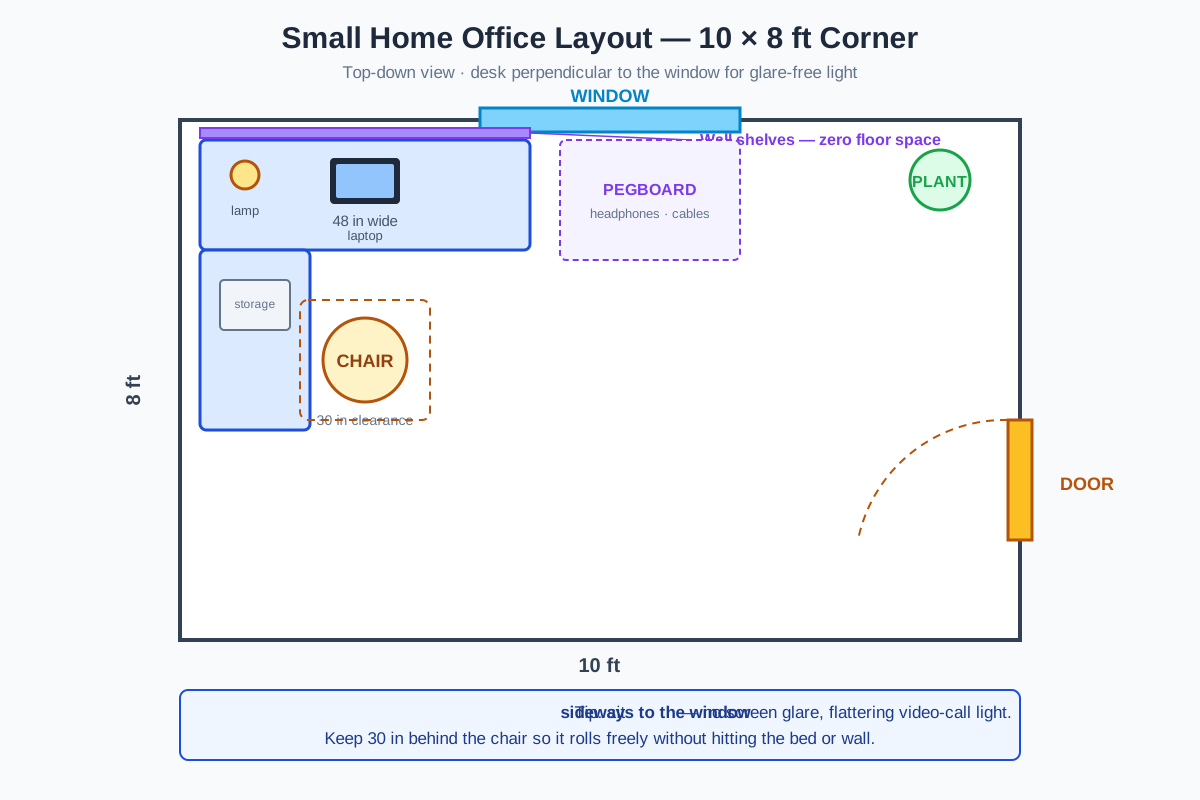
14. Steal window light — position matters (free). Put your desk perpendicular to a window, not facing it or with your back to it. Facing the window causes screen glare; back to it turns you into a silhouette on video calls. Sideways gives you soft, even light on your face and your desk. For more on placement, see our small bedroom office setup guide.
Where Do You Put Everything in a Tiny Space?
Small rooms punish horizontal thinking. The fix: go vertical.
15. IKEA LACK wall shelves (~$10 each). Two or three LACK shelves ($9.99 each) above your desk hold books, a plant, and storage boxes in zero floor space. They’re rated for about 11 lbs each when mounted into studs — enough for books and decor, not for a printer.
16. Add a pegboard ($15–$25). An IKEA SKÅDIS pegboard (~$20 with a starter set of hooks and cups) turns a blank wall into customizable storage for headphones, cables, scissors, and small tools. Everything hangs within arm’s reach, and rearranging takes seconds.
17. Tame cables with a $12 kit. A cable-management kit (sleeve + adhesive clips + ties, ~$10–$15) hides the spaghetti under your desk in twenty minutes. Route the power strip to the desk edge, bundle cables in a sleeve, and clip the phone charger where your hand lands. Cheap, fast, and it makes a $29 desk look like a $300 one. Our cable management ideas guide has the full playbook.
How Do You Stay Comfortable and Focused on a Shoestring?
18. Get a laptop stand — or fake one ($0–$25). A stand plus an external keyboard is the ergonomic core of any laptop-based setup: screen at eye level, elbows at 90°. The free version is a stack of books; the $20–$25 Amazon version folds flat for travel. Either way, pair it with our ergonomics checklist to dial in heights.
19. DIY a footrest ($0–$10). If your feet dangle, your lower back pays. A sturdy box, a stack of books, or a $10–$15 adjustable footrest keeps knees at roughly 90° and takes pressure off your spine. It’s the most-forgotten $10 in ergonomics.
20. Add one plant ($5–$10). A pothos or snake plant from IKEA or Home Depot costs $5–$10, survives neglect, and makes a corner feel like a room instead of a workstation. Studies consistently link even small amounts of greenery to lower perceived stress — the cheapest mood upgrade available.
21. Do the 5-minute end-of-day reset ($0). Clear the desk surface, close every tab, and write tomorrow’s top three tasks on a sticky note. A small space only works if it resets to zero daily; clutter compounds fastest where there’s no room to ignore it.
What Does a Full Budget Setup Actually Cost?
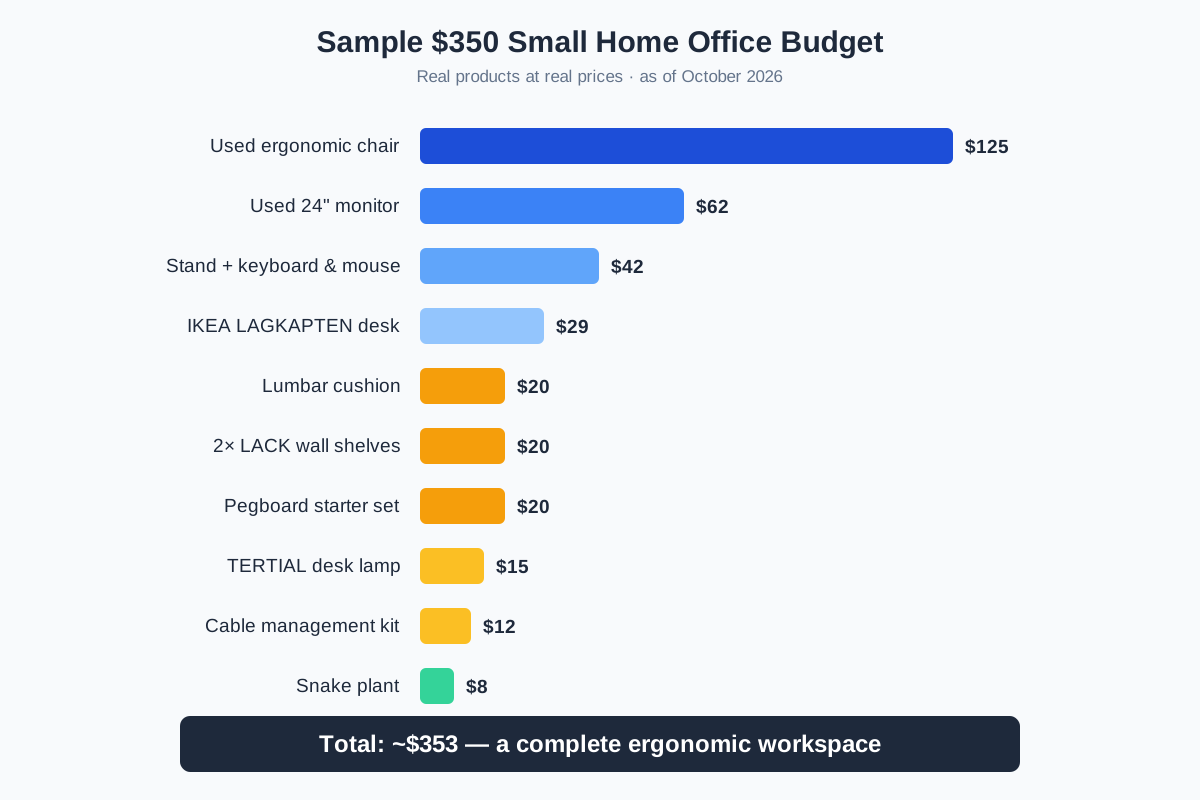
Here’s one realistic build using the ideas above — every line is a real product at a real price:
| Idea | Typical cost |
|---|---|
| IKEA LAGKAPTEN + ADILS desk | ~$29 |
| Secondhand ergonomic chair (e.g., used Steelcase Leap) | $100–$150 |
| Used 24″ 1080p monitor (e.g., Dell P2419H) | $50–$75 |
| IKEA TERTIAL desk lamp | ~$15 |
| Laptop stand + wireless keyboard/mouse set | $35–$50 |
| 2× IKEA LACK wall shelves | ~$20 |
| Cable management kit | ~$12 |
| Lumbar support cushion | ~$20 |
| SKÅDIS pegboard starter set | ~$20 |
| Snake plant or pothos | ~$8 |
| Total | ~$290–$350 |
That’s a complete, ergonomic, good-looking workspace for roughly the price of one mid-range office chair bought new. If you’re starting from absolute zero, our home office under $500 guide covers a slightly roomier version of this build.
Frequently Asked Questions
How much does a small home office cost on a budget?
About $290–$350 for a complete setup. That covers a $29 IKEA desk, a $100–$150 secondhand ergonomic chair, a $50–$75 used monitor, lighting, storage, and small accessories. You can go lower (~$150) if you already own a laptop and a chair, or if you score free furniture from Marketplace.
Can I set up a home office in a bedroom corner?
Yes — a corner is actually ideal. Corners give you two walls for shelves and a pegboard, and an L-shaped arrangement fits in as little as 4×4 feet. Keep the desk perpendicular to the window for the best light, and use a folding or wall-mounted desk if the room doubles as a guest room.
What is the single best upgrade under $50?
A secondhand ergonomic chair — or a $20 lumbar cushion if you can’t find one. Seating affects your body for 8+ hours a day; nothing else under $50 comes close in impact per dollar. After that, a $15 TERTIAL lamp and a $12 cable kit deliver the biggest visible improvement.
Should I buy new or used office furniture?
Buy used where it matters and new where hygiene matters. Desks, chairs, monitors, and shelves are excellent secondhand — they’re durable and depreciate fast. Buy new for anything that touches your skin daily (cushions, keyboard) or is cheap enough that used savings are trivial (bulbs, cable ties). Always test used electronics in person before paying.
How do I hide cables cheaply in a small home office?
A $10–$15 kit plus ten minutes. Mount the power strip under the desk edge with adhesive mounts, bundle the cables in a zippered sleeve, and clip charging cables to the desk side. In a small space, visible cables dominate the visual field, so this tiny job has an outsized payoff.
The Bottom Line
A small home office on a budget isn’t about deprivation — it’s about spending where it counts and refusing to pay for looks alone. Buy the $29 desk, hunt the $120 chair, raise your screen for free, and put everything else on the wall. Start with ideas 1, 6, and 9 — desk, chair, screen height — and you’ll feel the difference on day one. Add one idea per week after that, and in two months you’ll have a workspace that looks and feels three times its price.