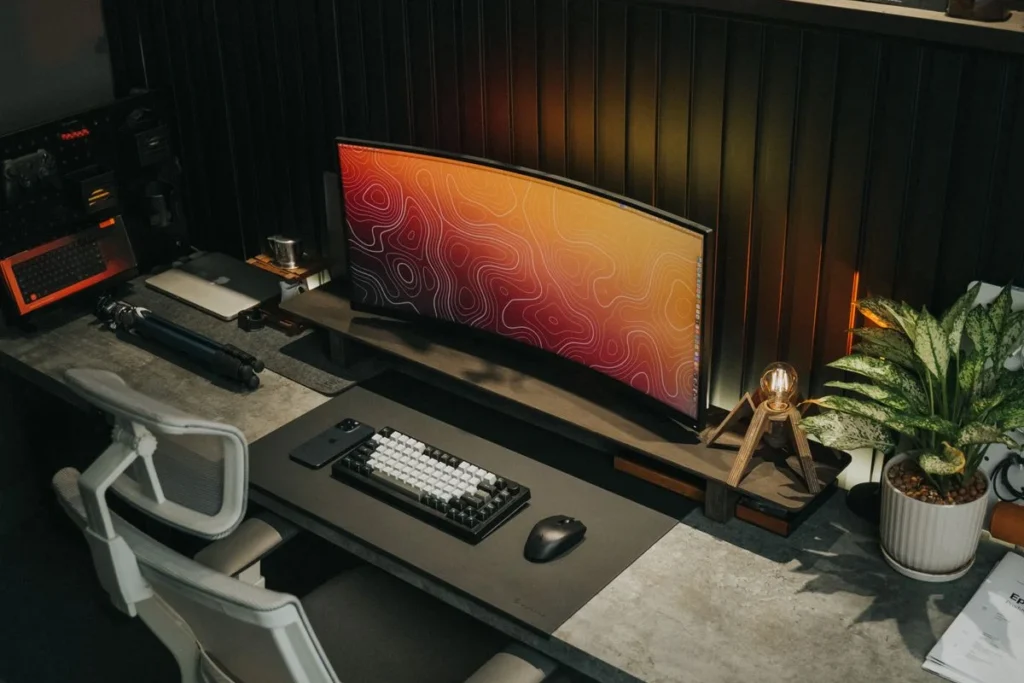
Standing Desk vs Regular Desk: Which Is Better for You? (2026)
A standing desk wins if you sit through 6+ hours of desk work daily and want to cut that sitting time — but only if you actually alternate positions. A regular desk wins on price, silence, and simplicity. Standing all day is not the goal: the 2024 research consensus is that rotating between sitting and standing (roughly 1–2 hours of standing in an 8-hour day) beats both all-day sitting and all-day standing.
As an Amazon Associate I earn from qualifying purchases.
Standing desk vs regular desk: the head-to-head comparison
All prices below are typical US street prices as of October 2026.
| Factor | Regular desk | Standing desk (electric) | Winner |
|---|---|---|---|
| Typical price | $50–$350 (e.g. IKEA LAGKAPTEN/ALEX combo ~$250) | $200–$1,100 (budget dual-motor ~$230–$400; FlexiSpot E7 ~$450–$550; UPLIFT V2 ~$850–$1,000) | Regular desk, by 2–4× on price |
| Sitting time reduction | None | ~100 fewer minutes of sitting per workday (Cochrane-reviewed trials) | Standing desk |
| Noise | Zero — no moving parts | Dual-motor models run ~45–50 dB (quiet hum, noticeable on calls) | Regular desk |
| Assembly | 15–30 minutes, basic tools | 45–90 minutes, heavy frame (60–80 lbs), usually a two-person job | Regular desk |
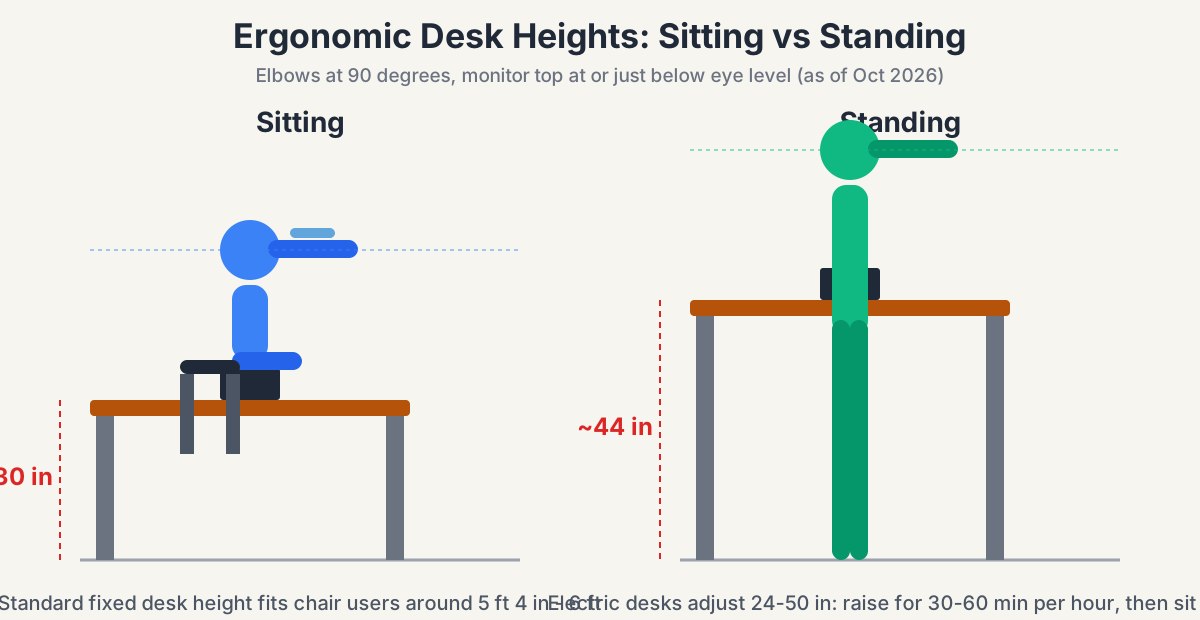
| Height adjustment | Fixed (~29–30 in); fit by chair height | 24–50 in electric range; 4 memory presets on most dual-motor models | Standing desk |
| Monitor-arm compatibility | Any clamp mount fits standard tops | Works with clamp mounts; check the frame’s crossbar doesn’t block clamp placement | Tie |
| Reliability/longevity | 10+ years, nothing to break | Motors and control boxes can fail; quality desks carry 10–15 year frame warranties | Regular desk |
| Posture flexibility | One position all day | Sit, stand, perch — rotation is the health point | Standing desk |
What does the research actually say about standing desks and health?
Standing desks reliably change one thing: posture variety. Cochrane-reviewed workplace trials found sit-stand desks cut sitting time by roughly 100 minutes per workday compared with regular desks, with no evidence of lost productivity.
Standing more is not the same as standing all day. A 2024 analysis of UK Biobank data (83,000+ adults, International Journal of Epidemiology) found that standing more than 2 hours per day was associated with a higher risk of circulatory problems such as varicose veins and orthostatic conditions — and it did not lower cardiovascular disease risk versus sitting.
The honest health summary, as of October 2026: alternating between sitting and standing reduces back and neck discomfort for people who previously sat all day, because movement breaks and position changes do the work. Static standing for 6–8 hours trades one set of problems (sedentary time) for another (leg fatigue, swollen feet, varicose-vein risk).
Think of it as posture rotation, not posture replacement. A standing desk you stand at for two hours a day is a health tool; the same desk used as a standing-only workstation is just a different kind of static.
Does standing actually make you more productive?
There is no credible evidence that standing makes you think faster or work better. What the trials show is narrower but useful: workers using sit-stand desks report less afternoon fatigue and back discomfort, and self-rated energy improves — plausible productivity channels, but not a measured output boost.
The most honest claim the data supports: standing desks don’t hurt productivity and may reduce the afternoon slump that comes with 8 straight hours in a chair. If you expect sharper focus from standing, you’ll be disappointed; if you want your legs to feel less dead at 5 PM, you won’t be.
 FlexiSpot 48×24 inch electric standing desk sits around $210–$250 — proof that the standing-desk premium has shrunk to under $150 versus a comparable regular desk.

On a $/year basis the gap narrows further: a $500 standing desk kept 8 years costs about $63/year — less than one office chair replacement. The regular desk only stays clearly cheaper at the bottom of the market, where a $50–$90 fixed desk has no standing equivalent.
If you’re not in a hurry, Black Friday week (Nov 27–30) is when standing desks hit their yearly floor — our Black Friday home office deals guide tracks the discount bands to expect, which have run 25–40% off dual-motor desks in recent years.
Who should buy a standing desk — and who should stick with a regular desk?
| Your situation | Better pick | Why |
|---|---|---|
| You sit 6+ hours daily at your desk | Standing desk | Alternating positions is the only proven way to break up that much sedentary time |
| Existing lower-back or neck pain from sitting | Standing desk | Position changes reduce discomfort more than any single “ergonomic” posture |
| Budget under $150 | Regular desk | Nothing worth buying in standing form exists at this price; spend it on a good chair instead |
| You share a room and take calls | Regular desk | Motor noise during calls and creaky budget frames are real annoyances |
| You’re very tall (6’2″+) or very short (under 5’2″) | Standing desk | Fixed 29–30 in desks fit a narrow band; electric height range covers 24–50 in |
| Heavy multi-monitor setup (3+ screens, 40+ lbs) | Premium standing desk ($450+) | Budget standing desks wobble at full height under heavy loads |
| You mostly work from a laptop on the couch/bed | Neither — skip the desk upgrade | The desk question assumes a real workstation; fix the workstation first |
| You want a simple, silent, 10-year setup | Regular desk | Zero moving parts, zero things to break, zero noise |
Is a sit-stand converter the smart middle ground?
A converter sits on your existing desk and raises just your monitors and keyboard, so you keep your current desk and gain a standing option for $150–$300. It’s the right answer for exactly one scenario: you already own a regular desk you like and just want to try standing.
The compromises are real. Converters raise the screens but leave no raised work surface — your desk space shrinks because the converter footprint (typically 32×20 in) sits on top of the desk permanently. Most support 25–33 lbs total, which handles two monitors and a keyboard tray but strains under three monitors. And the keyboard tray on budget converters sits 1–2 inches higher than desk height at the “standing” setting, a mild but chronic ergonomic penalty.
A converter that avoids most of these problems is the VIVO DESK-V000K 32-inch sit-stand converter — 33 lb capacity, 31.5×15.7 in top, height-adjustable keyboard tray, around $180–$200 as of October 2026. For full details, see our best standing desk converter roundup.
Rule of thumb: converter if you already have a desk you love; full standing desk if you’re buying fresh. Buying a brand-new regular desk plus a converter ($250 + $200) costs more than a budget electric standing desk (~$230) and delivers a worse experience.
What about space, noise, and monitor-arm compatibility?
Space: a standing desk’s footprint is identical to a regular desk of the same top size — the legs just telescope. The real space cost is vertical: you need clearance above the desk for monitors rising to ~50 in, and tall rear shelving or hutches can collide with the rising top. Measure twice. If space is tight, our space-saving standing desk guide covers 40-inch compact models.
Noise: dual-motor desks emit a low hum around 45–50 dB during the 10–15 seconds of travel — quieter than normal conversation (60 dB) but audible on microphone if you adjust mid-call. Budget single-motor desks are louder and slower. This never matters with a regular desk, because nothing moves.
Monitor arms: nearly every electric standing desk works with clamp-mount monitor arms, with one caveat — some frames have a rear crossbar or cable tray that sits exactly where a clamp wants to be. Check the frame diagram before buying, or use a grommet mount. This is also where cable management gets harder on a standing desk: every cable must have slack for 24+ inches of vertical travel, so a cable spine or sleeve is near-mandatory.
So which desk is better for you?
Buy the standing desk if you work 6+ hours a day at a desk and will commit to alternating — 30–60 minutes standing per hour block, with an anti-fatigue mat underfoot. The health payoff comes from the rotation, not the standing.
Keep the regular desk if your budget is tight, your setup already feels good, or you work mostly from a laptop in varied locations. A $500 standing desk you never raise is a $500 regular desk.
And if you’re deciding purely on money: under $400, the budget electric standing desk has made the old “standing desks are luxury” argument obsolete — the premium over a decent regular desk is now under $150.
Frequently asked questions
Is a standing desk actually healthier than a regular desk?
A standing desk used for position rotation (sitting + standing) reduces sitting time by ~100 minutes per workday, which the 2024 research consensus supports — but standing all day raises circulatory risks and is worse than rotating.
Do I need a standing desk if I already walk a lot?
No. If you already break up sitting with walks or exercise, a standing desk adds little — the health benefit comes from reducing uninterrupted sedentary time, which you already handle.
Can I put a standing desk in a small room?
Yes. The footprint matches a same-size regular desk; you only need vertical clearance (up to ~50 in) and to keep tall shelving behind it clear of the rising top.
How much should I spend on a standing desk in 2026?
Budget dual-motor desks start around $230 as of October 2026; the sweet spot is $400–$550 for a stable dual-motor desk with memory presets, and $850+ only if you need heavy loads or a 15-year warranty. More price data in our best standing desk under $500 roundup.
Is a sit-stand converter as good as a real standing desk?
No — converters keep your desk but sacrifice workspace and usually carry 33 lbs or less, so they’re a good trial step, not a permanent equal.
Will my monitor arm fit a standing desk?
Almost always, using a clamp or grommet mount — just verify the frame’s rear crossbar doesn’t block the clamp, and add a cable spine for the 24+ inches of travel.
Does a standing desk help with back pain?
It can: alternating positions reduces the static-load discomfort of all-day sitting, and multiple trials show less reported back and neck discomfort — but it won’t fix pain caused by a bad chair or poor monitor height.