
What Desk Height Is Right for You? (2026)
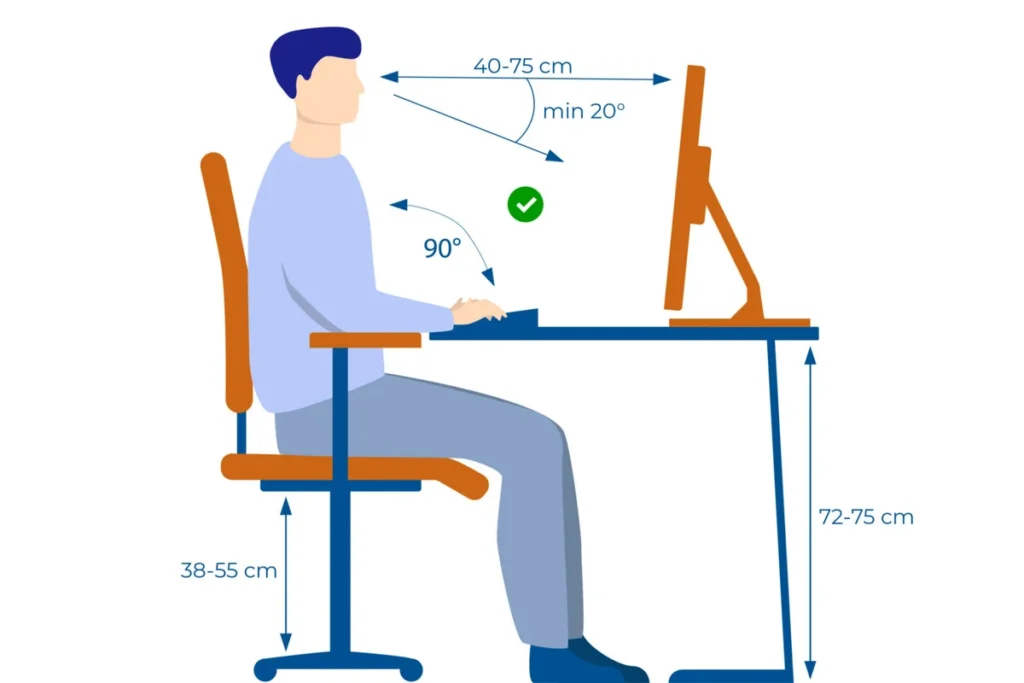
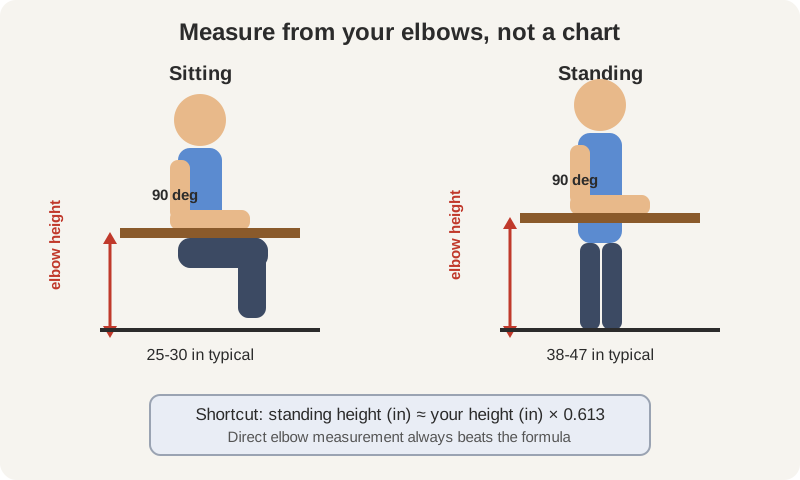
Your ideal desk height equals your elbow height: sit (or stand) with relaxed shoulders and elbows bent at 90 degrees, then measure from the floor to the underside of your forearms. For most adults this lands between 25–30 inches sitting and 38–47 inches standing. Standard fixed desks sit at 29–30 inches, which fits people roughly 5’9″ to 6’0″ — everyone else should adjust the chair, the desk, or both.
Why is desk height the foundation of ergonomic posture?
Everything else in your setup hangs off the desk height. If the desk is too high, your shoulders shrug upward all day and your wrists bend back to reach the keyboard — the two classic ingredients of neck tension and wrist pain. If the desk is too low, you hunch forward, rounding your spine and craning your neck down at the screen.
A good chair can compensate a little, but it cannot fix a desk that is four inches off. The keyboard tray, the monitor arm, the chair height — all of them are downstream adjustments. Get the desk height right first, and the rest of the setup falls into place with small tweaks.
The one sentence that matters: Set the desk from your elbows, not from an average — averages are built for people you are not.
What are the standard desk heights?
Fixed-height desks cluster around a few standard measurements, and knowing them helps you judge whether a desk will fit you before you buy.
| Desk type | Typical height | Who it suits |
|---|---|---|
| Standard office desk | 29–30 in (74–76 cm) | Adults roughly 5’9″–6’0″ in shoes |
| Compact / writing desk | 28–29 in (71–74 cm) | Adults roughly 5’6″–5’9″ |
| Kids’ or short-user desk | 24–27 in (61–69 cm) | Children, or adults under ~5’3″ |
| Counter-height desk | 34–36 in (86–91 cm) | Standing work with a tall stool, or very tall users sitting |
| Adjustable standing desk | 24–50 in (61–127 cm) | Anyone — covers sitting through standing for nearly all adults |
The standard 29–30 inch desk exists because it fits the statistical middle of adult workers. If you are 5’4″, that standard desk is roughly two inches too tall for you. If you are 6’4″, it is roughly two inches too short. Two inches sounds trivial until it is the distance your shoulders have to shrug, eight hours a day, for years.
How do you measure your ideal sitting desk height?
This takes two minutes with a tape measure and a friend (or a mirror). Do it in the shoes you actually work in, because heel height changes the numbers.
- Sit in your work chair with your feet flat on the floor, thighs roughly parallel to the floor, and your back supported.
- Relax your shoulders completely. Let them drop — do not hold them up. This is the posture your body defaults to, so measure it, not an idealized one.
- Let your arms hang with elbows bent at 90 degrees, as if your hands were hovering over a keyboard. Your forearms should be roughly parallel to the floor.
- Measure from the floor to the underside of your forearms. Have your helper run the tape from the floor straight up to the bottom of your forearm, right where your hands would meet the keyboard.
- That number is your ideal desk height. For most adults it falls between 25 and 30 inches. If you use a thick keyboard (many mechanical keyboards add nearly an inch of height), subtract about half an inch so your wrists stay neutral on the taller keys.
Do the measurement twice and average the results — posture drifts the moment you start thinking about it, and a second reading catches that.
What is your ideal standing desk height?
The method is identical, just standing: relax your shoulders, bend your elbows to 90 degrees, and measure from the floor to the underside of your forearms. For most adults this lands between 38 and 47 inches.
If you cannot measure right now, the widely used rule of thumb is standing desk height in inches ≈ your height in inches × 0.613. It is an approximation — torso-to-leg ratios vary — but it gets you within an inch for most people. A standing desk under $500 adjusts finely enough that the starting number just needs to be close; your elbows do the final calibration.
| Your height | Formula standing height | Practical setting |
|---|---|---|
| 5’0″ (152 cm) | 36.7″ | 36–37″ |
| 5’3″ (160 cm) | 38.6″ | 38–39″ |
| 5’6″ (168 cm) | 40.6″ | 40–41″ |
| 5’9″ (175 cm) | 42.2″ | 42–43″ |
| 6’0″ (183 cm) | 44.2″ | 44–45″ |
| 6’3″ (191 cm) | 46.1″ | 46–47″ |
For sitting, the equivalent shortcut is roughly your height in inches × 0.39, though the direct elbow measurement above is more reliable. A 5’9″ person gets about 26.9 inches — noticeably below the 29–30 inch standard desk, which is exactly why average-height people still benefit from a height check.
What if your desk is not height-adjustable?
Most people cannot replace their desk tomorrow. The good news is that a fixed desk can be adapted, because the real target is the relationship between your elbows and the keyboard — the desk is just one way to get there.
- Desk too high (the common case for shorter users): Raise your chair until your elbows sit at 90 degrees relative to the desk, then add a footrest so your feet are not dangling. Dangling feet cut off circulation and tilt your pelvis — the footrest is not optional, it is the fix.
- Desk too low (the common case for taller users): Raise the desk with sturdy risers or furniture legs. Bed risers work for light desks; purpose-made desk risers handle heavier setups. Do not stack books — they shift, and a shifting desk is a disaster waiting for a deadline week.
- Add a keyboard tray. A tray mounts under the desk and drops the keyboard 2–4 inches below the desktop, which rescues a desk that is too high without touching the chair. It also frees desk surface, which is why it pairs well with a space-saving standing desk in tight rooms.
- Mind the monitor separately. Whatever you do to the keyboard height, the top of the screen should stay at or just below eye level, 20–28 inches from your eyes. A monitor arm or a simple riser handles this independently of the desk.
The hierarchy of fixes: keyboard tray first (cheapest, biggest effect), then chair plus footrest, then desk risers, then a new desk. Most fixed-desk problems are solvable for under $100.
How do desk, chair, and monitor heights work together?
Desk height is the anchor, but three numbers have to agree for the setup to actually feel right. Think of it as a chain: feet → chair → desk → screen.
| Element | The rule | Why |
|---|---|---|
| Feet | Flat on the floor or a footrest | Dangling feet tilt the pelvis and round the lower back |
| Chair seat | Thighs roughly parallel to the floor, 2–3 fingers of clearance behind the knees | Too high cuts circulation behind the knees; too low collapses the hip angle |
| Desk surface | At elbow height, forearms parallel to the floor, wrists straight | The master setting — everything else keys off this |
| Monitor | Top of screen at or just below eye level, 20–28 in (50–70 cm) away | Prevents the forward head tilt that loads the neck |
If you change one element, recheck the others. Raising your chair to meet a tall desk, for example, means your feet need a footrest and your monitor may need to go up — the chain moves together. This is also why an adjustable desk is the cleanest solution: it changes the anchor without disturbing the chair and monitor.
What are the signs your desk height is wrong?
Your body reports a bad desk height long before you measure it. Watch for these:
- Shoulders creeping toward your ears by mid-afternoon — the desk is too high, and your trapezius muscles are holding your arms up all day.
- Wrists bent upward while typing — same cause; your hands are reaching up to a keyboard that sits above your neutral forearm line.
- Forward head posture and a sore neck — the desk is too low, pulling your whole upper body down toward the work.
- Lower-back ache in a chair that used to be comfortable — often a knock-on effect: a wrong desk height makes you perch or slouch, and the chair takes the blame.
- Numbness or tingling in the fingers — sustained wrist extension from a too-high keyboard compresses the carpal tunnel over time. This one deserves a prompt fix, not a “someday” plan.
None of these require a medical diagnosis to act on. They are your body asking for a two-minute measurement and a small adjustment.
Frequently asked questions
What is the most ergonomic desk height?
There is no single most ergonomic desk height — the ergonomic height is your elbow height with shoulders relaxed and elbows at 90 degrees. As a reference, that is roughly 25–30 inches for sitting and 38–47 inches for standing for most adults. Any chart number is a starting point; the measurement from your own body is the answer.
Is 30 inches too high for a desk?
For many people, yes. A 30-inch desk suits someone around 5’10″–6’0″. If you are 5’5″, your ideal sitting desk height is closer to 26–27 inches, so a 30-inch desk forces your shoulders up about three inches all day. The fix is a higher chair plus a footrest, a keyboard tray, or — cleanest of all — a height-adjustable desk.
Should my elbows be at 90 degrees when typing?
Yes — 90 degrees (roughly, 90–100) with relaxed shoulders is the neutral arm position ergonomists recommend. Forearms stay parallel to the floor, wrists stay straight, and the shoulder muscles stay out of the equation. If your elbows are much wider than 90 degrees, the desk is too low; much narrower, and it is too high.
How high should a standing desk be for a 5’6″ person?
About 40–41 inches, from the × 0.613 rule of thumb — but measure your actual elbow height to confirm, since arm and torso proportions vary. Set the desk so your forearms rest parallel to the floor with shoulders relaxed, then fine-tune over a few days of real work. Small daily tweaks beat one heroic setup session.
Does desk height affect back pain?
Indirectly but genuinely. A wrong desk height pushes you into compensating postures — hunching over a low desk or perching at a high one — and those postures load the lower back and neck for hours. Correcting desk height removes the cause of the compensation, which is why it often relieves aches that stretching alone could not fix.
Is a height-adjustable desk worth it for ergonomics?
Yes, if you sit and stand through the day — it is the only way to hit both your sitting and standing elbow heights with one piece of furniture. If you only ever sit, a well-fitted fixed desk plus the right chair does the same job for less money. The adjustable desk earns its price when your posture needs change across the day, or when more than one person uses the same desk.
Your elbows know the answer. Measure them once, set the desk, and stop thinking about it — that is the whole point of getting the height right.