
Best Footrests for Under Desk (2026)
The best footrest for under a desk in 2026 is the ErgoFoam Adjustable Foot Rest (~$35 as of October 2026): 17.3 × 11.5 inches of high-density foam, a 5.9-inch height, and a washable cover. Budget buyers should grab the Mind Reader platform (~$25); active sitters will prefer the rocking HUANUO (~$30).
As an Amazon Associate I earn from qualifying purchases.
TL;DR — The 6 best footrests for under a desk:
- Best overall: ErgoFoam Adjustable Foot Rest (~$35) — high-density foam, 5.9″ height, washable cover.
- Best for offices: Fellowes Office Suites Foot Rest (~$45) — 3 heights, ±30° tilt, proven classic.
- Best for active sitting: HUANUO Adjustable Desk Footrest (~$30) — rocks gently, massage texture + roller.
- Best budget: Mind Reader Ergonomic Footrest (~$25) — 17 × 13″ platform, 3.25–6.25″ height.
- Best premium: Kensington SoleMate Comfort (~$60) — memory foam, foot-pedal height adjust.
- Best cushion: ComfiLife Memory Foam Foot Rest (~$40) — teardrop design, travel-friendly.
The quotable rule: your feet should rest on something — if your chair is set right and your feet dangle, a $30 footrest fixes the whole posture chain.
Why Does Your Chair Leave Your Feet Dangling?
Because your desk, not your chair, decides your seat height. On a fixed 29-inch desk, most people need the chair at 20–22 inches to keep elbows at 90 degrees — and at that height, anyone under about 5’9″ can’t plant their feet flat. Lower the chair and you hunch up to the keyboard; keep it high and your feet dangle.
Dangling feet are a posture problem, not a comfort quirk: the seat’s front edge presses into the back of your thighs, and your pelvis slides forward, flattening your lower back. (Source: Mayo Clinic) A footrest breaks the chain — it lifts the feet, opens the knee angle toward 90 degrees, and lets your pelvis sit upright.
The quotable rule: if your chair height is right and your feet don’t reach the floor, you don’t have a chair problem — you have a floor problem, and a footrest is the floor.
Our home office ergonomics checklist walks through seat height, monitor height, and keyboard position together — the footrest is one piece of the same setup.
How High Should an Under-Desk Footrest Be?
Three to six inches for most people at a standard 29–30-inch desk. Target: thighs parallel to the floor, knees at ~90 degrees, feet fully supported. Start low — if your knees rise above your hips, it’s too high.
Shorter users (under ~5’4″) usually need 5–6 inches; taller users may only need 3–4 inches. If you share a
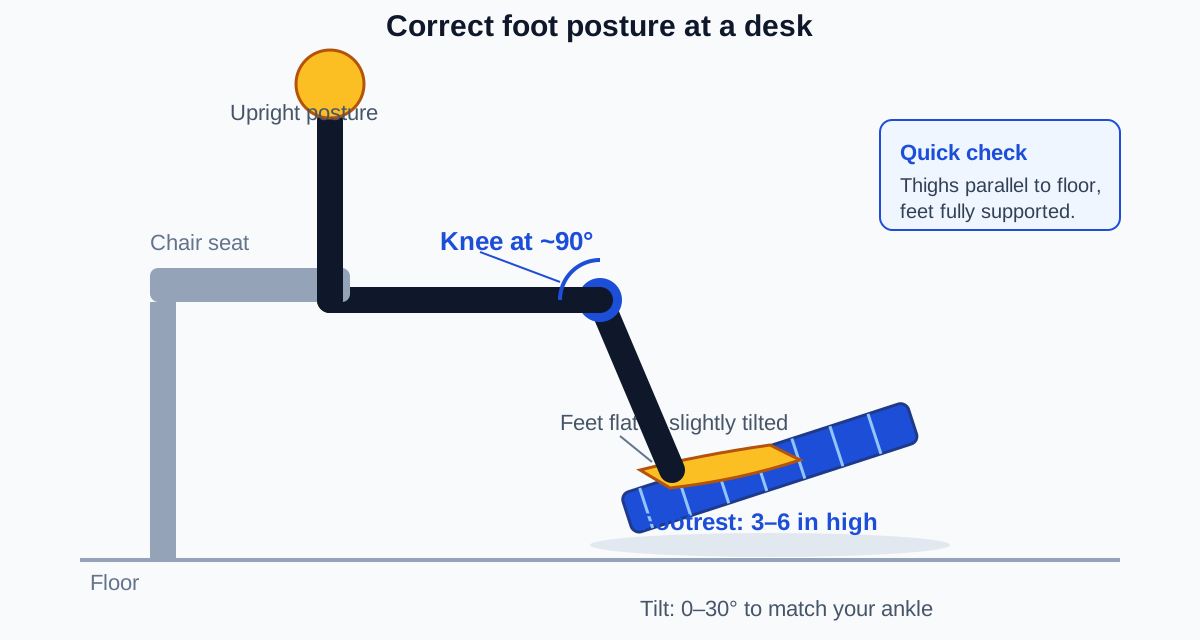
The quotable rule: a footrest is correctly sized when your thighs are parallel to the floor — knees higher than hips means you’ve gone too far.
Foam, Platform, or Rocking: Which Footrest Type Should You Buy?
Foam cushions for comfort, platforms for durability, rocking models for movement. The three types solve different problems, so pick by what bothers you most at your desk.
Foam cushions (ErgoFoam, ComfiLife): high-density foam blocks with a washable cover. They conform to your feet and stay quiet. Best for carpeted home offices and anyone who works barefoot or in socks. The trade-off: foam compresses over years of daily use, and fixed heights can’t be fine-tuned.
Platform footrests (Fellowes, Mind Reader, Kensington): plastic or metal platforms with height steps and tilt locks. They’re nearly indestructible, easy to wipe clean, and the adjustments stay where you set them. Best for shared offices and anyone who wears shoes at the desk. The trade-off: hard surfaces can feel cold — wear socks or add a mat.
Rocking footrests (HUANUO): a tilting platform on a curved base that rocks as you shift your feet. Best for restless sitters — the micro-movement keeps blood flowing, like a subtle fidget toy for your feet. The trade-off: the movement takes getting used to.
The quotable rule: comfort buyers get foam, office buyers get platforms, fidgeters get rockers — buy the type that matches your worst habit, not the cheapest price.
What Are the Best Footrests for Under a Desk in 2026?
Six picks, each with a real job. Prices are Amazon street prices as of October 2026.
1. ErgoFoam Adjustable Foot Rest — Best Overall
The default recommendation for a reason: high-density foam that holds its shape, a breathable mesh cover that comes off for the wash, and a 17.3 × 11.5-inch platform wide enough for both feet side by side. It’s the footrest equivalent of a good mattress — supportive without fighting back.
At 1.45 pounds it slides under the desk when idle, and the non-slip base grips hardwood and carpet. The mesh version breathes better than velvet — it’s the one we’d buy.
Dimensions: 17.3″ × 11.5″ × 5.9″H. Material: high-density foam, mesh or velvet cover. Weight: 1.45 lbs. Price: ~$35 as of October 2026 (typical range $30–$42). Check the ErgoFoam Adjustable Foot Rest.
2. Fellowes Office Suites Adjustable Foot Rest — Best for Traditional Offices
The corporate-office classic — the safest pick for a shared desk. The textured platform tilts ±30 degrees (toe-operated) and locks at three heights — roughly 4.1, 4.9, and 5.7 inches — so whoever sits down can set it in seconds.
The hard-plastic platform is the point in an office: it wipes clean and won’t look tired after two years of daily use. It pairs naturally with an ergonomic chair for lower back pain in a proper office build-out.
Model: 8032201. Heights: 3 settings (~4.1″ / 4.9″ / 5.7″). Tilt: ±30°, foot-operated. Price: ~$45 as of October 2026 (typical range $38–$55). See the Fellowes Office Suites Adjustable Foot Rest.
3. HUANUO Adjustable Desk Footrest — Best for Active Sitting
The fidgeter’s footrest: a rocking platform plus a massage-textured surface with a center roller for bare feet. The rocking keeps your calves and ankles moving through the day, which is the real circulation benefit — static footrests support you, but movement pumps blood.
Height adjusts through three positions (3.9, 5.3, and 6.5 inches) and the platform tilts 0–30 degrees, so you can lock it flatter if the rocking distracts you. At 17.3 × 13 inches it’s one of the larger footprints here — measure under-desk clearance before ordering, especially with a CPU tower nearby.
Dimensions: ~17.3″ × 13″. Heights: 3.9″ / 5.3″ / 6.5″. Tilt: 0–30°. Features: massage texture, center roller. Price: ~$30 as of October 2026 (typical range $26–$36). Check the HUANUO Adjustable Desk Footrest.
4. Mind Reader Adjustable Ergonomic Footrest — Best Budget Platform
The cheapest adjustable platform worth buying: ~$25 as of October 2026 for a 17 × 13-inch platform with three height settings (3.25–6.25 inches) and a tilting, massage-textured top. It does 90% of what the Fellowes does for half the price.
Its height range beats the Fellowes at the top end — the better pick for shorter users who need a full 6 inches of lift. For a dorm room, a first apartment, or a second workstation, it’s the sensible buy.
Dimensions: 17″ × 13″. Heights: 3.25″–6.25″ (3 settings). Tilt: yes, foot-operated. Weight: 5.5 lbs. Price: ~$25 as of October 2026 (typical range $22–$30). See the Mind Reader Adjustable Ergonomic Footrest.
5. Kensington SoleMate Comfort with SmartFit — Best Premium Memory Foam
The premium platform pick: memory foam instead of hard plastic, with a foot-pedal height control (3.5–5 inches) and up to 30 degrees of angle adjustment you can change without bending down. Kensington’s SmartFit system matches the setup to your body — genuinely useful when several people share one desk.
The 22 × 14-inch platform is the widest here. At ~$60 it’s double the Fellowes — buy it for the memory-foam comfort and pedal adjust.
Dimensions: 22″ × 14″. Heights: 3.5″–5″ (foot-pedal). Angle: up to 30°. Material: memory foam, polyester cover. Price: ~$60 as of October 2026 (typical range $50–$70). Check the Kensington SoleMate Comfort with SmartFit.
6. ComfiLife Memory Foam Foot Rest — Best Cushion Style
The travel-friendly cushion: a teardrop-shaped 100% memory-foam block (~17 × 11.5 × 5.9 in) under 2 pounds, with a washable velour cover. The sloped profile supports the full length of your feet rather than just the soles — it doubles as a leg rest on the couch and a foot pillow on long flights.
It’s a one-person, one-desk pick — skip it for shared workstations. But for barefoot home offices, one cushion for desk, couch, and plane is the most versatile $40 here.
Dimensions: ~17″ × 11.5″ × 5.9″. Material: 100% memory foam, washable velour cover. Weight: ~1.8 lbs. Price: ~$40 as of October 2026 (typical range $35–$48). See the ComfiLife Memory Foam Foot Rest.
How Do the Six Footrests Compare?
Every cell below stands on its own — no cross-referencing needed.
| Footrest | Size (L × W × H) | Height range | Tilt | Price (Oct 2026) | Best for |
|---|---|---|---|---|---|
| ErgoFoam Adjustable | 17.3″ × 11.5″ × 5.9″ | Fixed 5.9″ | Fixed | ~$35 | Best overall — foam, washable cover |
| Fellowes Office Suites 8032201 | Standard platform | 4.1″ / 4.9″ / 5.7″ | ±30°, foot-operated | ~$45 | Offices — wipe-clean, shared desks |
| HUANUO HNFR3 | ~17.3″ × 13″ | 3.9″ / 5.3″ / 6.5″ | 0–30° + rocking | ~$30 | Active sitting — rocking, massage roller |
| Mind Reader FTREST-BLK | 17″ × 13″ | 3.25″–6.25″ | Yes, foot-operated | ~$25 | Budget platform — tallest range under $30 |
| Kensington SoleMate K56144USF | 22″ × 14″ | 3.5″–5″ (pedal) | Up to 30° | ~$60 | Premium memory foam — widest platform, pedal adjust |
| ComfiLife (gray) | ~17″ × 11.5″ × 5.9″ | Fixed ~5.9″ | Fixed | ~$40 | Cushion style — softest, doubles as travel leg rest |
Frequently Asked Questions
Do I really need a footrest if my chair is ergonomic?
Yes, if your feet don’t reach the floor flat when the chair is set right. Even the best desk chairs under $300 can’t change your leg length — a footrest is the missing piece, not a chair upgrade.
What is the correct sitting position with a footrest?
Thighs parallel to the floor, knees at ~90 degrees, feet fully supported. If your knees sit higher than your hips, the footrest is too high.
Are rocking footrests actually good for you?
Yes for circulation. Gentle rocking keeps calf muscles pumping blood upward — but some people find the motion distracting during deep-focus work. (Source: CDC NIOSH)
Can a footrest help with lower back pain?
It helps when the pain comes from poor sitting posture. By keeping your pelvis upright and your knees at 90 degrees, a footrest reduces the slouching that loads the lumbar discs.
Should I get a footrest or a standing desk?
Different problems. A footrest fixes seated posture for ~$30; a standing desk adds movement variety at 10x the price. Our are standing desks worth it guide breaks down when standing actually pays off — fix your sitting setup first.
How do I keep a footrest from sliding on hardwood floors?
All six picks have non-slip bottoms. On slick hardwood, the heavier platform models (Fellowes, Mind Reader) stay put best; light foam cushions can drift and need occasional repositioning.
The Bottom Line
Set your chair for your elbows, then give your feet somewhere to live. The ErgoFoam Adjustable (~$35) is the best all-rounder; the Fellowes Office Suites (~$45) is the office workhorse; the HUANUO (~$30) is for fidgeters; the Mind Reader (~$25) wins on budget; the Kensington SoleMate (~$60) is the premium pick; the ComfiLife (~$40) is the softest. Your knees, hips, and lower back will notice the difference within a week.