Are Standing Desks Worth It? What the Research Actually Says (2026)
The verdict: Yes, with realistic expectations. Standing desks are worth it if your main goal is sitting less: sit-stand users sit 84–116 fewer minutes per workday and report better energy and mood. But the extra calorie burn is tiny (~0.15 kcal/min), and evidence for back-pain relief is weak. Don’t buy one expecting weight loss.
What the research actually supports (and what it doesn’t)
Most standing-desk marketing blends three different claims — less sitting, more calories burned, better health — as if they were one. The research separates them. Here is where each claim stands, based on peer-reviewed studies and government ergonomics guidance reviewed for this article in October 2026.
| Claim | Verdict | What the research shows |
|---|---|---|
| Reduces daily sitting time | Strong evidence | A Cochrane review of 34 studies (3,397 workers) found sit-stand desk users sat 84–116 minutes less per workday than people at conventional desks, with fewer sitting bouts lasting 30+ minutes (Cochrane). |
| Improves energy and mood | Moderate evidence (self-reported) | In the 12-month SMArT Work trial (BMJ, 146 office workers), users reported better job performance, engagement, and less occupational fatigue; in the Take-a-Stand project, 87% of users felt energized and 71% felt more focused (BMJ, CDC). |
| Fixes back pain | Weak to mixed evidence | A 2018 meta-analysis in Ergonomics found only small reductions in low-back discomfort, mostly in people who were not in pain to begin with; Cochrane found no clear effect on musculoskeletal symptoms, and rated the overall evidence low to very low quality. |
| Burns meaningful calories | Not supported as meaningful | Standing burns about 0.15 kcal/min more than sitting — roughly 54 extra kcal for six hours standing, per a pooled analysis of 46 studies and 1,184 participants (Saeidifard et al., 2018, European Journal of Preventive Cardiology). Cochrane concluded standing “hardly increases energy expenditure,” so a sit-stand desk should not be bought as a weight-loss tool (study summary, Cochrane press release). |
| Reduces cardiovascular risk | Uncertain | A 2020 meta-analysis of 9 clinical trials (877 adults) found replacing sitting with standing produced very small but significant decreases in fasting blood glucose (−2.53 mg/dL) and body fat mass (−0.75 kg), with no significant effect on lipids, blood pressure, weight, or waist circumference (PMC). |
| Boosts productivity | No boost — but no harm either | The SMArT Work trial found small improvements in self-rated job performance and engagement, but no change in cognitive function; Cochrane found standing more did not decrease productivity. Productivity stays flat, it doesn’t climb. |
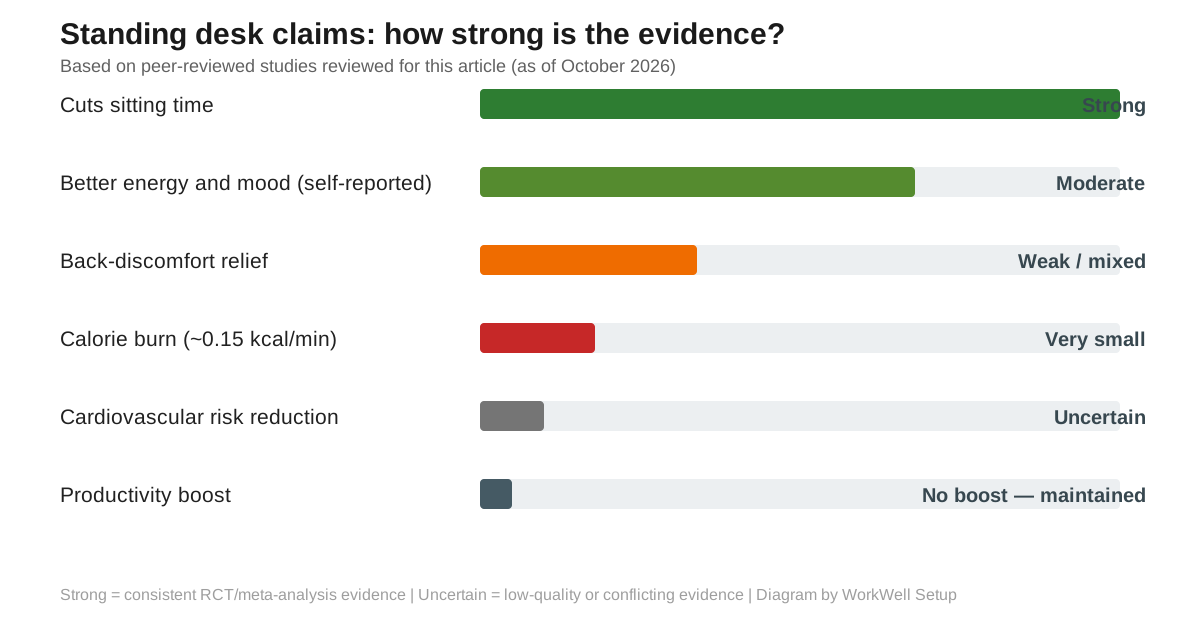
The pattern is consistent across studies: standing desks are excellent sitting-reduction devices and mediocre everything else. That single sentence determines whether they’re worth it for you.
Does standing burn meaningful calories?
No. This is the most overstated benefit in standing-desk marketing.
The frequently cited math comes from Saeidifard et al. (2018), published in the European Journal of Preventive Cardiology, which pooled 46 studies covering 1,184 participants (average age 33, average weight 65 kg). Standing burned 0.15 kcal per minute more than sitting. Standing for six hours instead of sitting therefore expends about 54 extra kilocalories per day — theoretically 2.5 kg of weight over a year, assuming food intake never rises to compensate.
That “assuming” carries the whole claim. When researchers tested actual body-weight outcomes, the effect vanished. Saeidifard’s own 2020 follow-up meta-analysis of 9 clinical trials (877 adults, published in Mayo Clinic Proceedings: Innovations, Quality & Outcomes) found no significant change in weight or waist circumference — only tiny improvements in fasting glucose and body fat mass.
Cochrane’s reviewers were blunt: standing instead of sitting “hardly increases energy expenditure,” and a sit-stand desk should not be bought as a weight-loss tool. Senior study author Francisco Lopez-Jimenez of Mayo Clinic noted the real-world gap may be slightly larger than measured, because people sway and shift while standing rather than standing perfectly still — but even so, the effect remains small.
The quotable bottom line: a standing desk burns roughly the calories in one small apple per workday — meaningful for breaking up sedentary time, not for losing weight.
Will a standing desk fix my back pain?
Maybe a little — but buy the desk for sitting less, not as a treatment.
The most cited workplace study is the Take-a-Stand Project (Pronk et al., 2011), run among sedentary office workers in Minneapolis over 7 weeks. When workers reduced their sitting time, upper back and neck pain dropped by 54%, and the change in sitting time correlated significantly with reduced pain (r = 0.47, P = .006). Afterward, 87% of the 24 intervention participants said they felt more comfortable with the sit-stand device installed.
A 2018 systematic review and meta-analysis in the journal Ergonomics (Agarwal et al.) pooled the sit-stand desk studies measuring low-back discomfort. It found small reductions, mostly measured in workers who were not in pain to begin with. The overall evidence was graded low to very low quality, so nobody can promise you pain relief.
Two cautions matter. First, Cochrane’s review found no clear effect of sit-stand desks on musculoskeletal symptoms, and described potential health benefits as “very uncertain.” Second, none of this says standing causes pain: in the studies Cochrane reviewed, standing more did not produce harms such as musculoskeletal pain, varicose veins, or reduced productivity.
Mayo Clinic physical therapists give practical advice that fits the evidence: review your whole workstation rather than chasing one fix, and break up sitting every 30 minutes (Mayo Clinic Q&A, 2021). OSHA’s Computer Workstations eTool makes the same point: no posture held all day is healthy — change positions frequently, stand up and walk around periodically, and perform some tasks standing (OSHA).
If your back already hurts badly, see a clinician. A standing desk is an ergonomics tool, not medical treatment.
Do standing desks boost productivity?
They protect it. They don’t raise it.
The strongest workplace trial is SMArT Work (Stand More AT Work), published in the BMJ in 2018 by Edwardson et al. It randomized 146 office workers (77 to the sit-stand intervention, 69 to control) and followed them for 12 months.
The results: intervention workers sat 50.6 minutes less per day at 3 months, 64.4 minutes less at 6 months, and 82.4 minutes less at 12 months versus controls. They also reported better job performance, engagement, and less occupational fatigue. But — and this is the important part — there were no notable changes in cognitive function, job satisfaction, or sickness absence.
That matches the broader pattern. In the Take-a-Stand project, 66% of users felt more productive and 71% felt more focused — again, self-reported. Cochrane found standing more did not decrease productivity in any reviewed study.
The quotable bottom line: you will not type faster or think sharper because you’re standing — but the research says you won’t get worse at your job either, and you may feel less drained by 4 p.m.
How much standing per day is enough?
Nobody knows the exact dose, but the guidance converges on the same answer: alternate, and aim for roughly 2–4 hours of standing across the workday.
Mayo Clinic’s active-workstation guidance suggests that for those who are able, sitting for less than three to four hours per day is a good goal, and recommends building movement in gradually rather than jumping from sitting all day to standing all day (Mayo Clinic Q&A). OSHA’s position guide is simpler and worth quoting directly: work in the same posture is not healthy; stand up and walk around for a few minutes periodically, and perform some of your tasks — computing, reading, phone calls, meetings — in standing (OSHA).
A practical progression that matches what the studies did:
- Week 1–2: stand 15–30 minutes per hour, mainly for email, calls, and reading.
- Week 3–4: build toward 1–2 hours of standing per day, split across the morning and afternoon.
- Steady state: alternate every 30–60 minutes, targeting 2–4 standing hours in an 8-hour day.
Mayo Clinic’s standing-desk tips add the detail most beginners skip: don’t go from sitting all day to standing all day, keep your posture aligned (head, neck, and torso in line, monitor top at or just below eye level), and wear supportive shoes or use an anti-fatigue mat to keep your feet comfortable.
There is no evidence that standing all day is better than alternating. Prolonged static standing is its own ergonomic problem — the entire benefit of these desks comes from movement variety.
When is a standing desk NOT worth it?
Honesty requires the other side. Skip the purchase (or spend the money elsewhere) if any of these describe you:
- You want to lose weight. As shown above, the extra burn is ~54 kcal for six hours of standing. A 20-minute walk burns more than a full day at a standing desk.
- You already move a lot. If your job or lifestyle already keeps you on your feet and moving, an $800 frame adds little the research can measure.
- You’d stand rigidly for 8 hours. Swapping static sitting for static standing trades one problem for another. The desks only show benefits in studies where people alternated.
- Your budget is tight. A quality adjustable frame is a real expense. Regular movement breaks and a walking routine deliver a large share of the sitting-reduction benefit for free.
If one of these applies, the verdict flips: not worth it — yet.
If you buy one, which specs actually matter?
The research can’t tell you which desk to buy, but ergonomics guidance and verified owner feedback point to the same shortlist. Specs to compare before you spend:
- Height range: OSHA’s purchasing guide recommends keyboard height adjust from 22–30 inches for seated work and 36–46.5 inches for standing work; your desk’s full range should comfortably cover your elbow height in both postures (OSHA).
- Dual motors and stability: single-motor frames wobble noticeably at full height, especially with a monitor arm. Owners consistently report that dual-motor frames stay stable while typing standing up. Check real weight capacity (200+ lbs is a safe floor for a dual-monitor setup).
- Desktop depth: OSHA recommends the monitor sit at least 20 inches from your eyes. A 24–30-inch-deep top leaves room for a keyboard in front without hunching.
- Adjustment speed and noise: you will move this desk 4–6 times a day. Slow or loud frames get left in one position — defeating the point.
- Warranty: 7–15 years signals a manufacturer that trusts its own motors; 2–3 years signals the opposite.
If you want a head start, our guide to the best standing desks under $500 compares frames by exactly these criteria. Timing matters too: if you’re not in a hurry, Black Friday week (Nov 27–30) is when standing desks hit their yearly floor — our Black Friday standing desk deals guide tracks the discount bands to expect.
For the full reasoning behind the head-to-head comparison, read our standing desk vs regular desk head-to-head. Once it arrives, follow our ergonomic setup guide to set monitor height, keyboard position, and sit-stand rhythm — and if your feet complain in week one, a good anti-fatigue mat is the cheapest comfort upgrade you can add.
Frequently asked questions
How long should I stand at a standing desk each day?
Start with 1–2 hours spread across the day and work toward 2–4 hours, alternating between sitting and standing every 30–60 minutes. No study supports standing all day; the benefits come from breaking up sitting, not from standing itself.
Can a standing desk help me lose weight?
Not meaningfully on its own. Standing burns only about 0.15 kcal/min more than sitting — roughly 54 extra kilocalories over six hours — and clinical trials found no significant effect on body weight or waist circumference. Buy it to sit less; lose weight with diet and exercise.
Are standing desks bad for your knees or feet?
Standing rigidly all day can cause foot, leg, and lower-back discomfort, so alternate positions and listen to your body. Mayo Clinic’s standing-desk guidance recommends supportive shoes or an anti-fatigue mat and easing in gradually rather than switching to all-day standing.
Should I get a standing desk or just take more breaks?
Both reduce sitting, and the research suggests the combination wins. In the 12-month SMArT Work trial, the desk plus coaching reduced sitting far more than advice alone — the desk removes the friction of breaking up your day.
Is a fixed-height standing desk better than a sit-stand one?
For most people, no. Every study showing benefits used desks that let users alternate postures, and both Mayo Clinic and OSHA emphasize posture changes over any single posture.