1.
See our ergonomic chairs guide for help choosing the right chair.
Best Desk Chairs Under $300 (2026)
The best desk chair under $300 is the Sihoo Doro C300: adjustable lumbar support in both directions, a headrest, and 4D armrests at around $280–$350, just grazing the top of this budget. Below $250, the GABRYLLY mesh chair ($200–$260) and the Hbada ergonomic chair ($150–$220) cover the essentials without the premium trimmings. Under $300 you can get genuinely adjustable seating — you just don’t get decades-long build quality or a fancy badge. If back pain is your main problem rather than your budget, our best office chairs for back pain ranks chairs by support type across all budgets. (Source: Mayo Clinic)
As an Amazon Associate I earn from qualifying purchases.
The Short Answer: Top Picks at Each Price
Best overall value: Sihoo Doro C300 (~$280–$350) — the most chair per dollar in the category, with adjustable lumbar support, headrest, and 4D armrests. (Source: OSHA)
Best under $250: GABRYLLY Ergonomic Mesh Chair (~$200–$260) — high back, flip-up arms, and solid lumbar support. The pragmatic pick.
Best under $200: Hbada Ergonomic Office Chair (~$150–$220) — positionable lumbar support and flip-up armrests that tuck under desks. The budget sweet spot.
Cheapest worth buying: Yaheetech Ergonomic Chair (~$110–$160) — basic but honest adjustability for the price.
Best for larger frames: COLAMY Mesh Office Chair (~$170–$230) — higher weight capacity and a roomier seat pan.
Best traditional office look: Flash Furniture Mid-Back Task Chair (~$120–$180) — plain, inoffensive, and better built than most chairs at this price.
What Do You Actually Get Under $300?
Honesty first: a sub-$300 chair will not match a $1,000 Steelcase or Herman Miller. The mechanisms are simpler, the plastics are thinner, and the warranty is typically 1–2 years instead of 10–12. That said, the gap between a $200 ergonomic chair and a $60 “gaming-style” chair from a big-box store is enormous — and it runs in the $200 chair’s favor.
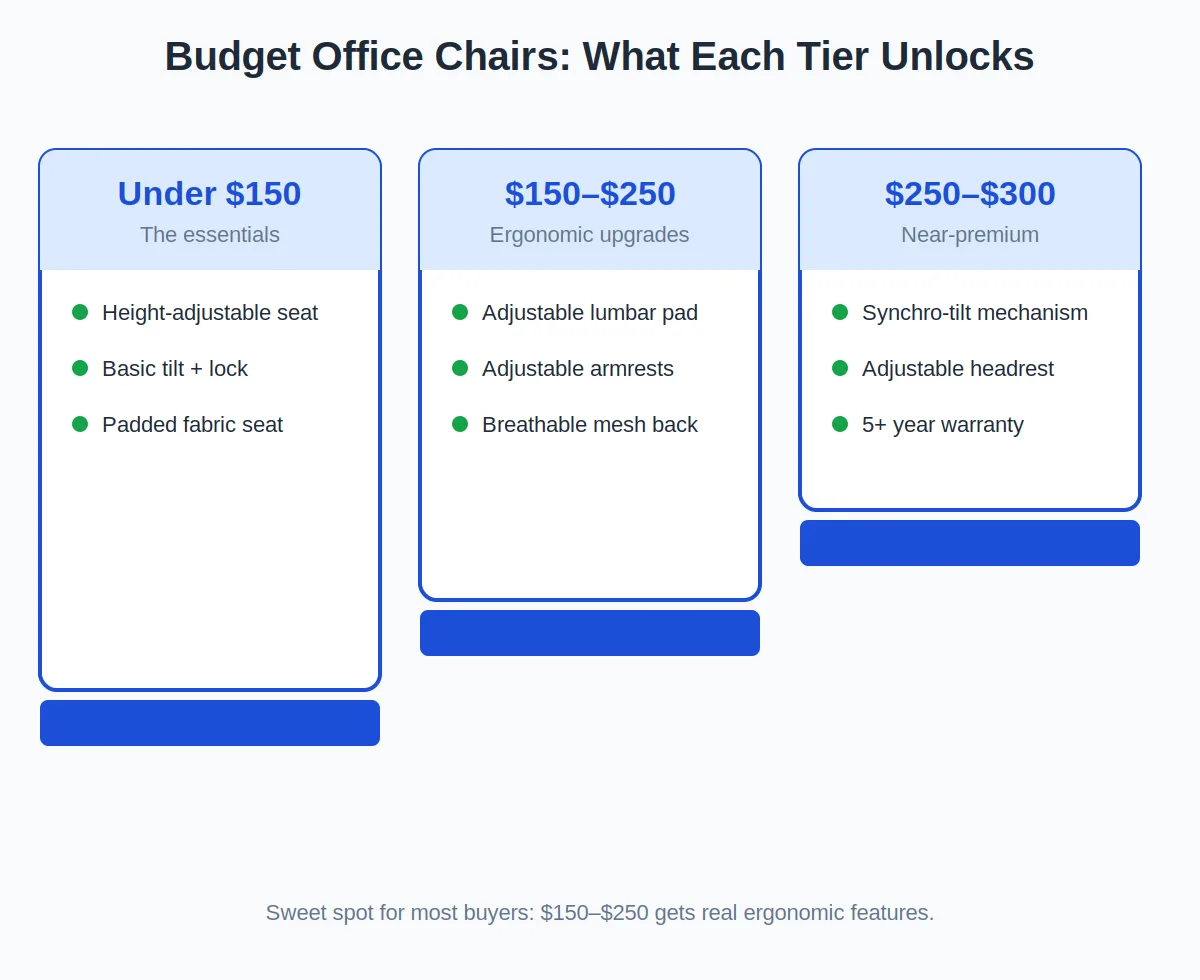
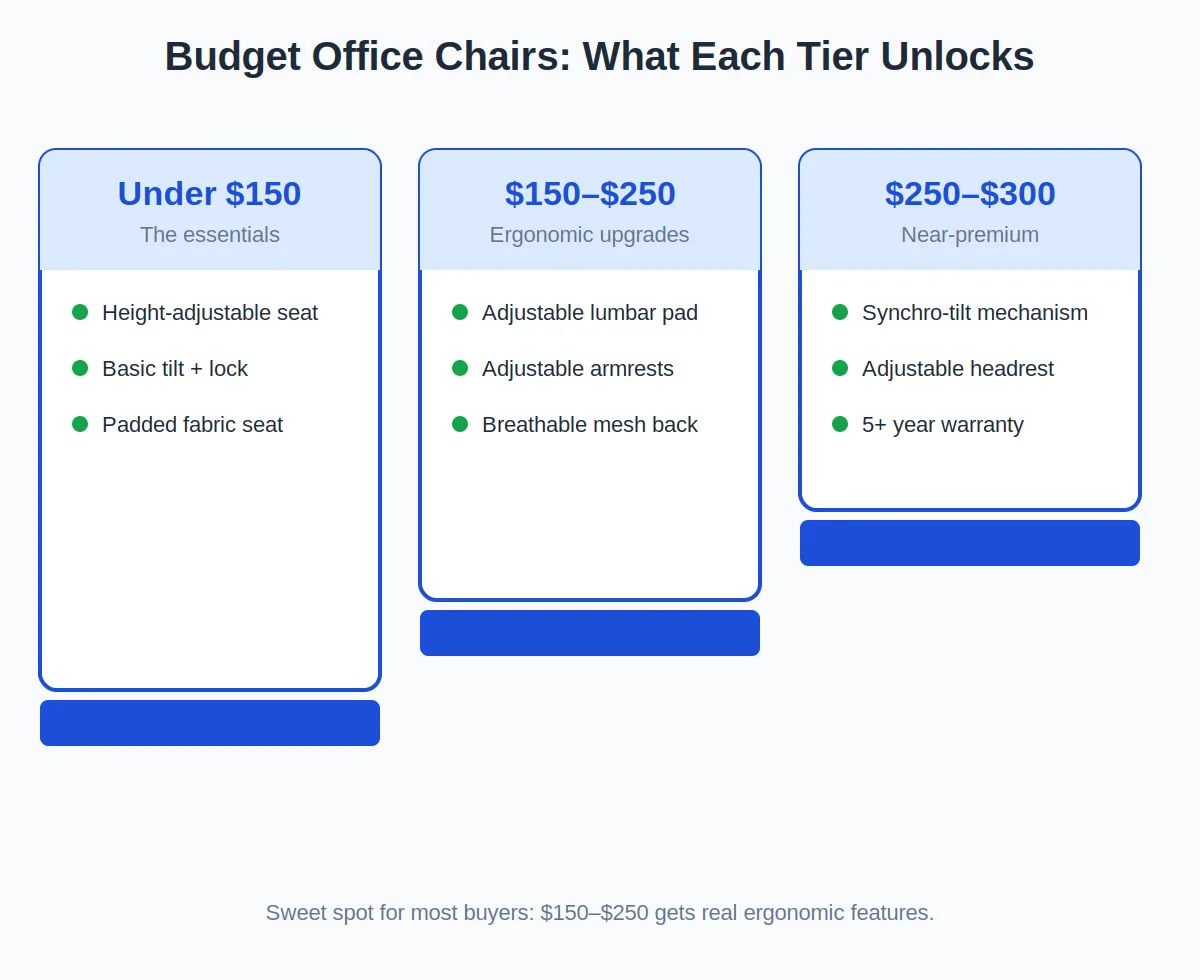
Here’s what the money buys at this tier. Under $150, you get basic height adjustment, a lumbar bump (usually fixed), and tilt that’s more suggestion than mechanism. Between $150 and $250 — the real sweet spot — you start getting adjustable lumbar support, flip-up or height-adjustable armrests, and mesh backs that breathe. Approaching $300, chairs like the Sihoo Doro C300 add 4D armrests and headrests, which is where budget chairs stop feeling budget.
The one thing price consistently fails to buy under $300 is longevity. Plan on 3–5 years of daily use from a good budget chair, versus 10+ from a premium one. Do the math honestly: a $250 chair replaced every four years still costs less over a decade than a $1,000 chair — it just costs you two shopping trips and some landfill guilt.
The Ranking: 6 Chairs Under $300
1. Sihoo Doro C300 — best overall value (~$280–$350)
The Doro C300 is the chair that makes this price bracket interesting. Adjustable lumbar support that moves both up/down and in/out, a headrest, 4D armrests, adjustable seat depth, and tilt lock — that’s a spec sheet that reads like a $600 chair. The mesh backrest keeps you cool through long sessions.
The price hovers right at the top of this list’s budget — typically $280–$350 as of October 2026 — and occasionally dips under $300 on sale, which is when to buy. The compromises are real but minor at this price: the tilt mechanism lacks the refined feel of premium chairs, and the armrest padding is thin. Neither affects whether the chair supports your back properly.
Who it’s for: anyone who wants the closest thing to a premium ergonomic chair without the premium price. If your back specifically hurts, cross-check our back-pain chair rankings — the C300 appears there too, as the value pick.
2. GABRYLLY Ergonomic Mesh Chair — best under $250 (~$200–$260)
GABRYLLY’s mesh chair is a perennial bestseller because it nails the essentials and skips the rest: high backrest, adjustable lumbar support, flip-up armrests, adjustable headrest, and a breathable mesh back. Around $200–$260 as of October 2026.
The flip-up armrests deserve a callout: they let you roll the chair fully under your desk, which matters in smaller home offices where every inch of floor space counts. The lumbar support adjusts in height, which covers most spines adequately.
Who it’s for: the practical buyer who wants a comfortable all-day chair and doesn’t care about brand names. Pair it with proper keyboard and mouse positioning and you’ve covered the biggest ergonomic wins for under $300 total.
3. Hbada Ergonomic Office Chair — best under $200 (~$150–$220)
Hbada’s chair is the one we recommend when someone says “I need something decent, today, without thinking about it.” The lumbar support is genuinely positionable — not just a fixed bump — and the flip-up armrests tuck under desks. The W-shaped seat design distributes pressure reasonably well for the price.
Typical street price as of October 2026: $150–$220. Be realistic: the tilt is basic, the armrests feel cheap before anything else does, and the mesh back won’t stay taut forever. But for lower-back support per dollar, it’s genuinely hard to beat.
Who it’s for: first apartments, students, anyone furnishing a home office on a tight budget. It’s also a sensible stopgap — buy it now, save the difference toward a premium chair later.
4. COLAMY Mesh Office Chair — best for larger frames (~$170–$230)
Larger and taller users get quietly punished by most budget chairs, which are designed around a 5’6″, 160-lb median. The COLAMY offers a roomier seat pan and a higher weight capacity (typically rated around 275–300 lbs) at a price that stays in the $170–$230 range as of October 2026.
The lumbar support is adequate rather than exceptional, but the chair’s real virtue is fit: if standard budget chairs leave your thighs hanging off the seat edge or your shoulders above the backrest, the extra dimensions here matter more than any feature list.
Who it’s for: anyone over 6 feet or over 220 lbs who finds typical budget chairs feel like they were built for someone else.
5. Flash Furniture Mid-Back Task Chair — best traditional office look (~$120–$180)
Not everyone wants a mesh-back ergonomic chair in their home office — or in their video-call background. Flash Furniture’s mid-back task chair is the plain, inoffensive workhorse: padded seat, lumbar-supporting backrest, height adjustment, and tilt lock. No racing stripes, no mesh, no drama.
Build quality at $120–$180 is better than the price suggests, because the design is simple — fewer moving parts means fewer things to break. It’s a popular choice for furnishing multiple home-office seats or a guest workspace.
Who it’s for: buyers who want a chair that looks like office furniture, not a cockpit. Our desk lamp for video calls guide pairs well here — if your background is on camera, the chair is part of the set.
6. Yaheetech Ergonomic Chair — cheapest worth buying (~$110–$160)
Below $150, most chairs are decoration. The Yaheetech is the exception that proves the rule: height adjustment, a lumbar-supporting backrest, tilt, and armrests that don’t immediately snap. It’s not luxurious and it won’t win comfort awards, but it’s an honest chair at a price where honesty is rare.
Typical price as of October 2026: $110–$160. Think of it as the minimum viable ergonomic chair — a massive upgrade over a dining chair or stool, and a stopgap you won’t regret while you save for something better.
Who it’s for: the absolute tightest budgets, dorm rooms, and anyone who needs a chair this week. If your total setup budget is $500, our home office under $500 guide shows how a chair like this fits into a complete build.
More Picks Worth Knowing About
Four more chairs worth knowing about — including the secondhand cheat code that out-specs everything new under $300.
Modway Articulate (EEI-757)
~$143 at Best Buy (list ~$166). The Articulate is the value king of this list. You get a breathable mesh back with passive lumbar support, a padded contoured seat, height-adjustable backrest and armrests, and — critically — tilt tension plus a tilt lock, all rated to 331 lbs. The “passive” lumbar is a fixed curve rather than an adjustable pad, but the height-adjustable backrest lets you position that curve where your spine needs it.
It’s been on the market for years with consistently strong reviews — its own kind of quality signal in a segment full of fly-by-night Amazon brands. If you want the ergonomic basics done right for the least money, stop here.
NEO CHAIR Mid-Back Mesh Chair
~$54–$90. The NEO CHAIR is the floor of this guide — included so you can see what “under $100” actually means: a built-in (fixed) lumbar curve, fixed armrests, a 120° tilt without a lock, and a 250-lb rating. It has thousands of positive reviews because it’s genuinely decent for light use — students, part-time desks, or a few hours a day.
Don’t buy it as an 8-hour work chair. Without a tilt lock or adjustable lumbar, your posture options are “the chair’s idea” and nothing else. If your budget is truly capped here, it’s fine for now — but check the checklist in this article first so you know what you’re missing.
Smugdesk High Back Ergonomic Mesh Chair
~$107–$156. The Smugdesk is the cheapest way to get a high back with a 90–120° tilt: adjustable headrest, fixed lumbar curve, padded armrests, and a 300-lb rating. At this price the lumbar is a shaped curve rather than an adjustable pad, and the armrests are fixed — you get the silhouette of ergonomics plus the two adjustments that matter most (headrest height and tilt).
It’s a sensible pick for a secondary workspace or if you’re not sure you’ll sit in it 8 hours a day. For a primary daily driver, the extra ~$40 for the Modway Articulate buys you adjustable armrests and a locking, tension-controlled tilt.
Used Steelcase Leap V2 (Secondhand)
$150–$250 on Facebook Marketplace; $400–$600 from refurbished dealers. This is the cheat code of the under-$300 world. A used Steelcase Leap V2 — a chair that cost over $1,000 new — gives you height-adjustable lumbar with a firmness dial, 4D armrests, adjustable seat depth, a 5-position recline lock, and a 400-lb rating. No new chair under $300 matches that adjustment list; ergonomics don’t depreciate.
The catch: refurbished-dealer Leap V2s with warranties run $400–$600, over this guide’s budget. Under $300 means a private seller or office-liquidation listing — no warranty, so test before paying: check the gas cylinder, the tilt lock, the armrests, and that the lumbar dial actually moves. Sit in it for ten minutes — good ones sell fast.
Comparison Table: All 6 Budget Chairs at a Glance
| Chair | Typical price (Oct 2026) | Lumbar support | Armrests | Headrest | Best for |
|---|---|---|---|---|---|
| Sihoo Doro C300 | $280–$350 | Adjustable, 2 directions | 4D | Yes | Best overall value |
| GABRYLLY Mesh Chair | $200–$260 | Adjustable height | Flip-up | Yes | Best under $250 |
| Hbada Ergonomic Chair | $150–$220 | Positionable | Flip-up | No | Best under $200 |
| COLAMY Mesh Chair | $170–$230 | Fixed lumbar curve | Height-adjustable | No | Larger frames |
| Flash Furniture Mid-Back | $120–$180 | Fixed lumbar curve | Padded, height-adjustable | No | Traditional office look |
| Yaheetech Ergonomic Chair | $110–$160 | Fixed lumbar curve | Fixed | No | Tightest budgets |
Chairs in this tier drop 25–35% during Black Friday week — see our Black Friday ergonomic chair deals guide.
The Budget Buyer’s Checklist: What Not to Cut
When every dollar counts, spend them in this order:
- Adjustable lumbar support. The single biggest comfort differentiator. A fixed bump helps only if your spine matches its curve; adjustable covers everyone.
- Seat depth that fits you. Too deep and you slouch to reach the backrest. Look for adjustable seat depth, or at minimum a seat pan that doesn’t press behind your knees.
- Height-adjustable armrests. Shoulders should hang relaxed with elbows near 90 degrees. Fixed armrests that are too high are worse than none.
- Tilt with tension control. Reclining slightly (100–110 degrees) with backrest contact takes pressure off spinal discs.
- Mesh or breathable back. Sweat changes posture as surely as bad design — and budget foam backs trap heat.
Skip without guilt: 4D armrests (nice, not necessary), fancy tilt mechanisms, aluminum bases (nylon is fine), and brand names. None of them determine whether your back hurts at 5 PM.
What About Gaming Chairs Under $300?
They’re the elephant in the room — and worth addressing plainly. Most sub-$300 gaming chairs prioritize racing-seat aesthetics over adjustability: fixed lumbar pillows instead of adjustable support, bucket-seat geometry designed for style, and armrests that adjust in name only. A boring-looking ergonomic chair at the same price supports your back better in nearly every case. Buy a gaming chair because you like how it looks, not because you think it’s ergonomic.
Is a $200 office chair actually good enough for 8 hours a day?
Yes, if it has adjustable lumbar support and fits your body. The Hbada and GABRYLLY both qualify — thousands of full-time remote workers use them daily. What $200 doesn’t buy is longevity: expect 3–5 years instead of 10+, and budget for a replacement down the road.
Should I buy a cheap chair now and upgrade later, or save for a premium one?
Buy cheap now if your current chair is actively hurting you — a $180 GABRYLLY today beats a $1,000 Aeron six months from now. Pain compounds; savings don’t. The smart middle path is a refurbished premium chair ($400–$600), which our back-pain chair rankings cover in detail.
Do I need a headrest on a budget chair?
It’s nice but not essential. Headrests matter most if you recline during calls or breaks. If you sit upright all day, a headrest is decoration. Don’t pay extra for one you won’t use — put that money toward better lumbar support instead.
What’s the best desk chair under $300 for back pain specifically?
The Sihoo Doro C300 — its two-direction lumbar adjustment is the feature that matters most for back pain, and it’s the cheapest chair here that has it. If back pain is your primary concern rather than your budget, start with our best office chairs for back pain guide, which ranks by support type across all price points.
Are mesh chairs better than padded chairs at this price?
Usually yes. Budget foam padding compresses and loses support within a year or two; mesh stays consistent longer and breathes. The exception is very cold rooms, where mesh can feel drafty — a minor complaint most people solve with a cushion.
How long will a sub-$300 chair last?
Plan on 3–5 years of daily full-time use from the better picks here (Sihoo, GABRYLLY, Hbada). The armrests and tilt mechanism are usually what go first. Chairs under $150 are more like 2–3 year chairs. Check the warranty — 1–2 years is standard at this tier.
Should I buy a used Steelcase or a new budget chair?
If you can test it in person, the used Steelcase wins on ergonomics. A $200 used Leap V2 has more adjustments than any new chair under $300 — but no warranty and no returns. Inspect the gas cylinder, tilt lock, and armrests before paying. If you can’t test, buy new for the warranty and return window.
The Bottom Line
Under $300, buy adjustability, not branding. The Sihoo Doro C300 is the value ceiling, the GABRYLLY is the pragmatic middle, and the Hbada is the budget floor worth standing on. Whichever you pick, run through our home office ergonomics checklist after it arrives — a $200 chair set up correctly beats a $500 chair set up wrong, and the checklist takes ten minutes.