
Home Office Design Ideas That Actually Work (2026)
The best home office design ideas start with placement, not purchases: put the desk where the light is, give work a visible boundary, and store everything vertically before buying a bigger desk. A small room works when each square foot has one job, and most of the ideas below cost little — several need no new furniture at all.
As an Amazon Associate I earn from qualifying purchases.
TL;DR — Home office design ideas that actually work
- Best first move: put the desk facing the window — free daylight beats any lamp you can buy.
- Best small-room trick: mark a work zone with a rug or a shelf so the office ends where the living room begins.
- Best storage idea: go vertical — wall shelves and a drawer unit beat a wider desk.
- Best lighting fix: a monitor light bar frees the desk space a lamp would take.
- Best desk upgrade: a monitor arm reclaims about a square foot of desk surface.
- Best time to buy: Black Friday week (Nov 27–30) is when desks and furniture hit their yearly floor.
Method: we compared published specs, November 2026 street prices, and verified owner feedback.
Which home office design ideas actually work in a small room?
| Idea | Cost (Nov 2026) | Biggest payoff |
|---|---|---|
| Desk facing the window | Free | Free daylight, better mood |
| Rug or divider as a work zone | $30–$80 | Work ends when you step off the rug |
| Corner desk | $100–$250 | Uses dead space other desks waste |
| Wall shelves + pegboard | $25–$60 | Storage without floor space |
| Monitor light bar | $109–$139 | Full lighting, no lamp base |
| Dual monitor arm | ~$35 | About 1 sq ft of desk back |
| Mesh desk organizer | ~$27 | Papers stop spreading |
| Drawer-unit desk | $120–$300 | Storage built into the furniture |
Where should the desk go in a small room?
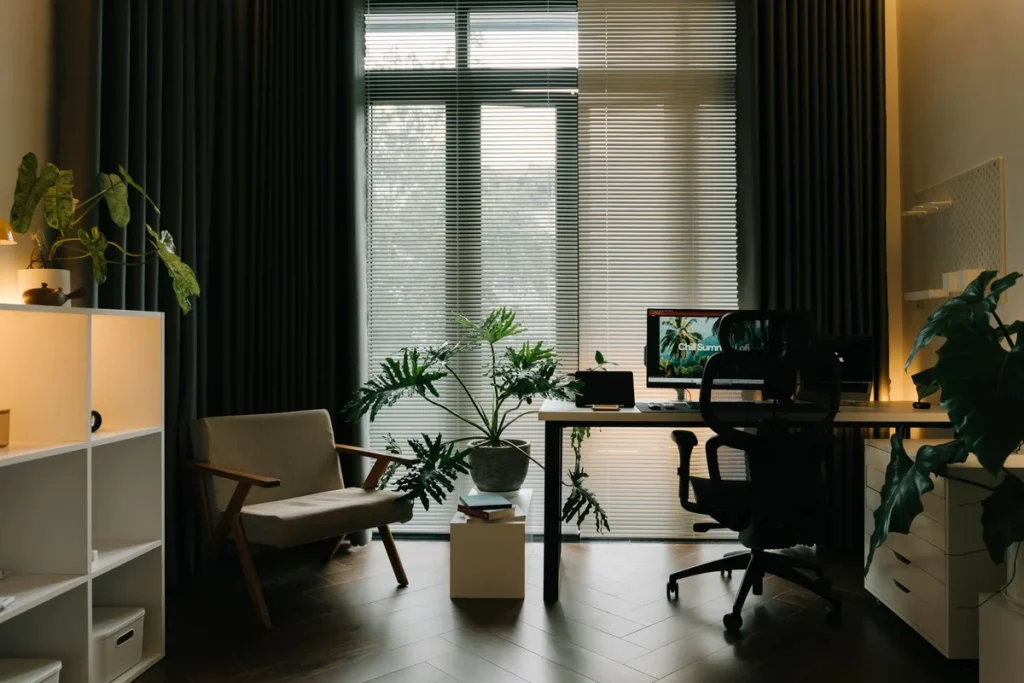
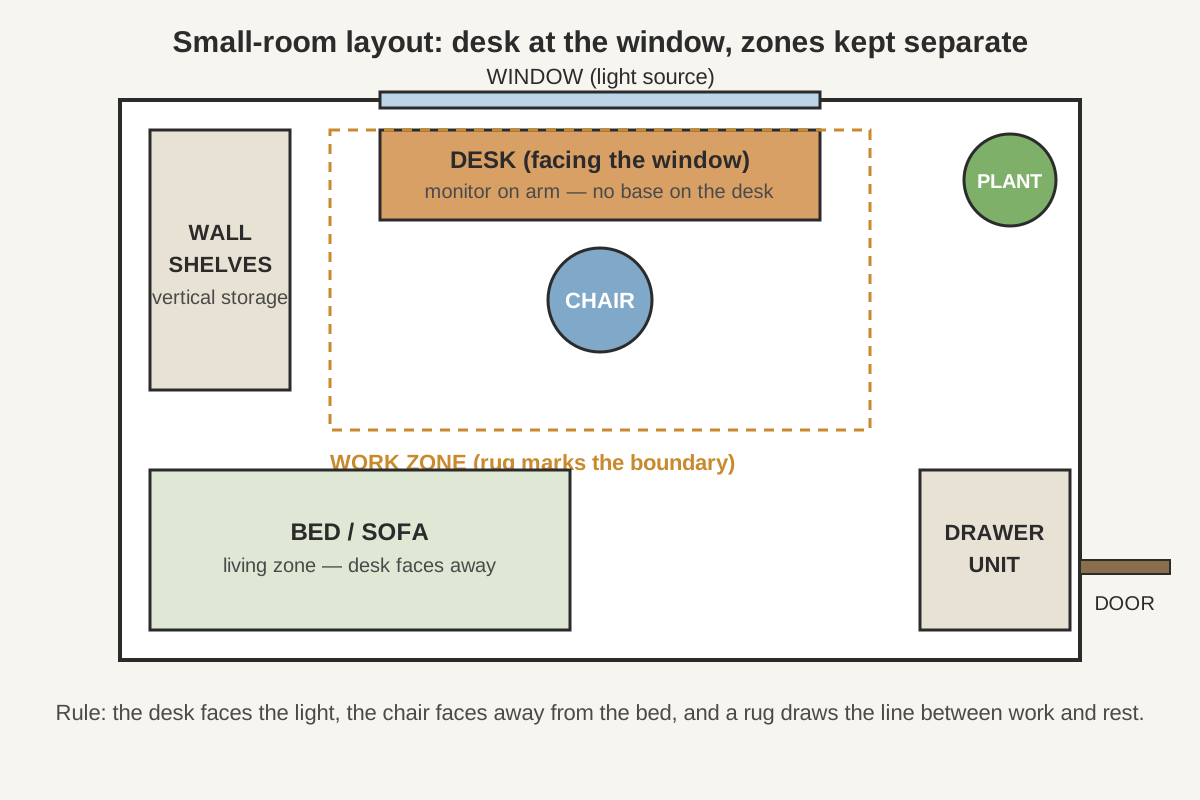
Put the desk facing the window, or perpendicular to it — never with your back to the only light in the room. Daylight is the one design element that costs nothing and changes everything: a desk by the window gets free, even light all morning, and the view gives your eyes somewhere to rest every twenty minutes. Facing the window also gives video calls flattering front light instead of a dark silhouette.
The second-best spot is a wall perpendicular to the window, which keeps glare off the screen while keeping the light beside you. The worst spot is the one most people pick first: pushed against the wall with your back to the window, where the screen glares and the room feels like a cave. Leave at least 30 inches (76 cm) behind the chair so you can push back and stand without hitting the bed or the wall.
How do you carve a work zone out of a shared room?
A work zone is a boundary you can see, not a room you can close. In a bedroom or living room that doubles as an office, the office needs an edge — otherwise work spreads across the whole room and the whole room feels like work. The cheapest boundary is a rug: a 4-by-6-foot rug under the desk and chair marks the office, and stepping off it at 6 p.m. is a real end to the day.
A bookshelf turned sideways works as a divider and storage in one move, and a folding screen costs $40–$70 and folds away when guests come. Even one painted accent wall behind the desk tells the eye where the office starts. The rule is simple: if you cannot see where work ends, work never ends.
Can a corner desk really double your usable space?
Yes — a corner desk turns the most wasted square footage in a room into your main workspace. Corners collect dust because no standard furniture fits them. An L-shaped corner desk fills that dead space with a surface that wraps around you: a long main run for the monitor and a side run for papers, a notebook, or a second screen.
A 42-inch corner desk fits where a 60-inch straight desk cannot, and the side wing puts the printer or reference books within arm’s reach. The trade-off is real: corner desks are harder to move, and a cheap one wobbles when you lean on the far edge, so check the weight rating and the leg design before buying. If your room has a genuinely unused corner, see our best corner desk for a home office guide for sizes that fit small rooms.
What storage actually works when you have no spare room?
Go vertical: wall shelves, a pegboard, and a drawer unit store more than a wider desk ever will. A desk gets wider, the clutter gets wider with it. A wall gets taller, and the clutter gets organized. Two floating shelves above the desk hold books and binders at eye level and off the work surface, and a pegboard beside the desk holds headphones and cables on hooks that move whenever your setup changes.
The storage that matters most is built into the furniture. A desk with drawers puts the printer paper, spare cables, and tax folder inside the desk instead of on top of it — and it costs little more than a flat-top desk of the same size. Our best desk with drawers for a home office guide compares the drawer layouts that actually hold office supplies.
How do you light a home office without a desk lamp eating the desk?
Clamp the light to the monitor instead of standing it on the desk. A traditional desk lamp eats roughly a square foot of desk and throws light from one side, so one half of the desk is bright and the other is in shadow. A monitor light bar sits on top of the screen, throws an asymmetric beam down onto the keyboard and papers, and leaves the desk surface completely free. It is the single best lighting idea for a desk under 48 inches wide.
The BenQ ScreenBar Plus is the established pick: a USB-powered LED bar with a desktop dial for brightness and color temperature (2,700K warm to 6,500K cool), auto-dimming, and a clamp that fits monitors 0.4 to 1.2 inches thick. It lists at $129 (as of November 2026) and usually sells for $118–$129. That is real money for a light, so the honest test is desk size: if your desk is 55 inches or wider, a $30 lamp works fine. If your desk is small, the light bar pays for itself in reclaimed space. Check the BenQ ScreenBar Plus on Amazon.
Why does a monitor arm change a small desk more than a bigger desk?
A monitor arm reclaims about a square foot of desk surface and fixes your posture in the same move. A monitor on its factory stand eats a 10-by-8-inch footprint plus the dead space behind it, and the screen sits wherever the stand allows — usually too low. An arm clamps to the back edge of the desk, lifts the screen to eye level, and leaves the space underneath free for a notebook or a speaker.
The VIVO Dual Monitor Desk Mount (STAND-V002) holds two screens up to 30 inches and 22 lbs each on a single pole, with a C-clamp or grommet mount and full tilt, swivel, and height adjustment. It lists at $34.99 and usually sells for about $29–$35 (as of November 2026) — the cheapest square foot of desk you will ever buy. Check the VIVO dual monitor mount on Amazon. With both screens on one pole, they sit at the same height and distance from your eyes — the setup that stops the neck ache.
What belongs on the desk — and what should leave it?
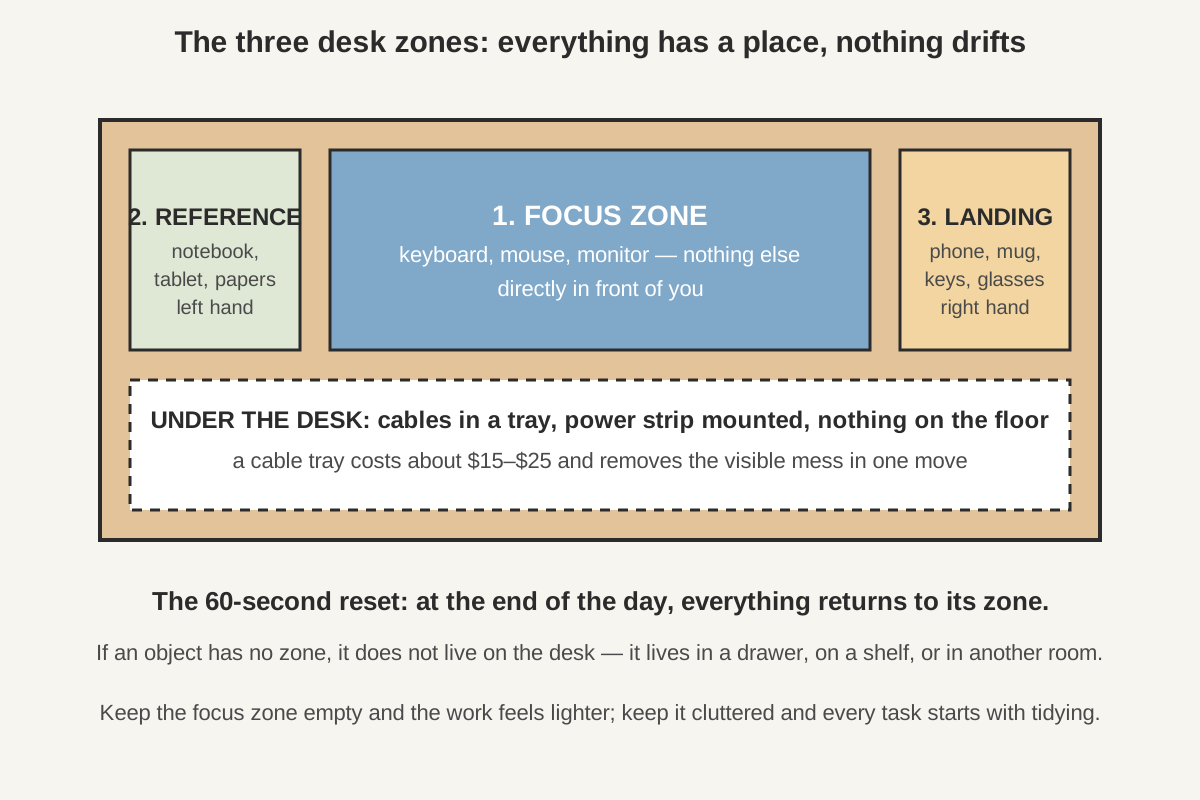
The desk holds three zones and nothing else: a focus zone, a reference zone, and a landing zone. The focus zone is directly in front of you — keyboard, mouse, monitor, nothing else. The reference zone is to your left — the notebook, the tablet, the papers for this task only. The landing zone is to your right — phone, mug, glasses, keys. Everything else lives in a drawer, on a shelf, or in another room. When an object has no zone, it does not live on the desk.
The tool that enforces this is a single desk organizer, not a drawer full of them. The SimpleHouseware Mesh Desk Organizer with Sliding Drawer is a 13.2-by-9-by-12-inch unit with a double tray, five upright sections for files, a sliding drawer, and a detachable pen cup — about $27 (as of November 2026). It holds the papers and supplies that otherwise colonize the desk, and because it is one unit with a fixed footprint, it cannot grow. Check the SimpleHouseware mesh desk organizer on Amazon. The daily reset makes the zones stick: sixty seconds at the end of the day, everything back to its zone. A desk that starts clean stays clean.
How do you make a small office feel bigger?
Light colors, one plant, and a clear floor make a small room feel larger than any furniture swap. Pale walls reflect the daylight your desk placement just captured; a dark accent wall behind the desk adds depth, but dark walls on all four sides shrink the room. A mirror opposite the window doubles the light and the perceived width — a $25 thrift-store mirror does this as well as a $200 designer one.
One large plant beats five small ones: a snake plant or pothos in a floor pot fills a dead corner and gives the eye a living thing to rest on. Keep the floor clear — no boxes under the desk, no bag beside the chair — because the eye reads floor space as room size.
When is the cheapest time to buy home office furniture?
Black Friday week (Nov 27–30) is when desks and office furniture hit their yearly floor — plan the purchase, don’t impulse-buy it. Standing desks, drawer units, and desk chairs see their deepest discounts of the year in that window, typically 20–40% off list, and the same models return to full price by mid-December. The trick is to decide what you need now and buy it then — not to browse the sales and discover a need.
Our Black Friday home office deals guide tracks the discount bands to expect on desks, chairs, and storage. If the purchase can wait two weeks, waiting saves real money on the big items; on the small ones — organizers, trays, light bars — the savings are a few dollars, so buy those whenever the desk needs them. A chair deserves the same timing logic as the desk: see our best desk chairs under $300 guide before the sales start, so you know which models are worth watching.
Frequently asked questions
What is the best layout for a small home office?
Desk facing the window with a rug marking the work zone. It gives you free daylight, a visible boundary between work and rest, and a chair that faces away from the bed or sofa.
How can I design a home office in a bedroom?
Use a rug or a bookshelf as a divider, store vertically with wall shelves, and keep the desk facing the window. The goal is a visible work zone inside the bedroom, not a second room.
What color makes a small home office look bigger?
Light, pale colors — white, warm gray, or pale sage — reflect daylight and make the walls feel farther away. One dark accent wall behind the desk adds depth; dark paint on all four walls shrinks the room.
How much does it cost to design a small home office?
A functional design costs $0–$100 if you rearrange what you own and add a rug, shelves, and an organizer. A full refresh with a new desk, chair, and lighting runs $300–$800, and Black Friday week is the cheapest time to buy the furniture.
Do I need a big desk for a home office?
No — a 42-to-48-inch desk with a monitor arm and vertical storage holds more than a 60-inch desk with everything piled on it. Storage and placement matter more than desk width.
The bottom line
A home office that works is a placed desk, a visible boundary, and storage that goes up instead of out. Put the desk by the window, mark the work zone with a rug, hang the storage on the wall, lift the monitor off the desk, and light it from the screen instead of a lamp base. None of these ideas needs a renovation or a big budget — most need an afternoon and a tape measure. Start with placement, add storage second, and buy furniture last, ideally in Black Friday week.