Best Wrist Rests for Keyboard and Mouse (2026)
The best wrist rest for keyboard and mouse is the HyperX Wrist Rest (Full Size), which pairs cooling gel-infused memory foam with a non-slip rubber base for about $23 as of October 2026. Budget shoppers should grab the Gimars 3-piece memory foam set at $10.99, while mouse-heavy users benefit most from the DeltaHub Carpio 2.0, which glides with the hand.
As an Amazon Associate I earn from qualifying purchases.
TL;DR — Our 2026 verdict: HyperX Wrist Rest (Full Size) is the best all-round pick at ~$23: cooling gel memory foam, anti-fray stitching, and a rock-solid anti-slip base. Gimars Upgrade Enlarge Set wins on value — keyboard rest, mouse rest, and coaster for $10.99. 3M WR310LE is the office-grade gel classic, DeltaHub Carpio 2.0 is the smartest mouse rest, Glorious Wooden is the premium desk-candy option, and CushionCare 4pc is the best complete starter kit.
Which wrist rest for keyboard and mouse should you buy in 2026?
A good wrist rest does one thing well: it keeps your wrists near-neutral instead of bent back during long sessions. (Source: Mayo Clinic) The six picks below cover every material and budget.
| Product | Best for | Material | Keyboard + mouse covered? | Price (Oct 2026) | Rating |
|---|---|---|---|---|---|
| HyperX Wrist Rest (Full Size) | Overall best | Gel-infused memory foam | Keyboard only (separate mouse rest sold) | ~$23 | 4.7/5, 13,000+ ratings |
| Gimars Upgrade Enlarge Set | Best budget set | 63D memory foam, spandex | Yes — keyboard rest, mouse rest + coaster | $10.99 | 4.5/5, 38,000+ ratings |
| 3M Gel Wrist Rest WR310LE | Best gel, office use | Gel, leatherette | Keyboard only | ~$31 | Office-supply classic, 1-yr warranty |
| DeltaHub Carpio 2.0 | Best mouse wrist rest | Silicone pads, PTFE gliders | Mouse (works with keyboards too) | $34.90 direct | 4.74/5, deltahub.io |
| Glorious Wooden Wrist Rest (GV-100-DARK) | Best wooden | White ash wood | Keyboard only (mouse version sold separately) | Premium tier | Enthusiast favorite |
| CushionCare 4pc Set | Best complete kit | Memory foam | Yes — keyboard rest + mouse pad with rest | Under $40 | 4.2/5, 8,565 reviews |
1. HyperX Wrist Rest (Full Size) — Best overall
The HyperX Wrist Rest is the safest recommendation in this category. Its cooling gel-infused memory foam cushions without the sweaty feel of plain foam, the natural rubber underside grips the desk during fast typing, and anti-fray stitching means it survives daily use instead of peeling at the seams.
At 18 inches long and 3.9 inches deep, the full-size version spans a standard 104-key keyboard. HyperX also sells tenkeyless and compact versions, and the two-year warranty is unusually generous for an accessory this cheap.
The catch: the full-size rest is keyboard-only, so mouse users need the separate mouse version. At ~$23 as of October 2026, it costs double the Gimars set — but the gel-infused foam stays cooler than plain foam through eight-hour days.
Check the HyperX Wrist Rest price on Amazon
2. Gimars Upgrade Enlarge Silky Gel Memory Foam Set — Best budget pick
The Gimars set is the best-selling wrist rest on Amazon for a reason: three pieces for $10.99. You get a 17-by-3.5-inch keyboard rest, a contoured mouse rest, and a coaster, all in 1.2-inch-thick 63D memory foam with a breathable spandex surface.
The 38,000+ ratings at 4.5 stars (as of October 2026) make it the most-reviewed wrist rest in existence. The foam is softer than the HyperX, and the non-slip rubber base holds on glass and laminate desks. Gimars backs it with an 18-month warranty.
The trade-off is longevity: softer foam compresses faster and the spandex shows wear sooner. At this price, replacing it every couple of years is still cheaper than any alternative here.
Check the Gimars set price on Amazon
3. 3M Gel Wrist Rest WR310LE — Best gel, office classic
3M literally invented the gel wrist rest, and the WR310LE is the product that defined the category. The 19.3-inch gel pad in black leatherette sits firm and flat, with antimicrobial product protection on the cover and a non-skid base. At 1.25 inches tall it pairs best with standard-height keyboards rather than low-profile mechanical boards.
Gel behaves differently from foam: it doesn’t compress much, stays cool, and wipes clean with a damp cloth. Office managers have bought these by the case for decades because they survive heavy shared use, and the 1-year limited warranty is standard for 3M office products.
Expect to pay around $31 through office suppliers as of October 2026 — a bit more than gaming-branded foam, but this is the reference point every other gel rest is judged against.
Check the 3M WR310LE price on Amazon
4. DeltaHub Carpio 2.0 — Best wrist rest for mouse users
The Carpio 2.0 breaks the mold: instead of a static pad, it’s a small silicone-cradled rest that glides with your hand on PTFE feet. Because it moves with you, your wrist stays supported while the whole arm drives the mouse — which is how ergonomists say you should mouse anyway.
The design came out of collaboration with a carpal tunnel surgeon, 3D hand scans, and MRI comparisons: the pads cradle the palm heel rather than pressing on the underside of the wrist. Size Large weighs just 22 grams and fits palms wider than a credit card; Size Small fits narrower hands. DeltaHub offers a 60-day money-back guarantee.
Two caveats: it supports only one hand (buy two for keyboard + mouse), and at $34.90 direct from DeltaHub as of October 2026 it’s the priciest single-hand option here. It sits low, so it pairs best with low-profile keyboards and mice — or a desk mat, which gives the PTFE feet their ideal glide surface.
Check the Carpio 2.0 on DeltaHub
5. Glorious Gaming Wooden Wrist Rest (GV-100-DARK) — Best wooden
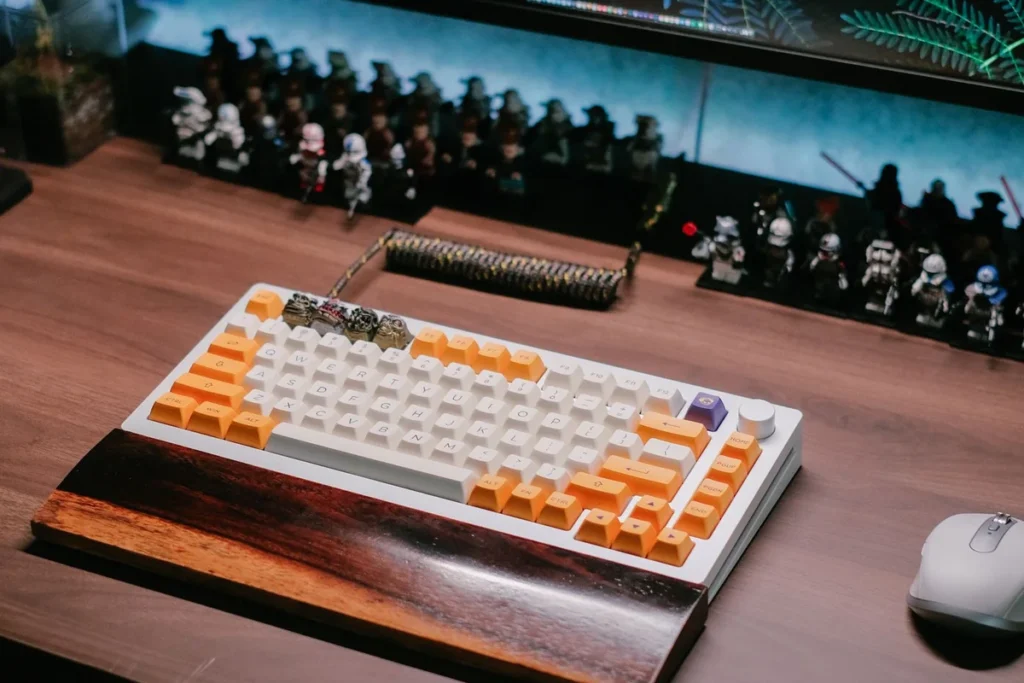
If your setup is a showpiece, a foam pad looks out of place. Glorious’s wooden wrist rest is cut from solid white ash, 17.5 by 4 inches and 19mm thick, with a polished coating that resists sweat and skin oils. Rubber pads underneath keep it planted.
Wood is the firmest option here — it doesn’t cushion, it positions. That firmness is the point for mechanical keyboard users: palms rest at a consistent height, which keeps wrist angle stable. It never compresses, never smells, and ages well. A matching wooden mouse rest (GV-M-DARK) is sold separately.
This is the premium pick, roughly double the price of the HyperX, and it gives you nothing in cushioning. Buy it for the look, the durability, and the height match with tall mechanical keyboards — not for plushness.
6. CushionCare 4pc Memory Foam Set — Best complete starter kit
The CushionCare set is the easy button for a full desk refresh: keyboard wrist rest, mouse pad with built-in wrist support, a coaster, and a microfiber cloth, all in black memory foam with rubber non-slip bottoms. It arrives in a gift-ready box — the most giftable option here.
The foam is firmer than Gimars’s and the pieces are sized generously. With 8,565 reviews at 4.2 stars as of October 2026, it’s well-tested but a notch below the top two — the trade-off for getting the whole kit under $40.
Check the CushionCare set price on Amazon
Do wrist rests actually reduce wrist pain?
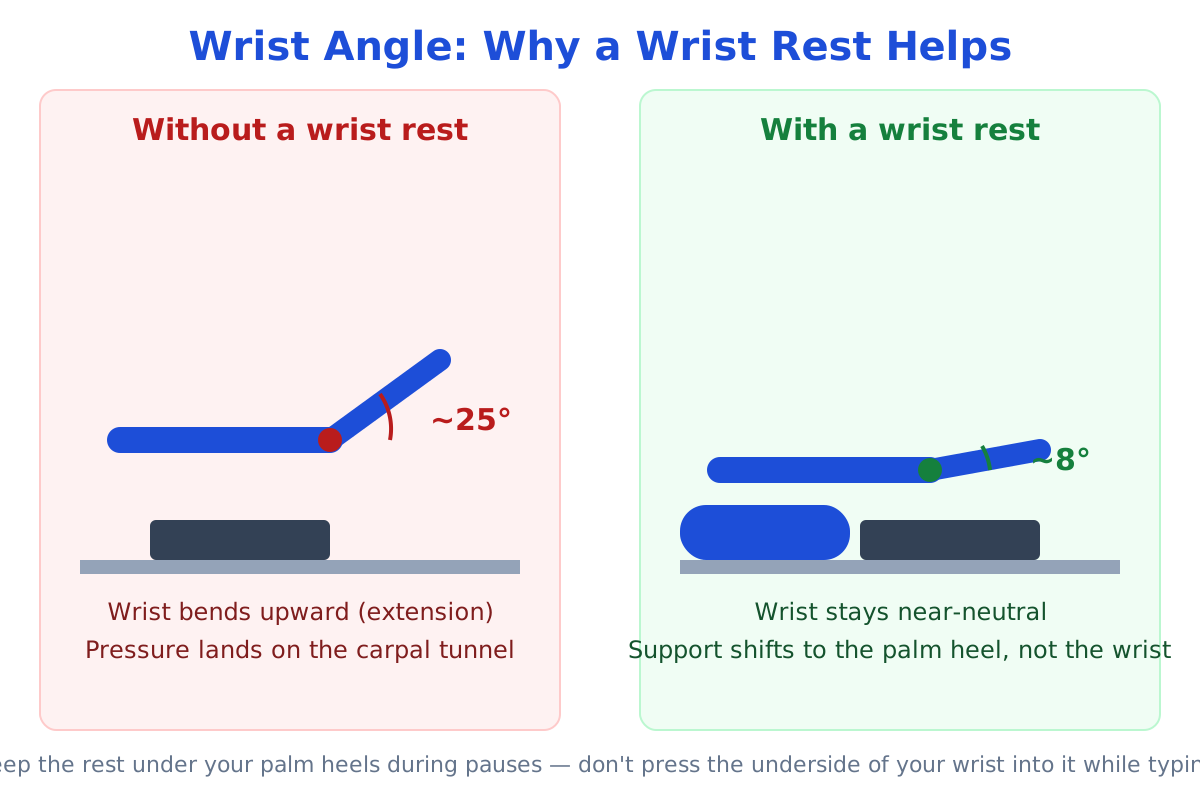
A wrist rest helps only when it reduces wrist extension — the upward bend that loads the tendons and the median nerve. (Source: OSHA) A rest matched to your keyboard’s front height keeps the wrist within roughly 8–10 degrees of neutral, as the diagram above shows.
Ergonomists draw one important line: rest your palm heels on the pad during pauses, not the underside of your wrist while typing. Pressing directly on the carpal tunnel area while hammering keys can make things worse — this is the exact problem the DeltaHub Carpio was designed around.
One honesty check: if your desk is too high or your chair too low, a wrist rest is a bandage on a posture problem. Fix the desk-chair-keyboard triangle first — an under-desk keyboard tray or a properly adjusted ergonomic chair does more for wrist pain than any pad.
What should you look for when buying a wrist rest?
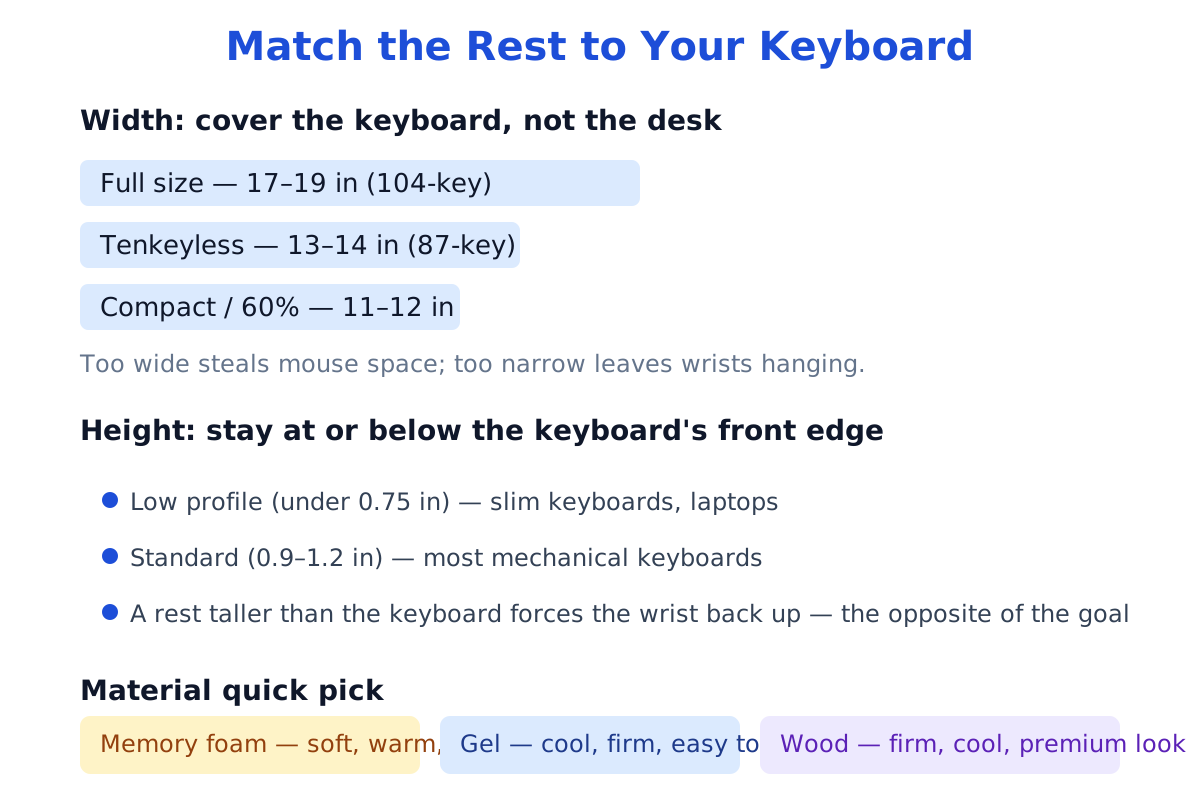
Match the width to your keyboard. A full-size board needs a 17–19 inch rest; tenkeyless boards take 13–14 inches; compact 60% boards take 11–12 inches. Too wide and it eats mouse space; too narrow and your wrists hang off the edges.
Match the height to your keyboard’s front edge. This is the spec most buyers ignore. A rest taller than your keyboard’s front edge pushes the wrist back up — the opposite of the goal. Slim keyboards and laptops want a low-profile rest under 0.75 inches; standard mechanical keyboards pair well with 0.9–1.2 inches.
Pick the material for your climate and cleaning habits. Memory foam is softest and cheapest but traps heat. Gel stays cool and wipes clean but feels firmer. Wood is the firmest and most durable, and it never compresses — but it offers zero cushion.
Check the base. A rubberized or textured non-slip base matters more than it sounds. A rest that creeps across the desk during fast typing gets abandoned within a week.
Consider a set if you need mouse support too. Keyboard-only rests leave the mouse hand unsupported, and the mouse hand is usually the one that hurts first. Sets like the Gimars or CushionCare cover both for barely more than a single premium rest.
Memory foam vs gel vs wood: which material is best?
Memory foam is the most popular choice: it conforms to your wrist over a few weeks and costs the least — but plain foam traps heat, which is why gel-infused variants exist. Gel stays cool, barely compresses, and wipes clean; it supports rather than cradles, and some typists find it too firm. Wood gives a fixed, cool, permanent platform that never deforms — ideal under tall mechanical keyboards — but cushions nothing.
Bottom line: foam for comfort, gel for cool easy cleaning, wood for firm support and looks.
Frequently asked questions
Should I use a wrist rest while typing or only during pauses?
Use it during pauses. Keep your wrists floating and straight while you type, and rest your palm heels on the pad when you stop — pressing the underside of your wrist into a rest while typing can increase carpal tunnel pressure.
Are wrist rests good for carpal tunnel syndrome?
They can reduce strain by keeping the wrist nearer to neutral, but a wrist rest is a comfort aid, not a medical treatment. Persistent numbness or pain deserves a clinician, not a shopping cart.
What size wrist rest do I need for a full-size keyboard?
Buy a 17–19 inch rest for a standard 104-key keyboard, so both wrists stay supported across the full width without crowding the mouse area.
Do wooden wrist rests work as well as foam?
They work differently: wood gives firm, cool, permanent positioning that pairs perfectly with tall mechanical keyboards, while foam gives cushioned comfort that suits long days and softer preferences. Neither is universally better.
How thick should a wrist rest be?
Match it to your keyboard’s front edge: under 0.75 inches for slim keyboards and laptops, 0.9–1.2 inches for standard mechanical keyboards. A rest taller than the keyboard’s front edge forces the wrist upward and defeats the purpose.
How do I clean a wrist rest?
Wipe gel and wooden rests with a damp cloth; spot-clean memory foam with mild soap and let it air-dry fully. Never soak foam or use harsh solvents.
The bottom line
Most people need one thing from a wrist rest: a height-matched, non-slip pad that keeps the wrists near-neutral through the workday. The HyperX Wrist Rest does that best at ~$23, the Gimars set does it cheapest at $10.99 with mouse support included, and the DeltaHub Carpio 2.0 rethinks the problem entirely for mouse-heavy users.
Pick the material that fits your setup — foam for comfort, gel for cool easy cleaning, wood for firm permanent support — and fix the bigger ergonomics first: desk height, chair height, and keyboard position matter more than any accessory. Prices were checked in October 2026; use the links above for current pricing.