

A sinking office chair is almost always a failed gas cylinder, and the fastest fix is a hose clamp tightened around the piston rod just under the seat — about 15 minutes and under $5. For a permanent repair, replace the cylinder itself for $25–40. The four fixes below cover every budget, from a $3 clamp to a new chair.
How to Fix a Sinking Office Chair (4 Fixes That Actually Work)
The quotable rule: a chair that sinks slowly under your weight has a worn gas-cylinder seal, not a broken frame — and a $3 hose clamp will hold it at your height today.
If your chair drops a few inches every time you sit down, the pneumatic cylinder under the seat has lost its seal, and the nitrogen inside is slowly escaping past it. The chair still rolls and swivels — it just will not stay up. We compared specs, prices, and owner feedback across the four common repair methods to find which fits which chair.
Why does an office chair sink?
Every height-adjustable chair rides on a gas cylinder — a sealed tube of pressurized nitrogen. Pull the lever and a valve opens, letting the gas push the seat up; release it and the seat locks at that height.
The seal around the piston wears out with use — heat, dust, and daily sitting all accelerate it — and once it leaks, gas escapes past the piston whenever weight presses down. A chair that sinks in seconds has a blown seal; one that drops an inch every ten minutes has a slow leak. Both are fixable.
Before spending money, run one quick check: pull the height lever while seated — if the seat pops up easily but will not hold, the cylinder is the problem. Also check the lever cable under the seat; if it slipped off its hook, the valve may be stuck partly open. Re-seat it and test again — if the chair still sinks, the cylinder itself has failed.
What tools do you need, and is it safe?
- Hose-clamp fix: one stainless hose clamp (1-1/4 to 1-3/4 inches), a screwdriver, a strip of rubber or old inner tube.
- PVC pipe fix: 1-1/2-inch PVC pipe (schedule 40), a hacksaw or PVC cutter, sandpaper, a tape measure.
- Cylinder replacement: a replacement gas cylinder, a rubber mallet, a pipe wrench, penetrating oil, work gloves.
Safety first: never drill, cut, or puncture a gas cylinder. It is pressurized with nitrogen, and drilling into it can release that pressure violently. Every fix here works around the cylinder — none opens it. Never work on a loaded chair: flip it upside down so the seat cannot drop on your hands, and wear gloves for the cylinder swap, because the tapers can be sharp.
Fix 1: How do you stop a chair sinking with a hose clamp?
The hose-clamp fix is the fastest and cheapest repair there is: a stainless steel clamp around the exposed piston rod acts as a physical stop, so the seat can sink only until the clamp meets the top of the outer cylinder tube. Cost: about $3–5, as of November 2026. Time: 10–15 minutes. Difficulty: easy.
Steps:
- Raise the seat to your preferred height with the lever, then sit to confirm it feels right — this is the height the clamp will lock in.
- Stand up and slide the hose clamp over the exposed piston rod, down to the shiny chrome section just below the seat mechanism — open the clamp fully if it will not slide over.
- Wrap a strip of rubber around the piston first — an old bicycle inner tube works well — to protect the chrome and help the clamp grip.
- Position the clamp flush against the underside of the seat mechanism, then tighten the screw until it is snug and cannot slide down the rod by hand.
- Sit and bounce gently. If the seat holds, you are done; if it still creeps down, tighten the clamp another half-turn.
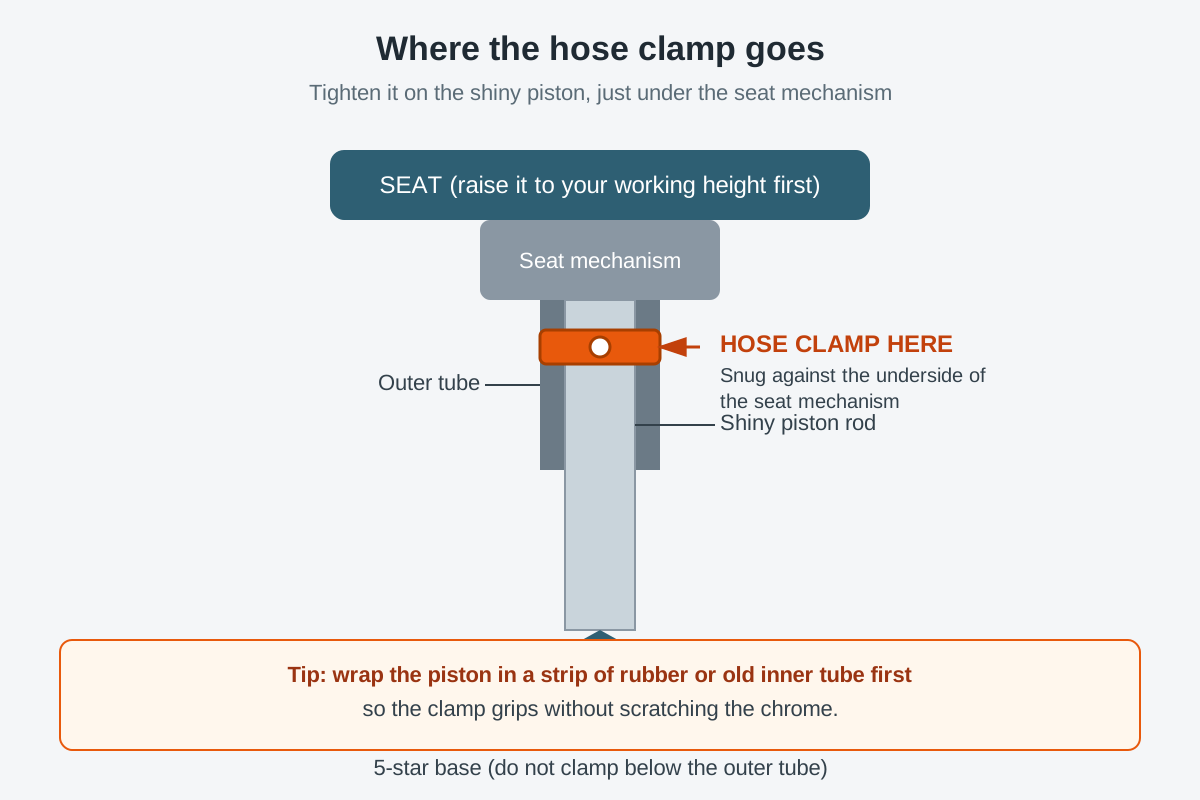
The trade-off: the clamp locks the chair at one fixed height, so it suits one person at one desk — not a shared chair where several people adjust the height daily. It can also leave a ring mark on the chrome over time, which is why the rubber strip matters. Still, for a chair that is otherwise comfortable, this is the fix to try first: it costs less than a coffee and takes less time than ordering a part.
Fix 2: How do you fix a sinking chair with a PVC pipe sleeve?
The PVC pipe sleeve works on the same principle as the hose clamp — a rigid collar around the piston rod stops the seat from dropping — but it looks cleaner and cannot slip if sized right. Cost: about $5–8, as of November 2026. Time: 20–30 minutes. Difficulty: easy.
Steps:
- Raise the seat to your preferred height and measure the exposed piston rod — the chrome section between the seat mechanism and the outer tube.
- Cut the PVC pipe to exactly that measurement — it must fill the whole gap, or the seat will still sink by the leftover distance.
- Sand the cut ends smooth so no burrs scratch the chrome.
- Cut a slit along the full length of the pipe with the hacksaw, so it can be spread open and snapped around the piston rod.
- Spread the slit pipe over the piston rod and push it up flush under the seat mechanism — the pipe now fills the gap, and the seat cannot drop past it.
The PVC sleeve hides better than a metal clamp — paint it black and it nearly disappears — and it spreads the load, so it is gentler on the chrome. The catch is the same: the height is fixed until you remove the sleeve. Measure carefully, because a sleeve cut half an inch short leaves the chair sinking by that half inch. Check the pipe’s inner diameter against the rod before buying: 1-1/2-inch schedule 40 PVC fits most standard cylinders, but not all heavy-duty ones.
Fix 3: How do you replace the gas cylinder in an office chair?
Replacing the cylinder is the only fix that restores full height adjustment, and it is the right call when the chair itself is worth keeping — a good seat, a solid base, casters that still roll. Cost: $25–40, as of November 2026. Time: 30–45 minutes. Difficulty: moderate.
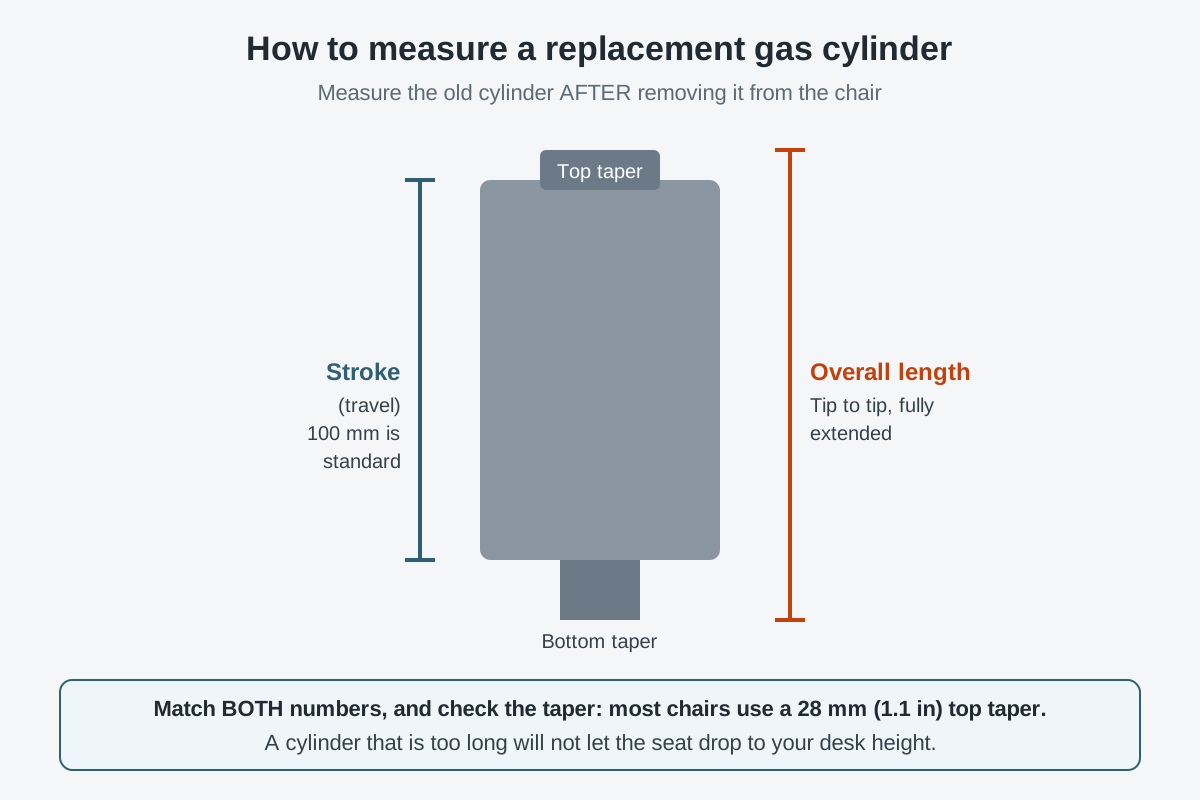
How do you measure for a replacement cylinder?
Two numbers matter, and both must match:
| Measurement | What to measure | Common value |
|---|---|---|
| Stroke (travel) | Piston travel, fully compressed to fully extended | 100 mm (4 in) is standard |
| Overall length | Tip to tip, piston fully extended | 230–350 mm by chair |
| Top taper diameter | Cone that plugs into the seat mechanism | 28 mm (1.1 in), most chairs |
| Bottom taper diameter | Cone that plugs into the 5-star base | 50 mm (2 in), most chairs |
Most standard chairs use a 100 mm stroke cylinder with a 28 mm top taper; heavy-duty chairs often use a longer stroke or higher weight rating, so check the old cylinder’s label before ordering. Too long a cylinder will not let the seat drop low enough for your desk, and the wrong taper will not seat properly.
Steps:
- Flip the chair upside down, remove the casters if they are in the way, and spray penetrating oil around both tapers — where the cylinder meets the seat mechanism and the base. Wait 10 minutes.
- Hold the base steady and strike the underside of the seat mechanism with the rubber mallet, rotating a quarter-turn between hits — the shock breaks the friction fit loose. Do not hit the cylinder itself.
- Once the mechanism lifts off, grip the cylinder with the pipe wrench and twist it out of the base. If it will not budge, add more oil and tap the base around the taper.
- Push the new cylinder into the base taper until it seats, then press the seat mechanism onto the top taper — no bolts needed, the tapers are self-locking friction fits.
- Flip the chair upright, sit in it, and cycle the height lever a few times — the new cylinder should lift smoothly and hold its height with no creep.
If the old cylinder refuses to separate after 15 minutes of tapping, stop and take the chair to a furniture repair shop — forcing it risks cracking the base. Replacement cylinders are widely sold, and the cylinder from a cheap donor chair often fits, since most manufacturers use the same standard tapers.
When should you replace the chair instead of repairing it?
A repair only makes sense when the rest of the chair is sound. Replace the chair when two or more of these are true: the cushion has collapsed, the backrest wobbles or its tilt lock no longer holds, the armrests are cracked or missing, the 5-star base is bent or a caster socket is split, or the upholstery is torn beyond cleaning. A $35 cylinder in a chair with a dead cushion is money spent twice.
The math is simple: a hose clamp or PVC sleeve costs under $8, so it is worth trying on almost any chair. A $25–40 cylinder is worth it when the chair originally cost $150 or more, or when you already know it fits you well. But if the chair cost under $100 new and is more than four years old, put the repair money toward a replacement instead. A new chair in the $150–300 range gives you a fresh cylinder, fresh foam, and a warranty — and our guide to the best ergonomic office chair under $300 compares the models that hold up best at that price. If the chair is otherwise fine but the wheels are the weak point, swapping the casters is a separate cheap fix — see our guide to the best replacement caster wheels for office chairs.
Which fix should you choose?
| Fix | Cost (Nov 2026) | Time | Height adjustment | Best for |
|---|---|---|---|---|
| Hose clamp | $3–5 | 10–15 min | Locked at one height | One user, one desk, quick fix |
| PVC pipe sleeve | $5–8 | 20–30 min | Locked at one height | One user, cleaner look |
| Replacement cylinder | $25–40 | 30–45 min | Fully restored | A good chair worth keeping |
| New chair | $150–300+ | None | Fully restored | Worn cushion, wobbly back, cracked base |
The hose clamp wins on speed and price, the PVC sleeve on looks, and the cylinder replacement on function — it is the only repair that restores full adjustment. The new chair wins when the cylinder is only one of several failing parts.
The quotable rule: spend $5 to fix a good chair, $35 to restore a great one, and $200 to replace one that is failing in more than one place.
Frequently asked questions
Why does my office chair keep sinking?
Your chair keeps sinking because the gas cylinder seal has worn out and nitrogen leaks past the piston whenever you sit down. The cylinder is the only part that holds the seat up, so a failed seal means a slow, steady drop.
Can you fix a sinking office chair without buying parts?
Yes. If you have a hose clamp and a screwdriver at home, the clamp fix costs nothing extra and takes about 15 minutes — tighten the clamp on the piston rod just under the seat mechanism.
How long does a hose clamp fix last?
A hose clamp fix can last for years — the clamp is a solid steel ring with nothing to wear out. It only fails if it loosens, so check the tightness every few months.
How much does it cost to replace an office chair cylinder?
A standard replacement gas cylinder costs $25–40 as of November 2026, and the swap takes 30–45 minutes with a mallet and a pipe wrench. A repair shop typically charges $50–80 including the part.
Is it safe to fix a sinking office chair yourself?
Yes, all four fixes here are safe for a DIY repair, as long as you never drill, cut, or puncture the gas cylinder — it is pressurized, and opening it can release that pressure violently. Work with the chair flipped over and unloaded.
Should I replace the cylinder or buy a new chair?
Replace the cylinder if the seat, backrest, and base are still solid — a $25–40 part restores a chair that fits you. Buy a new chair if the cushion has collapsed, the backrest wobbles, or the base is cracked. If you do buy new, our guide on how to choose an ergonomic office chair covers the measurements that matter, and tall users should check the best office chairs for tall people.