How to Keep Your Home Office Warm in Winter
You can keep your home office warm in winter by sealing the drafts first, then heating the room with a small space heater, warming your hands with a heated desk pad, and keeping your feet off the cold floor. Most home offices need only two or three of these fixes, and the whole job usually costs under $100.
As an Amazon Associate I earn from qualifying purchases.
Quick wins — the 80/20 of a warm office: Seal the gap under your door and the gaps around your window. Put a small space heater beside your desk, not across the room. Add a heated desk pad for your hands and a rug or footrest for your feet.
Why is my home office colder than the rest of the house?
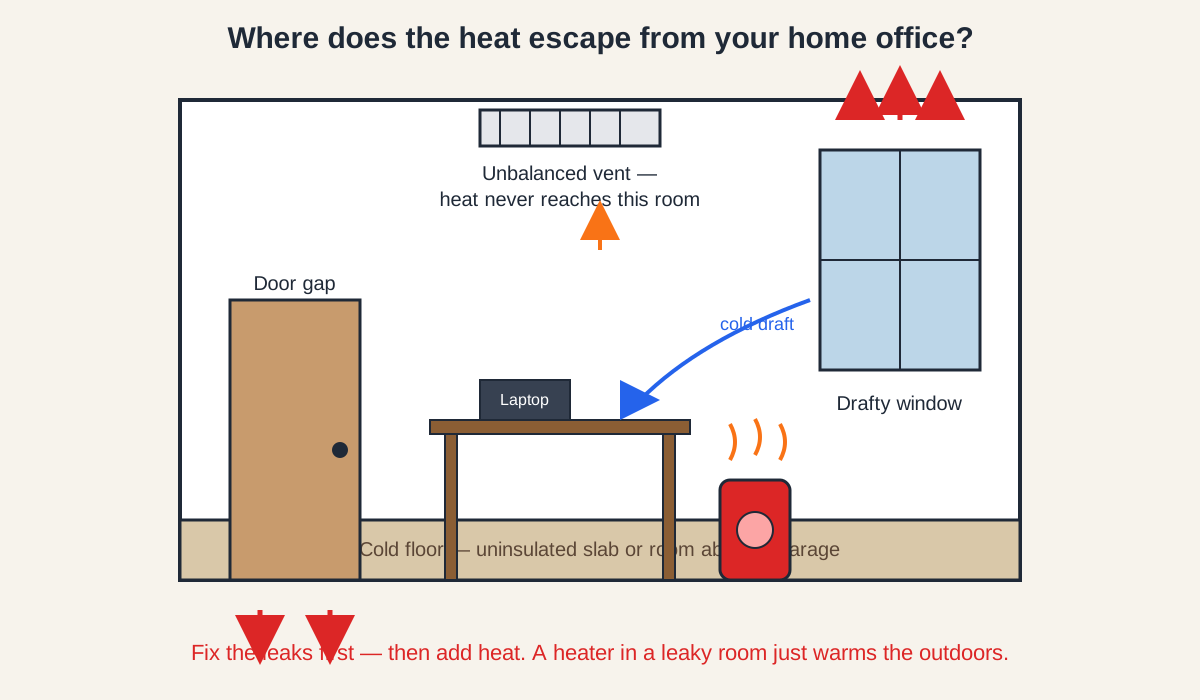
Home offices are usually the coldest room in the house because they are the rooms the heating system was never designed for. Spare bedrooms and rooms above garages sit at the end of the duct run, so they get the weakest airflow. They often have the most exterior wall area, the biggest windows, and the thinnest insulation — and one person sitting still generates almost no body heat.
The result is a room that can sit 5–10°F colder than the hallway outside it, even while the rest of the house feels fine. Raising the whole-house thermostat to fix one room wastes energy heating empty bedrooms and still leaves your office drafty. The fix is to treat the office as its own climate zone: stop the cold air coming in, then heat only the space you actually sit in.
A desk fan is worth considering — our guide covers the best options.
How do you stop drafts without spending much?
Drafts are the first fix: they are the cheapest, and they make every other fix work better — a space heater in a leaky room mostly warms the outdoors. Find your drafts with a 10-minute test: on a cold, windy day, hold a thin tissue near the door frame, the window frame, and any wall outlets. Where the tissue wavers, cold air is getting in.
- Seal the gap under the door. Slide a two-sided foam draft stopper under the door — the kind that hugs both faces and moves with the door. The Everlasting Comfort 2-Sided Door Draft Stopper fits 30- to 36-inch doors, needs no tools, and typically sells for $16–$20 as of October 2026. A 1/8-inch gap under a standard 36-inch door is about 4.5 square inches — roughly the size of a deck of cards — and can leak more cold air than the entire wall beside it.
- Weatherstrip the window frame. Press self-adhesive foam weatherstripping tape into the gaps around the sash. A roll costs about $5–$10 and covers one window. Test it with a sheet of paper: if the paper slides out easily when the window is closed, that spot still leaks.
- Add window film for single-pane glass. Shrink-wrap window film costs about $10–$15 for a kit covering several windows: tape it to the frame and shrink it tight with a hair dryer. It adds an insulating air layer and stops the cold radiating off the glass.
- Hang heavy curtains. Lined blackout curtains that extend past the frame and pool slightly on the floor cut both drafts and radiant heat loss. A pair costs $25–$40. Close them at dusk; open them on sunny mornings for free solar heat.
- Seal the outlets on exterior walls. Foam outlet gaskets cost about $5 for a pack and install behind the cover plate in two minutes with the power off at the breaker.
Do the door and window first, then re-test with the tissue. Most people feel the difference the same evening.
What is the best way to heat a small home office?
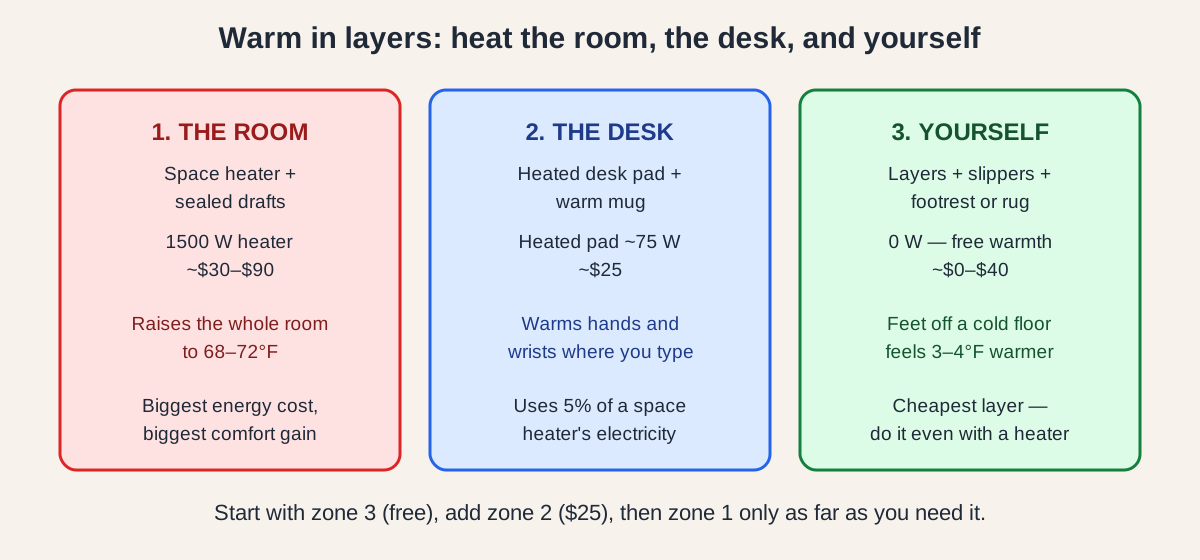
Once the drafts are sealed, a small space heater is the right tool for a room you occupy alone: heating one 100–150-square-foot office with a 1,500-watt heater costs far less than raising the whole house by 5 degrees, and the thermostat keeps the temperature steady.
The honest rule is simple: any 1,500-watt heater puts out the same amount of heat — about 5,100 BTU per hour. What you are paying for is how quietly and evenly it delivers that heat. For a home office, quiet matters more than raw power: a fan blasting at 50 decibels will ruin your video calls.
| Heater | Type | Noise | Best for | Price (Oct 2026) |
|---|---|---|---|---|
| Dreo Solaris Max 30″ (DR-HSH008) | Ceramic tower, 1,500 W | 25 dB | Larger offices, quiet calls | ~$90 |
| Dreo Solaris Slim H3 | Ceramic tower, 1,500 W | 37.5 dB | Typical 10×12 ft office | $74.99 |
| Lasko 754200 | Ceramic, 1,500 W | ~45 dB | Budget desktop heat | ~$30 |
| Vornado VH200 | Vortex fan, 1,500 W | ~45 dB | Even heat across the room | ~$70–$90 |
The Dreo Solaris Max 30-inch tower heater is the pick if your office is large or your calls are constant: at 25 dB it is quieter than a whisper, it oscillates 120 degrees, and its thermostat adjusts in 1-degree steps from 41 to 95°F. Dreo lists it at $89.99 as of October 2026. For a standard 10-by-12-foot office, the smaller Dreo Solaris Slim H3 at $74.99 does the same job at 37.5 dB — still quiet enough for calls. Our best space heater for a home office guide compares these models in detail, including safety features and running costs.
Place the heater beside your desk, about 3 feet from you, pointed at your legs — not across the room or under the desk. Keep 3 feet of clearance, never use an extension cord or power strip, and never leave it running in an empty room.
Running costs are smaller than most people fear. A 1,500-watt heater uses 1.5 kWh per hour at full power, but a thermostat-controlled heater cycles on and off — in a sealed office it may run only half the time. At roughly 17 cents per kWh, the US average residential rate, that is about 13 cents per hour, or roughly $1 a day for an 8-hour workday.
How do you keep your hands and feet warm at your desk?
Cold hands and cold feet are the two complaints that survive even after the room is warm, because sitting still slows circulation. The fix is to heat the surfaces you touch, not just the air.
Your hands. The cheapest effective upgrade is a heated desk pad — a thin leather mat, about 31.5 by 13 inches, that sits under your keyboard and mouse and warms to about 100–120°F. The Tulpock heated desk pad has three heat levels, a 4-hour auto shut-off, and typically sells for around $25 as of October 2026. It draws about 75 watts — roughly 5% of a space heater’s electricity — and warms your wrists and palms exactly where cold typing hurts most.
Your feet. Cold feet are usually a floor problem, not an air problem. A bare wood or tile floor can sit 10–15°F colder than the air above it, and your feet rest on it for eight hours. Three fixes, in order of cost:
- Wear warm slippers. Wool or shearling slippers with a thick sole cost $20–$40 and are the best dollar-for-dollar fix for cold feet — the sole insulating you from the floor matters more than the sock.
- Get your feet off the floor. A footrest lifts your feet onto an insulated surface and improves your posture. Our best footrest for under your desk guide covers adjustable options from about $25.
- Lay down a rug. A thick rug with a dense pad insulates the floor and cuts echo and footfall noise, so it pulls double duty. Our best office rug for a home office guide covers sizes that work under a desk chair.
Your body. Dress in layers, starting with a merino wool base layer under a sweater — it traps warm air against your skin better than one thick hoodie.
What temperature should a home office be in winter?
The comfortable range for focused work is 68–72°F (20–22°C); OSHA recommends keeping indoor workplaces between 68 and 76°F. Most people focus best around 68–70°F — much warmer than 72°F makes people drowsy, and below 65°F fingers get stiff and typing slows.
Set the thermostat to 70°F and leave it there rather than cranking it to 85°F to “warm up faster” — a thermostat does not make a heater work faster, it only makes it run longer and overshoot. Give the room 20–30 minutes to warm up, and use the timer to start the heater before your workday.
Humidity matters as much as temperature. Winter air heated indoors can drop below 30% relative humidity, which dries out your skin, eyes, and throat and makes the room feel colder than the thermometer says. A small humidifier keeping the room at 30–50% humidity makes 68°F feel like 70°F.
How much does it cost to warm a home office?
Most people can get a clearly warmer office for under $100 and one afternoon (costs as of October 2026).
| Fix | Cost (as of Oct 2026) | Time to install | What it does |
|---|---|---|---|
| Door draft stopper | $16–$20 | 2 minutes | Seals the biggest gap |
| Weatherstripping (door + window) | $5–$10 | 20 minutes | Seals frame gaps |
| Window insulation film | $10–$15 | 30 minutes | Adds an air layer to glass |
| Heavy blackout curtains | $25–$40 | 15 minutes | Cuts drafts + radiant loss |
| Heated desk pad | ~$25 | 2 minutes | Warms hands while typing |
| Warm slippers + wool socks | $20–$40 | 0 minutes | Insulates feet from cold floor |
| Thick rug + pad | $40–$100 | 10 minutes | Insulates floor, cuts echo |
| Space heater (ceramic tower) | $30–$90 | 5 minutes | Heats the whole room |
The first three rows — draft stopper, weatherstripping, window film — cost under $45 combined and deliver most of the result, because they stop the cold from getting in. Add a heated desk pad and warm slippers, and most offices feel fine before you ever buy a heater. If you’re not in a hurry, Black Friday week (Nov 27–30) is when space heaters hit their yearly floor — our Black Friday home office deals guide tracks the discount bands to expect.
What should you do first this weekend?
Do it in this order, one step at a time, and test after each one:
- Saturday morning: find the drafts. Do the 10-minute tissue test at the door, window, and outlets, and write down which spot leaks most — that list is your shopping list.
- Saturday afternoon: seal them. Install the draft stopper, weatherstrip the door and window, and put film on any single-pane glass. Hang the curtains if you bought them.
- Sunday morning: warm the desk. Set up the heated desk pad, lay the rug, put the footrest in place, and dig out the warm slippers.
- Sunday afternoon: set up the heater. Place it beside your desk with 3 feet of clearance, set the thermostat to 70°F, and set the timer for 30 minutes before Monday’s first call.
- Monday: measure. Check the temperature at your desk at 9 a.m. and 3 p.m. If it holds 68–72°F and your hands and feet stay warm, you are done.
Most home offices get there with a sealed door, a heated desk pad, and a rug — no contractor and no heating bill shock.
Keeping a home office warm in winter — FAQ
What is the cheapest way to keep a home office warm in winter? A door draft stopper ($16–$20) plus foam weatherstripping ($5–$10) is the cheapest effective start, and it targets the biggest cold-air leak in most rooms.
What temperature should my home office be in winter? Aim for 68–72°F (20–22°C), with humidity at 30–50%: warm enough to keep your fingers nimble, cool enough not to make you drowsy.
Is it cheaper to heat one room with a space heater or the whole house? Heating one office with a 1,500-watt space heater costs roughly $1 a day for an 8-hour workday — far less than raising the whole house by 5 degrees.
Do heated desk pads actually work? Yes, for cold hands: a 75-watt heated pad warms your wrists and palms to about 100–120°F where you type, using roughly 5% of a space heater’s electricity.
Should I leave my space heater on overnight? No — turn it off when you leave the room and use the timer to restart it 30 minutes before your workday.
Why are my feet cold even when the room is warm? Your floor can sit 10–15°F colder than the air, so warm slippers, a rug, or a footrest that lifts your feet off the floor usually fixes cold feet faster than raising the room temperature.