
Best Balance Boards for Standing Desks (2026)
The best balance board for a standing desk is the FluidStance Level ($249): its gentle 360-degree tilt keeps your legs and core moving without pulling your attention away from work, and it supports up to 300 lbs. If that price stings, the FEZIBO mat board (about $70) and the StrongTek wooden board (about $37) cover the budget end, while the Whirly Board Wide ($190) suits active users who want a real workout between calls.
See our complete standing desk guide.
As an Amazon Associate I earn from qualifying purchases.
TL;DR — the verdict in 30 seconds: Buy the FluidStance Level ($249) for the best all-day desk board. Buy the FEZIBO mat board (about $70) for comfort on a budget. Buy the Whirly Board Wide ($190) for the toughest workout that still works at a desk. Buy the StrongTek ($37) to try the idea for the least money. Skip roller boards for desk work — they demand too much attention to type safely.
What is the best balance board for a standing desk?
A balance board turns static standing into active standing: instead of locking your knees, you stand on a slightly unstable surface that forces small, constant corrections from your ankles, calves, and core — less stiffness and fatigue over a long session.
The catch is that not every balance board belongs at a desk. Gym wobble and roller boards are designed to challenge you; at a desk, that challenge becomes a distraction, and a distraction becomes typos. The best desk boards keep the motion small — a few degrees of tilt — so you can stay on them for an hour while writing emails.
Here is how the six boards in this guide compare, with prices as of October 2026.
| Board | Price (Oct 2026) | Motion type | Weight limit | Best for |
|---|---|---|---|---|
| FluidStance Level | $249 | 360° tilt, 8° | 300 lbs | All-day desk work |
| Whirly Board Wide 360 | ~$190 | 360° spin + tilt | 400 lbs | Active users, athletes |
| UPLIFT Motion-X | $89 | 360° swivel, gentle | 250 lbs | UPLIFT desk owners |
| FEZIBO mat board | ~$70 | Rocker, 8.5° tilt | 320 lbs | Comfort + subtle movement |
| Gaiam Evolve | ~$61–$80 | Rocker, subtle | 250 lbs | First-time buyers |
| StrongTek Advanced | ~$37 | 360° wobble, cross base | 350 lbs | Budget, shared offices |
Which balance board should you buy?
FluidStance Level — best overall
The Level created the standing-desk balance board category, and it still sets the standard for all-day use. Its die-cast aluminum base curves in every direction, so the maple deck tilts up to 8 degrees in any direction — forward, back, side to side — with no single axis and no dead spot. That omnidirectional motion is the key difference from cheaper rocker boards: your ankles never settle, so the micro-movements never stop.
At 26.5 inches long, the deck fits a natural shoulder-width stance. FluidStance tests the Level to 300 lbs, backs it with a lifetime warranty, and builds it in the USA from maple and recycled aluminum. Independent testing by the Mayo Clinic and the University of Idaho backs the health claims — no other board in this guide has that research behind it.
The trade-offs are price and comfort. At $249, it costs more than some standing desks, and the hard maple deck can feel unforgiving on bare feet — budget another $30 for FluidStance’s UPmat foam pad if you plan to stand barefoot. The Level is sold direct from the maker’s own store, not through Amazon.
Buy it if: you stand at your desk for hours a day and want a board you will still use in five years.
Whirly Board Wide 360 — best for active users
The Whirly Board Wide is the most fun board in this guide and the most demanding. Three semi-spherical balance points under an 8-ply Canadian maple deck let it spin a full 360 degrees, tilt, and pivot all at once — closer to a surf or snowboard trainer than an office accessory. It holds 400 lbs, the highest capacity here, weighs just 6 lbs, and carries a lifetime replacement guarantee.
That freedom is exactly why it is not the top pick for everyone. The first few sessions take real practice, and the board is hard on bare feet over long stretches. It shines for people who already have decent balance and want desk time to double as training: surfers, snowboarders, and anyone rehabbing ankle stability will get more from it than from any gentle rocker board.
The Whirly Board Wide 360 sells for about $190 on Amazon as of October 2026.
Buy it if: you want a workout, not just a fidget — and you already have the balance to handle it.
UPLIFT Motion-X — best for UPLIFT desk owners
UPLIFT’s Motion-X is the safe, desk-first choice. Its 27-inch bamboo deck sits on an inverted-dome base that lets it swivel and rock gently in every direction while rubber bumpers limit the range of motion. You will never feel like you might fall off it, which is the point: UPLIFT designed it for people who need to keep typing, not for people who want a challenge.
The 15-year UPLIFT warranty is the longest coverage in this guide. The downsides are well documented: the hard bamboo top hurts bare feet unless you buy the optional comfort mat, the exposed screw heads can scuff hard floors, and the 250-lb weight limit is a hard ceiling — heavier users report cracking sounds. It also does not work well on carpet, since the dome needs a firm surface to pivot on.
The UPLIFT Motion-X Balance Board sells for $89 on Amazon as of October 2026. If you already own an UPLIFT desk, it is the most natural add-on; if you do not, the FEZIBO below offers similar gentle motion for less money.
Buy it if: you own an UPLIFT desk and want a matching, low-drama board with a 15-year warranty.
FEZIBO mat board — best for comfort
FEZIBO’s board is really two products in one: a wooden wobble board bonded to a cushioned anti-fatigue mat, and the most comfortable board in this guide. The high-density latex top deck has give underfoot, the 8.5-degree tilt keeps your calves working, and the massage bar molded into the middle stretches your foot arches while you stand. It supports up to 320 lbs and measures 20 by 13.9 inches — compact enough to slide under a desk when you want the floor back.
The trade-off is challenge: at 8.5 degrees of fixed-axis tilt, it is a gentle rocker, not a trainer. But for the actual job — making four hours of standing feel better than four hours of standing still — that gentleness is a feature, not a flaw.
The FEZIBO Standing Desk Mat Balance Board sells for about $63–$70 on Amazon as of October 2026, in Obsidian Black, Denim Blue, or Altostratus Gray.
Buy it if: your feet hurt before your balance gives out, and you want comfort first.
Gaiam Evolve — best first board
Gaiam’s Evolve is the most-bought balance board on Amazon for a reason: it is simple, cheap, and hard to get wrong. The 27-inch plastic deck rocks on a curved base with a honeycomb non-slip texture, and its ergonomic arch keeps your ankles neutral instead of letting them roll inward. At 6.5 lbs it is light enough to carry between rooms, and the 250-lb limit covers most users.
The honest caveat is quality. Long-term reviewers report that the Evolve’s range of motion is limited and the plastic can feel flexy under heavier users. It is a starter board, not a lifetime board. But as a first board, that is fine: it tells you whether you like standing on a moving surface before you spend $249 on a FluidStance.
The Gaiam Evolve Balance Board lists at $79.99 but sells for about $61–$80 on Amazon as of October 2026.
Buy it if: you have never used a balance board and want the cheapest low-risk way to find out if it is for you.
StrongTek Advanced — best budget pick
The StrongTek is the cheapest board in this guide and the most surprising. Its crossed hardwood base creates a genuine 360-degree wobble — not just a single-axis rock — in a compact 17.5-by-13.5-inch footprint, and the lauan plywood deck holds up to 350 lbs. Anti-slip strips nailed (not glued) to the base keep it from wandering across hard floors, and the board arrives fully assembled.
The small deck is both the strength and the weakness. It fits under any desk and in any closet, but taller users will find their heels hanging off the edges, and the wobble is livelier than the FEZIBO or Gaiam — beginners should hold the desk for the first few sessions. At this price, it is the best board for a shared office where several people want to try the idea without a purchasing meeting.
The StrongTek Professional Wooden Balance Board sells for about $37 on Amazon as of October 2026, with a 4.5-star average across thousands of reviews.
Buy it if: you want the most balance per dollar, or you are equipping a shared workspace.
How do the different balance board types work?
Balance boards for desks come in four shapes, and the shape decides how much attention the board demands.
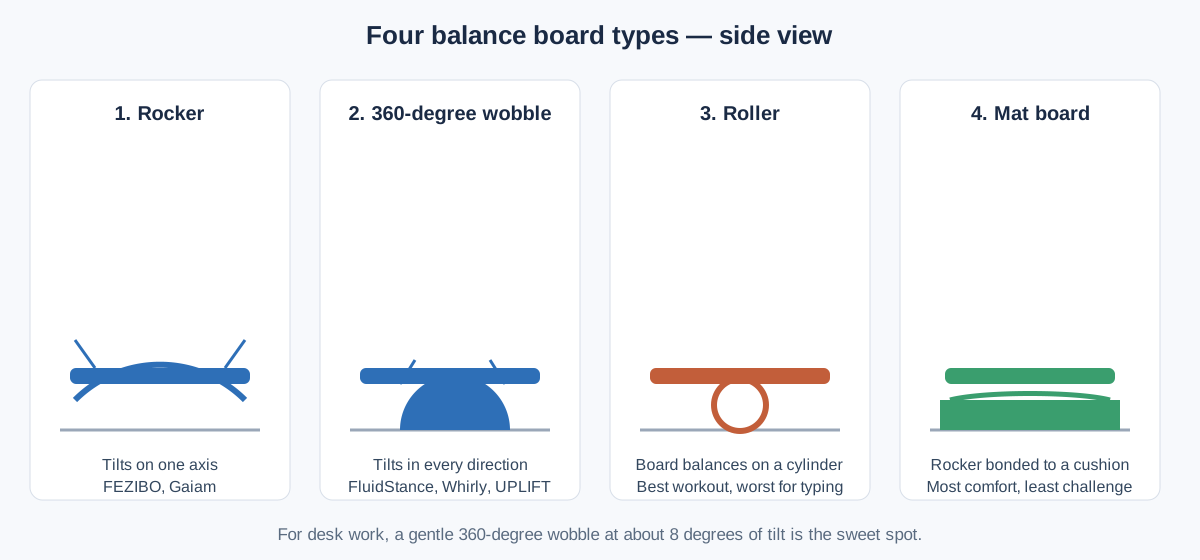
Rocker boards tilt on one axis, like a seesaw. FEZIBO and Gaiam use this design. The motion is predictable and easy to learn, which makes rockers the best starting point for desk work — but your body adapts quickly, and the workout plateaus.
360-degree wobble boards tilt in every direction. FluidStance, Whirly Board, UPLIFT, and StrongTek all use some version of this — a dome, a curved base, or three balance points that let the deck tip toward any edge. That is why the best desk boards use this design.
Roller boards balance a flat deck on a cylinder. They offer the best workout — and they are the worst choice for a desk, because they demand constant attention. Save them for fitness breaks, not for typing.
Mat boards bond a rocker to a cushioned mat, trading range of motion for comfort. They are the right call when foot fatigue, not balance training, is the problem.
How do you set up a balance board at a standing desk?
Getting the setup right matters more than picking the board. A board adds 2 to 3 inches of height under your feet, and if you do not compensate for it, your shoulders creep up and your wrists bend — the exact problems a standing desk is supposed to fix. (Source: OSHA)
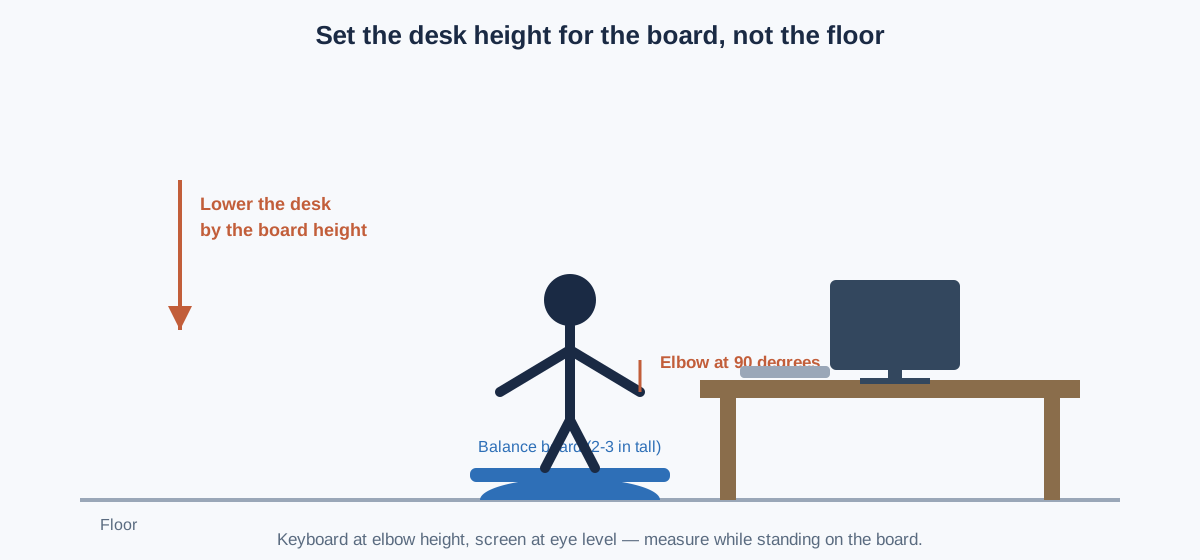
- Lower the desk by the board’s height. A FluidStance Level is 2.5 inches tall; a Whirly Board is 4 inches. If your desk cannot go low enough, pick a lower-profile board like the FEZIBO (2.2 inches) instead. Our best standing desk under $500 guide covers desks with the height range to make this adjustment easy.
- Put a mat under the board on hard floors. A thin anti-fatigue mat protects wood floors and stops the board from walking across the room. On carpet, skip the mat — most boards need a firm surface to pivot. Our best anti-fatigue mat for a standing desk guide compares mats that pair well with boards.
- Wear flat shoes or go barefoot — never heels. Flat trainers give the best grip; bare feet give the best feedback but need a cushioned board like the FEZIBO or a foam topper.
- Start with 15-minute sessions. Stand on the board for 15 minutes, step off for 45, and repeat. Most people can build to an hour on, an hour off within two weeks. If your calves burn in the first ten minutes, switch to a gentler rocker.
- Keep a chair nearby. Alternate standing on the board, standing on the floor, and sitting — the healthiest desk setup is the one that changes position most often. Some people pair a board with a walking pad for under-desk use instead of choosing between them.
When is the best time to buy a balance board?
Balance boards are small-ticket items, so the discounts are modest — but predictable. The FEZIBO and Gaiam boards go on sale most often, dropping $10–$20 during Prime Day (July) and Black Friday week; the Whirly Board and StrongTek see smaller cuts of $5–$15. FluidStance almost never discounts the Level.
If you’re not in a hurry, Black Friday week (Nov 27–30) is when balance boards and standing desks hit their yearly floor — our Black Friday standing desk deals guide tracks the discount bands to expect. Outside sale season, buy the budget board now to learn whether you like the motion, and upgrade to the FluidStance only after a month of daily use proves the habit sticks.
Balance boards for standing desks — FAQ
What is the best balance board for a standing desk? The FluidStance Level ($249) is the best all-around choice, with gentle 360-degree motion, a 300-lb capacity, and a lifetime warranty — while the FEZIBO mat board (about $70) is the best budget alternative.
Are balance boards good for standing desks? Yes, for most people: they add gentle movement that reduces leg stiffness and fatigue during long standing sessions.
How long should you stand on a balance board at work? Start with 15 minutes at a time and build toward an hour on, an hour off over two weeks, alternating with sitting and plain standing.
Do balance boards damage hardwood floors? They can scuff floors over time, so place a thin mat under the board on wood or laminate.
Can you use a balance board on carpet? Most boards work on low-pile carpet but lose range of motion on thick carpet, so a hard floor gives the best experience.