
How to Soundproof a Home Office (Without Remodeling)
You can soundproof a home office without remodeling by sealing the gaps sound travels through — the door, window frames, vents, and outlets — then adding soft surfaces to kill echo and masking whatever noise remains. Most of the difference comes from a $20 door seal and a few well-placed acoustic panels, not from tearing down walls.
As an Amazon Associate I earn from qualifying purchases.
Quick wins — the 80/20 of a quieter office: Seal the gap under your door first. Add weatherstripping around the door frame and window. Put acoustic panels on the wall behind your desk and the wall facing you. Lay down a rug and hang heavy curtains. Then mask what’s left with brown noise, and fix your mic so your calls sound clean even when the room isn’t silent.
Where does sound actually leak into a home office?
Sound behaves like water: it finds the gaps, not the walls. A standard interior wall blocks a reasonable amount of noise, but the holes in it — the door, the window, the vent, the outlets — let it pour straight through. A 1/8-inch gap under a standard 36-inch door leaves about 4.5 square inches of open area, roughly the size of a deck of cards, and can leak more noise than the entire wall beside it.
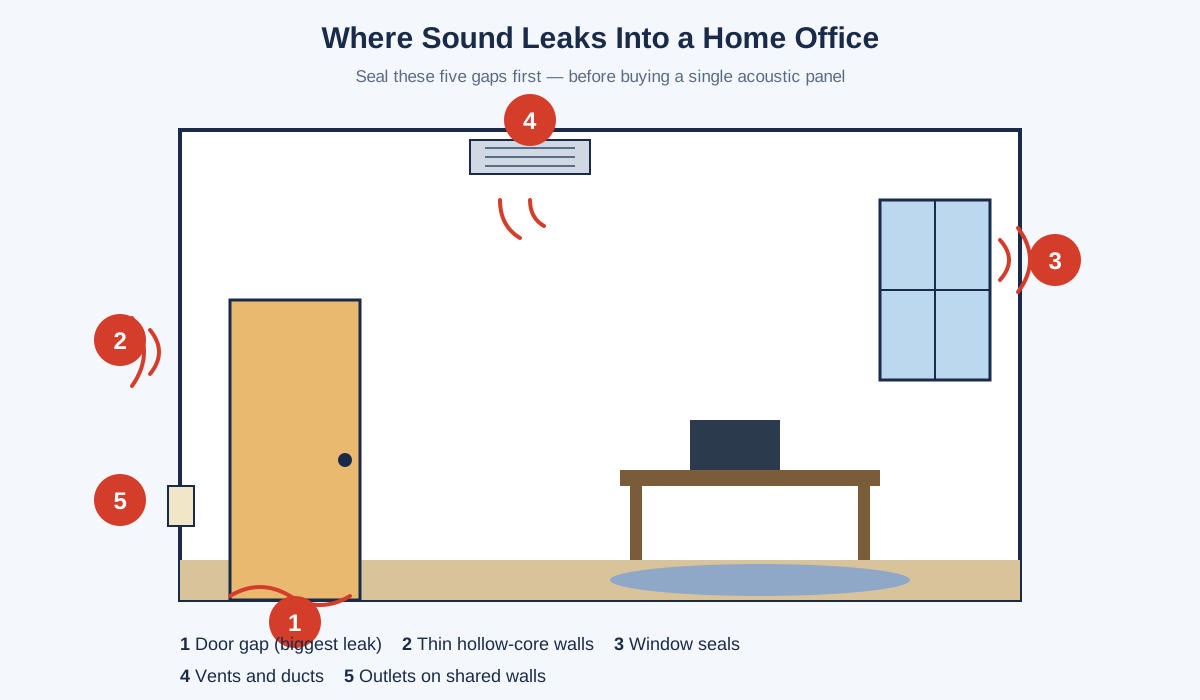
Before buying anything, find your leaks with a 10-minute test. Close the door, turn off music and fans, and walk the room slowly, listening at each of these five spots:
- The door. Hold your hand near the bottom gap while someone talks in the hallway. If you can feel air moving, sound is moving too.
- The window. Press your ear near the frame on a noisy day. Old or loose frames whistle and rattle.
- The vent. HVAC vents and return-air grilles are open pipes between rooms. Voices travel through ductwork surprisingly well.
- Outlets on shared walls. Electrical boxes cut holes straight through the drywall. Put your ear to one and you may hear the next room clearly.
- Thin walls. Knock on the wall. A hollow, drum-like sound means an empty stud cavity — the worst common case for blocking noise.
Write down which of the five is loudest. That list is your shopping list, in order.
An office rug is worth considering — our guide covers the best options.
How do you seal a door without remodeling?
The door is the first fix because it is usually the biggest leak and the cheapest to solve — about $20 and 15 minutes, with nothing permanent. A hollow-core interior door has a sound transmission class (STC) of roughly 20, which means it barely muffles conversation. You cannot turn a hollow door solid without replacing it, but you can close the gaps around it — and the gaps are where most of the sound gets in.
- Close the gap under the door. Slide a door draft stopper under it — the two-sided foam kind that hugs both faces of the door. The Everlasting Comfort 2-Sided Door Draft Stopper fits 30- to 36-inch doors, needs no tools, and typically sells for $16–$20 as of October 2026 (its price has bounced between about $15 and $24 through 2026). An adhesive door sweep stuck to the bottom of the door works too; cut it to width with scissors and press it on.
- Weatherstrip the frame. Stick self-adhesive foam weatherstripping tape around the door jamb so the door compresses it when closed. A roll costs about $5–$10 and covers one door. Close the door on a sheet of paper at several points: if the paper slides out easily, that spot still leaks.
- Mind the hinge side. A strip of foam tape on the stop molding — the thin lip the door closes against — seals the hinge-side gap without changing how the door swings.
- Add mass only if you still hear through the door itself. Hang a heavy moving blanket over the door on a tension rod. It looks odd, but mass is the only thing that blocks sound through a hollow door.
Where should acoustic panels go for the biggest effect?
Here is the honest truth about acoustic panels: they do not soundproof a room. They absorb echo inside the room. Sound from the hallway still comes through the wall and door; panels just stop it bouncing around once it is in. That distinction matters, because panels are the most-bought and most-misunderstood item in this whole project — and they are still worth buying, for the right job: they make your voice sound clearer on calls and make the room feel quieter by cutting flutter echo. Place them where sound first reflects:
- Behind your desk, at ear height. This is the wall your microphone “hears.” Panels here kill the slap-back echo that makes you sound like you are calling from a bathroom.
- On the wall facing you. The wall behind your webcam reflects your voice back at the mic a fraction of a second late. Four to six panels there clean up call audio noticeably.
- In the corners, if the room booms. Low-frequency rumble collects in corners. Stacking panels in two corners tames it better than spreading them thin across a whole wall.
A practical starter kit is one 12-pack of self-adhesive 12-by-12-by-2-inch panels — for example, the LIGHTDESIRE 12-pack acoustic foam panels (12″ x 12″ x 2″, self-adhesive polyester, black). Peel, stick, done — no drilling, which keeps landlords happy. Spread the pack across the two walls that matter rather than covering one wall completely; a checkerboard pattern absorbs nearly as well as full coverage. Our best acoustic panels for a home office guide compares thicker panels and renter-safe mounting in detail.
What about windows, vents, and thin walls?
Once the door is sealed, the next leaks are usually the window and the shared wall. None of these need a contractor either.
Windows and vents. The fix is layers. First, check the window seal: run a thin tissue along the frame on a windy day — if it moves, air (and sound) is getting in. Press adhesive foam weatherstripping into the gaps, the same tape you used on the door. Second, hang heavy lined blackout curtains that extend past the frame on all sides and pool slightly on the floor. They add mass and absorb the high-frequency hiss of traffic — though they will not block a truck’s bass. Third, if the window rattles, a strip of foam tape stops the rattle, which is often louder than the sound coming through the glass. For vents, never block an HVAC vent or return grille — restricted airflow can damage the system and, with gas appliances, create a safety problem. A magnetic vent cover over a supply vent you do not need during work hours is the safe middle ground.
Thin shared walls and floors. You cannot add a second layer of drywall without remodeling, but you can add mass in front of the wall. A tall, full bookshelf loaded with books against the shared wall is the classic trick — books are dense, irregular, and excellent at scattering sound. Seal the outlets on that wall with foam outlet gaskets (about $5 for a pack, installed behind the cover plate in two minutes with the power off at the breaker). Remember the rule: you are reducing echo and some transmission, not building a studio. If your office sits above a living room, a thick rug with a dense pad cuts footfall noise both ways.
How do you mask the noise you can’t block?
Some noise you cannot seal out — a neighbor’s dog, traffic, a housemate’s blender. The strategy flips: instead of blocking it, cover it with a steadier sound your brain can ignore. This is called sound masking.
Brown noise works better than white noise for most home offices: it is deeper and smoother, which masks low-frequency rumble like traffic and HVAC better, while white noise can sound hissy. Play it from a small speaker at a volume just loud enough that the intruding noise fades — about the level of a quiet fan. Free options include brown-noise tracks on YouTube and Spotify, or the built-in background sounds on iPhone and Android.
A fan does double duty: it masks noise and keeps the room cool. Avoid playing masking noise through laptop speakers at high volume — tinny speakers add their own harshness, and a $20 Bluetooth speaker sounds dramatically better.
The rule of thumb: masking should sit well below the noise you are trying to cover. If you have to shout over it, it is too loud. Measure both with a free phone app — the NIOSH Sound Level Meter app is the one acoustics professionals trust for rough readings — before and after each change.
How do you sound better on video calls when the room isn’t silent?
Here is the secret most soundproofing guides skip: your colleagues do not hear your room, they hear your microphone. A $30 fix on the mic side can matter more than $300 of panels.
- Get the mic close. Every doubling of distance from your mouth roughly halves the ratio of your voice to the room noise. A boom mic 2 inches from your mouth picks up far less room echo than a laptop mic 2 feet away. Our best headset for working from home guide covers boom-mic headsets that do this well.
- Use a cardioid pattern. Cardioid mics pick up sound from the front and reject it from the sides and rear. Point the back of the mic at the noisiest part of the room and it hears less of it.
- Turn on noise suppression. Zoom, Teams, and Google Meet all have built-in noise suppression; set it to high. Krisp and NVIDIA Broadcast go further, removing keyboard clatter and barking dogs in real time.
- Mute by default. The single most effective soundproofing tool in a meeting is the spacebar.
- Sit with your back to soft surfaces. A curtain, a bookshelf, or a closet full of clothes behind you absorbs the reflections that make you sound hollow. If video matters too, our best webcam for home office video calls guide covers cameras that pair well with a treated room.
Test it: record a 30-second clip before and after each change and listen back on headphones.
How much does it cost to soundproof a home office?
Most people can get a clearly quieter office for under $100 and one afternoon. The table ranks the fixes by impact per dollar, with costs as of October 2026.
| Fix | Cost (as of Oct 2026) | Install time | What it does | Renter-friendly? |
|---|---|---|---|---|
| Door draft stopper | $16–$20 | 2 minutes | Seals the biggest gap | Yes |
| Weatherstripping (door + window) | $5–$10 | 20 minutes | Seals frame gaps | Yes |
| Acoustic panels, 12-pack | $20–$40 | 30 minutes | Kills echo, cleans up calls | Yes (self-adhesive) |
| Heavy blackout curtains | $30–$60 | 15 minutes | Softens window noise + echo | Yes |
| Thick rug + pad | $40–$100 | 10 minutes | Cuts floor echo and footfall | Yes |
| Foam outlet gaskets | ~$5 | 10 minutes | Seals outlet holes | Yes |
| Brown-noise speaker/app | $0–$20 | 5 minutes | Masks noise you can’t block | Yes |
| Boom-mic headset | $30–$80 | 5 minutes | Fixes how you sound on calls | Yes |
The pattern is clear: the first three rows — door stopper, weatherstripping, panels — cost under $70 combined and deliver most of the result. A home office does not need studio silence; it needs the door sealed, the echo tamed, and the calls clean.
What should you do first this weekend?
Do it in this order, one step at a time, and test after each one:
- Saturday: find the leaks and seal the door. Do the 10-minute listening walk, then install the draft stopper and weatherstripping. This is the single biggest win and takes under half an hour.
- Sunday morning: treat the echo. Stick panels behind your desk and on the wall facing you, lay the rug, hang the curtains.
- Sunday afternoon: set up masking and the mic. Pick a brown-noise track, set your meeting app’s noise suppression to high, and record a test clip to confirm your calls sound clean.
- Monday: measure. Take a before-and-after reading with a phone sound meter app during your normal workday. A drop of even 5 decibels is clearly noticeable.
Most home offices get there with a sealed door, a dozen panels, and a rug — no remodeling, no contractor, no landlord permission needed.
Soundproofing a home office — FAQ
Can you really soundproof a home office without remodeling? Yes, for everyday noise: sealing gaps, adding soft surfaces, and masking what remains cuts most household noise noticeably, though it will not block loud bass or construction.
Do acoustic panels soundproof a room? No — panels absorb echo inside the room and improve call audio, but they do not block sound coming through walls or doors; sealing gaps is what blocks sound.
What is the cheapest way to soundproof a home office? A door draft stopper ($16–$20) plus a roll of foam weatherstripping ($5–$10) is the cheapest effective start, and it targets the biggest sound leak in most rooms.
How much do acoustic panels cost? A 12-pack of self-adhesive 2-inch panels typically costs $20–$40 as of October 2026, and one pack covers the two walls that matter most in a typical home office.
Does a rug help soundproof a room? Yes, for echo and footfall: a thick rug with a dense pad absorbs reflections off hard floors and muffles footsteps, though it does little for voices coming through walls.