Best Acoustic Panels for Home Offices (2026)
The best acoustic panels for a home office in 2026 are the TONOR Dual-Layer Thickened 4-Pack (about $100): large 47.2-by-23.6-inch peel-and-stick panels that cover a big wall area fast, which is exactly what tames the slap echo behind your desk on Zoom and Teams calls. Decorative felt panels like BUBOS work well when your wall is also your camera background.
As an Amazon Associate I earn from qualifying purchases.
Quick Verdict: Which Panel Should You Buy?
TONOR Dual-Layer Thickened 4-Pack (~$100) — best overall. Four 47.2″ x 23.6″ x 0.72″ self-adhesive panels cover ~31 sq ft, the most echo reduction per dollar here.
BUBOS Large 6-Pack (~$99) — best for walls on camera. Wood-grain/camel felt finish looks like decor, with a genuine NRC 0.95 rating.
AudioSilk 4-Pack Room Kit ($120) — best studio-grade felt. Four large 46″ x 23″ panels, NRC up to 0.91, from a specialist acoustic brand.
The rest of this guide explains how acoustic panels actually work, how many you need for a typical 10-by-12-foot home office, and exactly where to stick them so your colleagues hear your voice, not your room.
The Short Answer: What to Look for in Home Office Acoustic Panels
You are not building a recording studio. You are fixing one specific problem: your voice bounces off the hard wall behind you, comes back 20 to 50 milliseconds later, and your microphone picks up both the direct voice and the echo. That comb-filtered mess is why remote workers get told “you sound like you’re in a bathroom.”
Three specs actually matter for this job:
-
Size and coverage beat thickness for video calls. A handful of large polyester-fiber panels covering 20 to 30 percent of the wall behind you removes more audible echo than a full wall of thin foam tiles. That wall is the single most important surface: your voice travels straight at it and reflects straight back into your mic.
-
NRC (Noise Reduction Coefficient) measures absorption. NRC runs from 0 (perfect mirror) to 1.0 (perfect absorber). For home offices, 0.85 to 0.95 is the sweet spot — enough to absorb the mid and high frequencies where echo lives.
-
Peel-and-stick mounting matters for renters. Self-adhesive polyester panels go up in minutes and come down far more cleanly than glued foam wedges. Fiberglass and mineral-wool panels absorb slightly better but need frames or hardware, which overcomplicates a problem felt panels solve well enough.
Forget “soundproofing” as a marketing word: no $100 wall panel stops sound passing through a wall. Panels control reflections inside your room — and that is all you need for calls.
| Our pick | Best for | Price (as of Oct 2026) | Absorption | Pack size / coverage | Mounting |
|---|---|---|---|---|---|
| TONOR Dual-Layer Thickened 4-Pack | Best overall value | $99.99 | Dual-layer polyester, 0.72″ thick | 4 panels, ~31 sq ft | Full self-adhesive |
| BUBOS Large 6-Pack | Best for walls on camera | ~$99 | NRC 0.95, 230 kg/m³ felt | 6 panels, ~23 sq ft | Self-adhesive backing |
| AudioSilk 4-Pack Room Kit | Best studio-grade felt | $120 | NRC up to 0.91 | 4 large panels, 46″ x 23″ | Panel mount |
| TONOR Acoustic Wood Veneer 4-Pack | Best decorative wood look | Check listing | Dual-layer, OEKO-TEX certified | 4 panels, 47.2″ x 23.6″ | Self-adhesive |
What Do Acoustic Panels Actually Do? (Absorption vs. Soundproofing)
Acoustic panels absorb sound energy that would otherwise reflect off hard surfaces. When you speak, sound radiates in all directions: your mic captures your voice directly, but also the reflections arriving milliseconds later from walls, ceiling, and floor. Those late arrivals are echo and reverb, and they make speech harder to understand — for your colleagues and for meeting transcription and AI notetakers.
Soundproofing is a different discipline: it stops sound from leaving or entering a room and requires mass — double drywall, decoupled studs, sealed doors. A 0.4-inch felt panel cannot do that. Any listing promising “soundproof panels” for $50 is using the word as marketing, not physics.
The practical takeaway for WFH: you do not need to stop your neighbor hearing your standup. You need to stop your room repeating every word back into your mic. Absorption panels do exactly that.
How Many Panels Do I Need, and Where Do They Go?
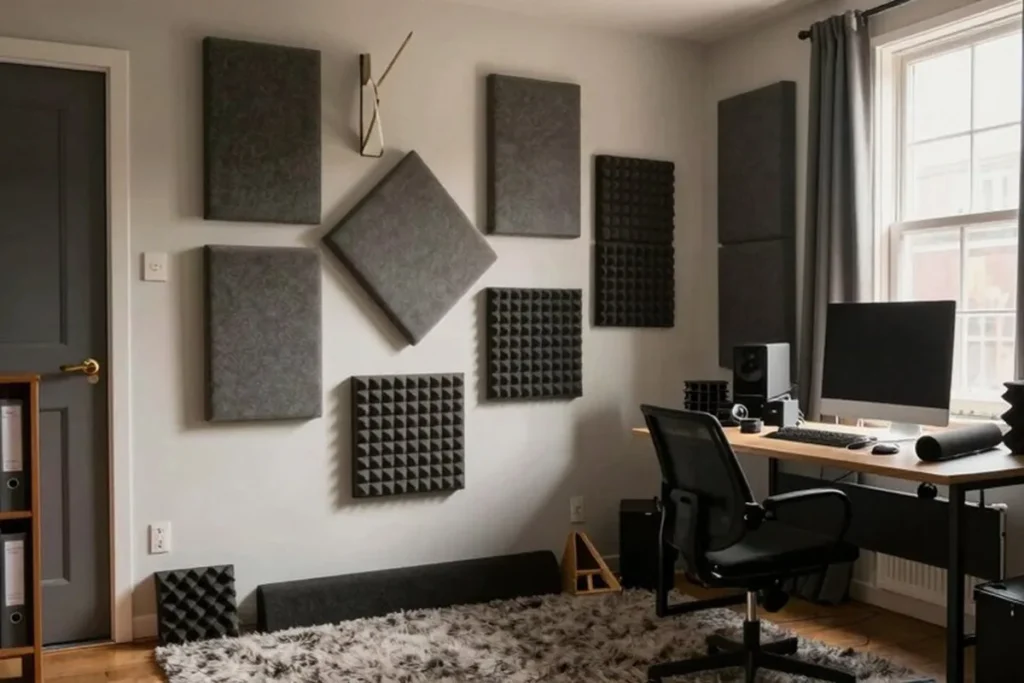
Start with the wall behind you — the wall your webcam faces away from and your voice faces toward. Cover 20 to 30 percent of it with panels at head height (about 3 to 6 feet off the floor), and you will hear a clear difference on your next call.
For a typical 10-by-12-foot bedroom office with 8-foot ceilings, that is roughly 20 to 30 square feet of coverage. One 4-pack of large 47.2-by-23.6-inch panels gets you there in a single purchase; six 23.6-inch squares do the same job with a more decorative grid.
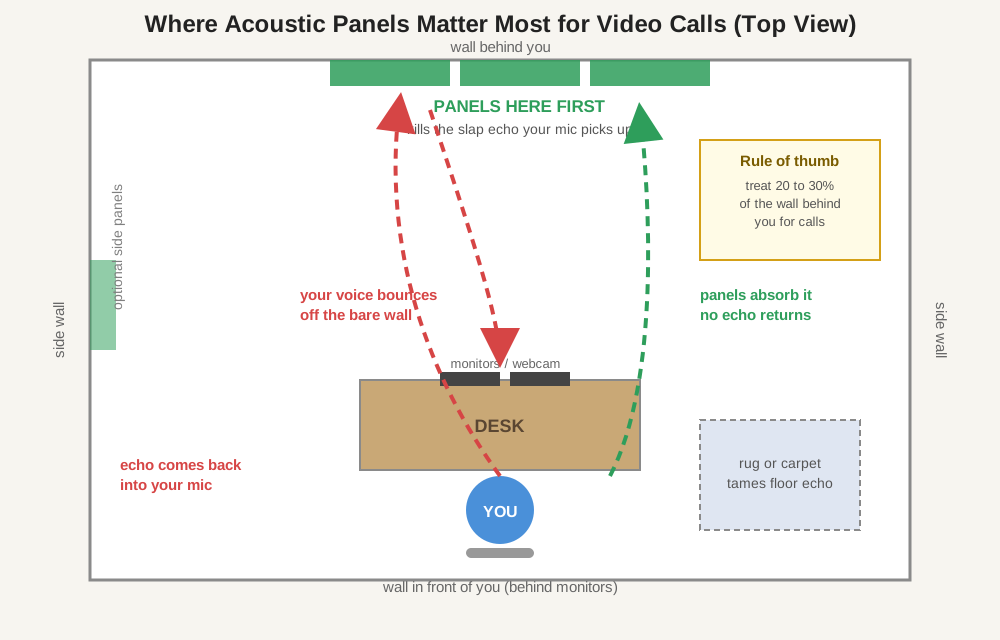
Placement priority, in order:
- The wall directly behind you — first reflection point for your voice. Treat this first and treat it generously.
- Side walls at the reflection points — sit at your desk, have someone slide a mirror along the side wall; wherever you can see your monitors in the mirror is a reflection point worth a panel.
- The ceiling above your desk — a ceiling cloud helps in rooms with hard floors, but a thick rug usually handles floor reflections more cheaply.
- The wall behind your monitors — lowest priority for calls, since your voice radiates away from it.
One more placement tip from real WFH setups: do not stack all panels in one tight cluster. Spreading the same coverage across the wall breaks up more reflection paths than a single dense block.
The 4 Best Acoustic Panels for Home Offices (2026)
1. TONOR Dual-Layer Thickened 4-Pack — Best Overall Value
The TONOR Dual-Layer set is the easiest recommendation here because it solves the coverage problem in one box. Each panel measures 47.2 by 23.6 by 0.72 inches — roughly four times a standard 12-inch tile — so four panels treat about 31 square feet. At $99.99 as of October 2026 (down from $109.99), that is roughly $3.20 per treated square foot, the best ratio on this list.
The dual-layer construction sandwiches a denser core behind a softer face layer, covering more of the speech frequency range than single-density felt of the same thickness. The full-coverage self-adhesive backing means panels sit flat on clean, dry painted drywall with no tools. The panels are OEKO-TEX Standard 100 certified with over 50 percent recycled content.
This is the pick when the wall behind you is mostly out of frame and you want maximum echo reduction per dollar. Check the current price of the TONOR Dual-Layer 4-Pack on Amazon.
Best for: renters and budget-focused remote workers who want big coverage fast. Watch out for: 0.72″ is still mid-frequency treatment — it will not tame subwoofer bass, but that is not your problem on calls.
2. BUBOS Large 6-Pack — Best for Walls That Appear on Camera
If your desk faces the room and your wall is your Zoom background, you need panels that look like decor. The BUBOS Large 6-Pack uses UV printing to give high-density polyester panels a realistic wood-grain or camel finish with vertical strip detailing — from three feet away they read as wall art, not acoustic treatment.
The specs are genuinely good: NRC 0.95, 230 kg/m³ density, 100 percent polyester fiber, B1-class flame retardant, zero formaldehyde or odor. Each panel is 23.6 by 23.6 by 0.4 inches, so the six-pack covers about 23 square feet, and panels trim easily with scissors or a utility knife to fit around shelves and outlets.
Expect about $99 for the six-pack as of October 2026 (the wood-grain finish listed at $98.99; other colors vary slightly). Check the current price of the BUBOS Large 6-Pack on Amazon.
Best for: anyone whose wall is visible on video calls. Watch out for: 0.4″ felt is thinner than the TONOR pick — spread all six across the wall rather than clustering four.
3. AudioSilk 4-Pack Room Kit — Best Studio-Grade Felt Panels
AudioSilk is a UK acoustic brand whose panels sit a step above generic Amazon felt. The 4-Pack Room Kit uses large 46-by-23-inch panels rated NRC up to 0.91, targeting the flutter echo that makes small rooms sound boxy. The matched “room kit” format takes the guesswork out of quantity: one kit treats the core reflection zone of a typical home office.
At $120 as of October 2026, you pay a premium for documented acoustic performance and a more refined finish — matte, consistent color, clean edges that suit a client-facing office. Mounting is more deliberate than peel-and-stick, so budget 30 minutes rather than five.
This is the pick if you record content or host client calls and want treatment from a specialist acoustic brand. Check the current price of the AudioSilk 4-Pack Room Kit on Amazon.
Best for: content creators and client-facing professionals. Watch out for: mounting takes more effort than self-adhesive packs.
4. TONOR Acoustic Wood Veneer 4-Pack — Best Decorative Wood Look
The second TONOR entry pairs the same dual-layer polyester core with a 3D wood-veneer face in finishes like Blackwood and Walnut Brown. At 47.2 by 23.6 by 0.74 inches, the four panels deliver the same fast coverage as our top pick, but they look like slatted wood paneling — a big upgrade when your office wall is always on camera for client calls.
Material credentials match the dual-layer line: OEKO-TEX Standard 100, Climate Pledge Friendly with at least 50 percent recycled content, and full self-adhesive backing for tool-free mounting. Pricing varies by finish — check the listing for the current price. Check the current price of the TONOR Wood Veneer 4-Pack on Amazon.
Best for: home offices where the treated wall is always on camera. Watch out for: the decorative face costs more per square foot than plain felt — you pay for the look.
Will Acoustic Panels Make My Zoom Calls Sound Better?
Yes — for echo and roominess, panels are the single most effective upgrade after a good headset. A headset mic sits inches from your mouth, which is why a quality headset like the ones in our best headset for working from home guide already rejects a lot of room noise. But headset mics still catch strong early reflections in very live rooms, and laptop or webcam mics pick up everything.
Think of it as a stack: a good mic gets you 70 percent of the way, and treating the wall behind you covers most of the remaining 30 percent. Less reverb coming back at you also means less listening fatigue on long meeting days.
One realistic expectation: panels will not fix a noisy environment. Barking dogs, street traffic, or a loud HVAC vent are noise entering the room, and absorption cannot block that. For noise, pair treatment with a headset that has strong passive isolation or active noise cancellation.
What Pairs Well With Acoustic Panels
Acoustic treatment is one layer of a call-quality setup. Two upgrades multiply its effect:
- A dedicated headset with a boom mic. Mic proximity plus treated walls is the combination that makes people ask “did you get a new mic?” — see our best headset for working from home roundup.
- A decent webcam. Once your audio sounds professional, the 720p laptop camera becomes the weak link — covered in our best webcam for home office video calls guide.
Refreshing the whole desk? Our desk accessories for productivity roundup covers the small upgrades that make a home office feel finished.
Frequently Asked Questions
Do acoustic panels work for Zoom calls?
Yes. They absorb the wall reflections your mic would otherwise pick up as echo — the main reason voices sound hollow on calls.
How many acoustic panels do I need for a home office?
For a typical 10-by-12-foot office, one pack of large panels (four 47-by-24-inch panels, or six 24-inch squares) on the wall behind you is enough for a clear difference.
Do acoustic panels soundproof a room?
No. They absorb reflections inside the room; they do not block sound passing through walls. True soundproofing needs mass and sealed construction.
Where should I put acoustic panels for video calls?
On the wall behind you first, at head height (3 to 6 feet), since your voice reflects off it straight back into your mic. Side walls are second priority.
Are foam wedges or felt panels better for a home office?
Felt (polyester fiber) panels: denser, odor-free, often self-adhesive, and they look like decor. Foam wedges work but are messier to mount and remove.
Will acoustic panels help with noisy neighbors or street noise?
No — that is sound transmission, not reflection. Panels cannot block outside noise; use a headset with good isolation or noise cancellation for that.
The Bottom Line
Sounding professional on calls takes 20 to 30 square feet of absorption on the wall behind you — not studio treatment. The TONOR Dual-Layer 4-Pack gets you there for about $100, the BUBOS 6-Pack does it while looking like decor, and AudioSilk is the step up for creators. Stick them up this weekend; Monday’s standup will sound like a different room.