The best office chair for short people in 2026 is the Steelcase Series 1 (~$449–499 as of October 2026): it drops to 16.5 inches with a 15.5–17.7-inch sliding seat depth, and the 400-lb build carries a 12-year warranty. Budget pick: the Furmax racing-style chair (under $100) — its seat goes down to 15.2 inches.
As an Amazon Associate I earn from qualifying purchases.
Best Office Chairs for Short People (2026)
TL;DR — The 6 best office chairs for short people:
- Best overall: Steelcase Series 1 (~$449–499) — 16.5″ min seat height, 15.5–17.7″ sliding seat depth, 400-lb capacity, 12-year warranty.
- Best ergonomic mid-range: HON Ignition 2.0 (~$408–481) — 17.25″ min seat height, seat glide, adjustable lumbar, HON full lifetime warranty.
- Best premium: Steelcase Amia (~$1,099) — 16–21″ seat range, 15.5–18.5″ adjustable depth, LiveLumbar, 12-year warranty.
- Best budget: Furmax Racing-Style Office Chair (under $100) — 15.2″ min seat height, the lowest here, 280-lb capacity.
- Best small-space: Hbada Ergonomic Mesh Office Chair (~$140–150) — compact frame, flip-up arms, 17.3″ min seat height.
- Best design pick: Herman Miller Sayl (~$750+, hermanmiller.com — no Amazon buy box) — 16″ min seat height, 16–18″ adjustable depth, 350-lb capacity, 12-year warranty.
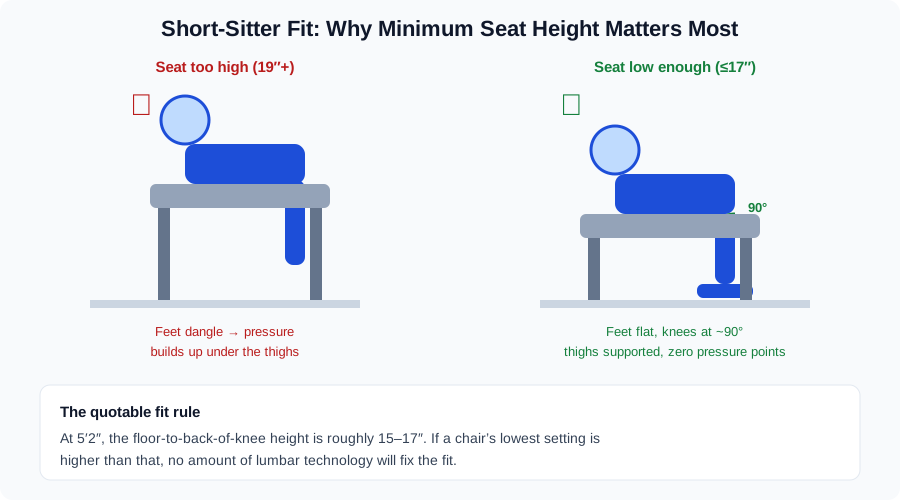
The quotable rule: minimum seat height is the spec short people should check first — a chair that only drops to 19 inches leaves a 5’2″ sitter’s feet dangling no matter how good the lumbar support is.
| Model | Min seat height | Seat depth | Backrest | Weight capacity | Price (Oct 2026) |
|---|---|---|---|---|---|
| Steelcase Series 1 | 16.5″ | 15.5–17.7″ (slider) | 21.5″ mesh back | 400 lbs | ~$449–499 |
| HON Ignition 2.0 | 17.25″ | Adjustable (seat glide) | Mid-back mesh | 300 lbs | ~$408–481 |
| Steelcase Amia | 16″ | 15.5–18.5″ (adj.) | 21.25″ + LiveLumbar | 300 lbs | ~$1,099 |
| Furmax Racing-Style | 15.2″ | 19.8″ (fixed) | 26.5″ high back | 280 lbs | Under $100 |
| Hbada Ergonomic Mesh (small) | 17.3″ | ~17″ (fixed) | Mid-back mesh | 250 lbs | ~$140–150 |
| Herman Miller Sayl | 16″ | 16–18″ (adj.) | Suspension mid-back | 350 lbs | ~$750+ (direct) |
What Should Short People Look for in an Office Chair?
Four numbers: minimum seat height of 17 inches or less, seat depth of 17 inches or less (or a slider), lumbar support that hits your real lumbar curve, and armrests that drop low enough. (Source: OSHA) (Source: Mayo Clinic)
Minimum seat height is the spec most listings bury. Standard chairs bottom out around 18–19 inches; at 5’2″, the floor-to-back-of-knee height is roughly 15–17 inches. If the chair can’t go lower than that, you face the short-sitter dilemma: sit back and your feet dangle, or scoot forward and lose all back support.
Seat depth is the second gate. A 19–20-inch pan on a 16-inch thigh means you can’t sit back far enough to use the backrest — you perch on the front half. For petite sitters, 17 inches or less works; a seat-depth slider is the precision tool. Slide the pan until two to three fingers fit between the seat edge and the back of your knee.
Finally, check lumbar placement and armrests. A lumbar pad built for a 5’10” torso lands between the shoulder blades on a 5’1″ frame — look for height-adjustable lumbar or a conforming back. Fixed arms set for average shoulders force shrugging; height-adjustable arms fix it.

Best Overall: Steelcase Series 1
The Steelcase Series 1 is the rare big-brand chair that genuinely goes low: 16.5-inch minimum seat height with a 15.5–17.7-inch sliding seat depth — the shallowest adjustable range here. Low enough for feet-flat sitting, shallow enough to sit all the way back: the exact short-sitter formula.
It’s a real commercial chair: 400-lb capacity, weight-activated recline that self-adjusts to lighter bodies (most tilt mechanisms are tuned for heavier sitters), height-adjustable lumbar, optional 4D arms, and a 12-year warranty.
Caveats: the seat runs firm for a week or two, and there’s no headrest without an add-on. At ~$449–499 on Amazon (as of October 2026), it’s the cheapest route to commercial-grade ergonomics that fits a small frame.
Best Ergonomic Mid-Range: HON Ignition 2.0
The HON Ignition 2.0 is the contract-furniture pick: HON sells more chairs to actual offices than almost any brand, and the Ignition 2.0 survives the least forgiving users — people who didn’t choose the chair and won’t baby it.
For short sitters, the numbers work: a 17.25-inch minimum seat height (per HON’s spec table), a seat glide for depth, height- and width-adjustable arms, and an adjustable lumbar panel on a breathable mesh back. Rated to 300 lbs with HON’s full lifetime warranty.
The trade-off is the minimum height: at 17.25 inches it’s the highest “low” here, so 5’0″-and-under sitters may still want a footrest. ~$408–481 on Amazon as of October 2026, with a 4.0-star average across roughly 1,600 ratings.
Best Premium: Steelcase Amia
The Steelcase Amia is the chair reviewers name when asked “what should most people buy” — and its range makes it a top premium fit for short users. The seat drops to 16 inches, depth adjusts 15.5–18.5 inches (the widest shallow range here), and the arms pull inward two inches per side — a detail short users notice, since most chairs leave arms sticking out sideways.
The standout is LiveLumbar: flexible contours flex as you move, so lumbar support lands right even on a shorter torso. Add the waterfall seat edge (less pressure behind the knees — the dangling-feet pain point), 4-way arms, and the 12-year warranty.
The caveat is price: ~$1,099 new on Amazon as of October 2026 — double the Series 1 for a better seat pad, better lumbar, and quieter refinement. Worth it for all-day sitters; overkill for a guest-room desk.
Best Budget: Furmax Racing-Style Office Chair
The Furmax racing-style office chair is the cheapest way to solve the actual problem: its seat adjusts from 15.2 to 18.3 inches (per the chair’s own user manual) — the lowest minimum height here, lower than chairs costing ten times more. For a 5’0″ sitter, that 15.2-inch floor is the difference between feet flat and feet dangling.
Set expectations: it’s a budget gaming-style chair — PU leather that will crack and peel after a couple of heavy-use years, 280-lb capacity, “good enough” ergonomics. But the low seat is real, and the high backrest with lumbar pillows supports a short torso better than most office chairs at triple the price.
At under $100 (as of October 2026), it’s the pick for dorm rooms, homework stations, and anyone who needs the fit fixed this week. Buy it for the seat height; upgrade to the Series 1 or HON when the budget allows.
Best Small-Space: Hbada Ergonomic Mesh Office Chair
The Hbada Ergonomic Mesh Office Chair (the brand’s classic small model) is built for tight spaces and smaller bodies: compact frame, flip-up armrests that let it slide fully under a desk, and a 44–54 cm (17.3–21.3″) seat range per the product manual.
It’s the lightest-duty chair here — 250-lb capacity, basic tilt, suited to light-to-moderate daily use rather than 10-hour marathons. But it has two features rare at this price: a vertically adjustable lumbar pad and a breathable mesh back.
At ~$140–150 (as of October 2026), it’s right for bedrooms, dorms, and small home offices. Note the 17.3-inch minimum: fine from 5’3″ up, but 5’1″-and-under should budget for a footrest or step up to the Furmax’s 15.2-inch floor.
Best Design Pick: Herman Miller Sayl
The Herman Miller Sayl earns its place on looks and engineering: Yves Béhar’s suspension-bridge back is the most recognizable silhouette in office seating, and the unframed elastomer back flexes where you push and holds where you don’t — which means the lumbar region conforms to a short torso instead of hitting it at the wrong height. The numbers fit: 16-inch minimum seat height, 16–18-inch adjustable seat depth, 350-lb capacity, and Herman Miller’s 12-year warranty.
Buying note: as of 2026 the Sayl sells through hermanmiller.com and authorized dealers — the old Amazon listing has no buy box, so there’s no Amazon link here. Retail starts around $750 (configured builds run $750–900).
Caveats: the seat runs firm, and you’re paying a design premium over the Series 1’s equivalent adjustability. Buy the Sayl if you want the chair to look like furniture; buy the Series 1 for the same fit at less.
How Low Should the Seat Go for Your Height?
Match the chair’s minimum seat height to your floor-to-back-of-knee measurement — add a footrest if the chair you love bottoms out an inch high.
Starting point, not a rule — inseam and shoes shift these by an inch either way:
| Your height | Target seat height | Target seat depth | Footrest? |
|---|---|---|---|
| 4’10” – 5’0″ | 14 – 16″ | 14 – 15″ | Usually |
| 5’1″ – 5’2″ | 15 – 17″ | 14 – 16″ | Often |
| 5’3″ – 5’4″ | 16 – 18″ | 15 – 16″ | Sometimes |
| 5’5″ – 5’6″ | 17 – 19″ | 15 – 17″ | Rarely |
The practical takeaway: at 5’2″ and under, only the Furmax (15.2″) and the Steelcase chairs (16–16.5″) go low enough for true feet-flat sitting; the HON (17.25″) and Hbada (17.3″) work from about 5’3″ up. Our office chairs for tall people covers the mirror-image problem.
Can I Just Use a Footrest With a Regular Chair?
Yes — a footrest is the cheapest fix, and for some sitters it’s all they need.
If your chair is otherwise comfortable but bottoms out an inch or two too high, a $30–40 footrest closes the gap: feet flat, knees at 90°, circulation restored. It also helps borderline chairs like the HON at 17.25 inches.
But a footrest can’t fix seat depth. If the pan is 19+ inches and fixed, you’ll still perch on the front edge — back unsupported, same slouch by 3 PM. Footrest first if the chair is otherwise good; new chair if the depth is wrong.
Does Seat Depth Matter More Than Seat Height?
For comfort, yes — depth is the spec that decides whether you actually use the backrest.
Height is the gate: if your feet can’t reach the floor, nothing else works. But once the height is close, depth decides the posture. A deep fixed seat on a short sitter means perching forward with the lumbar support inches behind your actual back. That’s why the seat-depth slider is worth paying for: the Series 1’s 15.5–17.7-inch range and the Amia’s 15.5–18.5-inch range dial the pan to your exact thigh length instead of the factory average.
Do Short People Need a Headrest on an Office Chair?
Usually not — and a misplaced headrest is worse than none.
Most fixed headrests are positioned for average-to-tall torsos; on a 5’1″ sitter they land at neck level and push the head forward. The chairs here mostly skip headrests for that reason (the Series 1 offers one as an add-on — skip it unless you’ve sat in one). If you recline a lot, look for a headrest with real vertical range. Our ergonomic chairs guide covers the general logic.
Frequently Asked Questions
What’s the best office chair for a 5’2″ person?
The Steelcase Series 1 (~$449–499) — its 16.5-inch minimum seat height and 15.5–17.7-inch sliding seat depth are sized for petite frames, backed by a 12-year warranty.
What seat height do I need if I’m 5 feet tall?
Look for a chair that drops to 15–16 inches. In this roundup only the Furmax (15.2″) goes that low; the Steelcase Series 1 (16.5″) and Amia (16″) get close, and a footrest closes any remaining gap.
Are gaming chairs good for short people?
Some are — the budget Furmax here has the lowest minimum seat height (15.2″). But most gaming chairs are built for larger frames with deep seats, so check the seat-height and depth numbers first.
Can a short person use a Herman Miller Aeron?
The Size A is built for smaller bodies with a 14.75-inch minimum seat height. It’s excellent and expensive (~$1,835); the Sayl (~$750+) is the more affordable small-frame option.
Do I need a footrest if my chair goes low enough?
No — if your feet are flat with knees at roughly 90 degrees, a footrest adds nothing. Buy one only when the chair bottoms out an inch or two above your ideal height.
How much should a good office chair for short people cost?
Under $100 buys the fit (Furmax) but not longevity; $140–150 gets the compact Hbada; $408–499 buys commercial-grade chairs that fit (HON, Series 1); $750–1,099 buys premium refinement (Sayl, Amia).
The Bottom Line
Buy the chair that goes low enough, not the one with the most features.
The Steelcase Series 1 (~$449–499) is the default answer: 16.5-inch minimum, sliding seat depth, 400-lb build. Tighter budget? The HON Ignition 2.0 (~$408–481). Least money? The Furmax (under $100). Premium? The Steelcase Amia (~$1,099). Small space? The Hbada (~$140–150). Design? The Sayl (~$750+, direct).
Sit all the way back, drop the seat until feet are flat with knees at ~90°, slide the depth until two fingers fit behind your knees. If you’re still shopping the category, our best ergonomic office chairs under $300 covers the budget end.
Pingback: Best Lumbar & Back Supports for Office Chairs (2026)