
Best Standing Desk Frames for DIY Builds (2026): 5 Frame-Only Kits Worth Your Desktop
The best standing desk frame for a DIY build in 2026 is the FlexiSpot E6 Max frame. Its dual-motor, 3-stage legs lift 330 pounds across a 24.4 to 50-inch range, and at about $330 it undercuts premium frames by hundreds while keeping a 10-year frame and motor warranty. Prices below are as of November 2026.
As an Amazon Associate I earn from qualifying purchases. This article also contains affiliate links to FlexiSpot, and we may earn a commission if you buy through them.
TL;DR — Our 2026 standing desk frame picks
- Best overall: FlexiSpot E6 Max frame — dual motor, 3-stage, 330 lb capacity, 24.4–50 in, ~$330
- Best premium: UPLIFT V2-Commercial C-Frame — 355 lb, 21.6–47.7 in, BIFMA-certified, 15-year warranty, ~$600–$700
- Best budget: ErGear EGESD3-1 frame — single motor, 176 lb, fits 39.4–63.3 in tops, ~$140
- Best single-motor upgrade: VIVO DESK-V102E — 3-stage, 24.5–50.3 in, touch memory keypad, ~$150–$200
- Best for wide tops: FEZIBO dual-motor frame — fits 43–59 in tops, 27.6–47.3 in, ~$180–$230
Method: we compared published specs, November 2026 street prices, and verified owner feedback — no hands-on lab testing.
Why buy a frame instead of a complete standing desk?
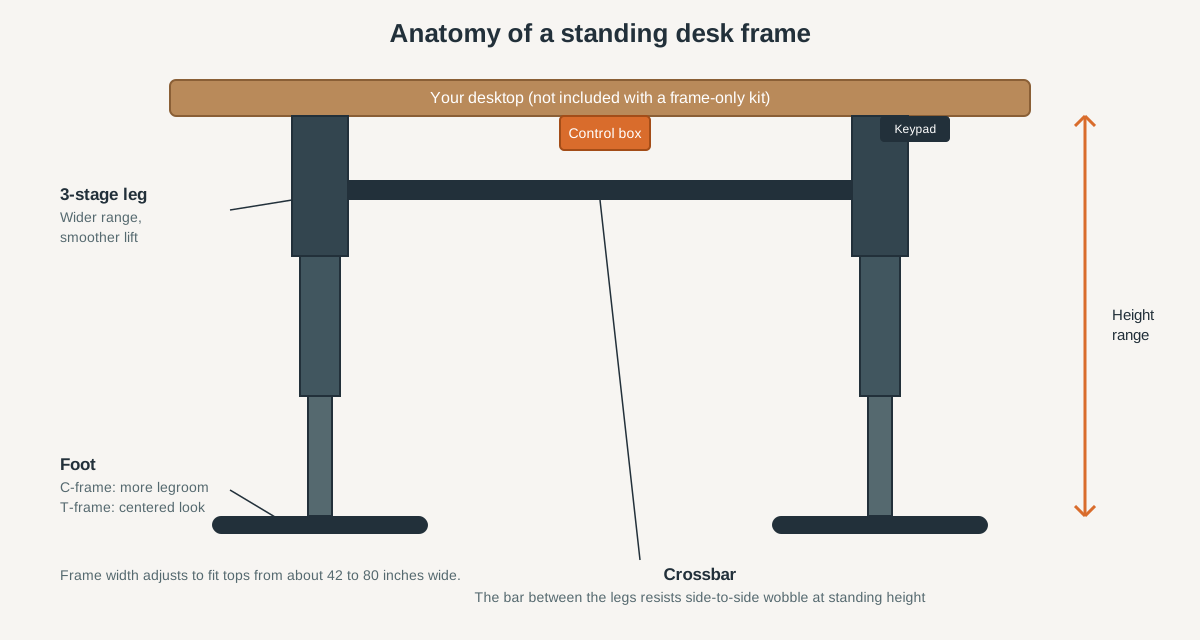
A frame-only kit is the legs, feet, crossbar, motors, control box, and keypad — everything except the desktop. You supply the top — a butcher-block slab, a reclaimed door, or a slab from the hardware store — and the frame bolts underneath.
The math is the main reason to go this route. A good complete standing desk runs $400 to $900, and much of that price is a desktop you may not want — usually a thin laminate slab. A frame costs $140 to $700, and a 60 by 30-inch butcher-block top runs about $150 to $250. The DIY route often lands at the same total or less, with a thicker, better-looking top.
The second reason is choice. Frame width adjusts to fit tops from about 42 to 80 inches wide, so the same frame works under a 48-inch top today and a 72-inch top later — and when a top gets scratched, you swap the top, not the whole desk.
If your top is under 48 inches, the compact end of that range matters more than the wide end — see our narrow standing desk guide for complete desks and frames that fit small rooms.
Here’s the takeaway in one quotable line: a standing desk frame buys you the lifting mechanism and lets you choose the desktop, so you pay for motors and steel instead of a laminate slab you didn’t pick.
One honest note: frame-only kits sell through Amazon in waves, so a link may land on an out-of-stock listing — the same frame is usually sold direct from the brand.
How do you pick a standing desk frame?
Five things matter more than the brand name on the box.
- 3-stage vs 2-stage legs. A 3-stage leg telescopes in three sections, giving a wider range — typically 24 to 50 inches versus 28 to 47 — and a lower seated minimum. If anyone using the desk is under 5’6″ or over 6’2″, 3-stage is worth paying for.
- Weight capacity. Capacity is rated including the desktop, so subtract your top’s weight first. A 1.5-inch butcher-block top at 60 by 30 inches weighs roughly 45–55 pounds. A 176-pound frame leaves about 120 pounds for monitors and gear; a 330-pound frame leaves room for a multi-monitor rig.
- Crossbar and stability. The crossbar is the horizontal bar between the two legs, and it is what resists side-to-side wobble at standing height. Frames with a fixed, bolted crossbar feel steadier than crossbar-free designs, especially above 45 inches.
- Desktop compatibility. Check three numbers before ordering: the frame’s width range against your top’s length, the minimum top thickness (most frames want at least 0.75 inches), and the screw length. Screws that are too long punch through the top surface — the most common DIY assembly mistake in owner reviews.
- Control box and keypad. A memory keypad with 3–4 presets is the feature owners mention most after a month of use: one tap returns the desk to your exact sitting and standing heights.
The 5 best standing desk frames for DIY builds in 2026
1. FlexiSpot E6 Max frame — Best overall standing desk frame
The E6 Max is the frame most DIY builders should buy first. Its dual motors drive 3-stage legs from 24.4 to 50 inches — the tallest maximum here, suiting users up to about 6’5″ — and the 330-pound capacity handles a heavy butcher-block top plus a dual-monitor setup. The motors run under 45 dB, quiet enough for a shared room.
The keypad carries four memory presets, and the frame ships with anti-collision protection and a cable-management tray. Warranty coverage is 10 years on the frame and motors with 2 years on electronics — the longest coverage at this price in the roundup.
Pricing as of November 2026: about $330 for the frame-only black listing, rated about 4.4 out of 5 by owners.
Best for: most DIY builds — the strongest capacity-per-dollar ratio here, with the tallest height range.
Check the FlexiSpot E6 Max frame price on Amazon
Also available direct from FlexiSpot.
2. UPLIFT V2-Commercial C-Frame — Best premium standing desk frame
The V2-Commercial is the frame to buy when the desk is a long-term investment. Its 3-stage, dual-motor legs run from 21.6 to 47.7 inches — the lowest seated minimum here, which matters for shorter users — and lift 355 pounds. The legs are 35 percent larger in cross-section than the standard V2’s, and the frame meets BIFMA X5.5 desk standards.
For roughly double the E6 Max’s price you get a 15-year warranty on frame, motors, and electronics; an advanced memory keypad with four presets and a digital height readout; a free wire-management tray; and a C-frame foot design with more legroom.
Pricing as of November 2026: roughly $600–$700 for the black C-frame listing, rated about 4.7 out of 5 by owners.
Best for: buyers who want the sturdiest frame available and a 15-year warranty, and who plan to keep the same base through several desktops.
Check the UPLIFT V2-Commercial C-Frame price on Amazon
3. ErGear EGESD3-1 frame — Best budget standing desk frame
The cheapest way to turn your own top into a sit-stand desk is the ErGear EGESD3-1, a frame-only kit that typically sells for about $140 as of November 2026 — less than half the E6 Max. It is a single-motor, 2-stage frame, so expect a slower lift and a narrower height range of about 28.3 to 46.5 inches, with a 176-pound capacity.
The frame fits tops from 39.4 to 63.3 inches wide, includes a memory keypad with four presets, and carries a 5-year warranty on the frame with 2 years on the motor and controller. For a single monitor, a laptop, and a light-to-medium top, 176 pounds is enough.
Pricing as of November 2026: $139.99 on Amazon, rated about 4.4 out of 5 by owners.
Best for: first DIY builds, light setups, and anyone who wants to try a standing desk without committing $300-plus to the frame.
Check the ErGear EGESD3-1 frame price on Amazon
4. VIVO DESK-V102E — Best single-motor frame with a touch keypad
The VIVO DESK-V102E is the single-motor frame for buyers who want 3-stage range without paying dual-motor prices. Its single motor drives 3-stage legs from 24.5 to 50.3 inches with a 176-pound capacity, and the frame adjusts to fit tops from about 38 to 63 inches wide.
The standout is the keypad: a touch-screen controller with memory presets and a sit-stand timer reminder. The frame is steel and aluminum, backed by a 3-year manufacturer’s warranty.
Pricing as of November 2026: roughly $150–$200, rated about 4.3 out of 5 by owners.
Best for: shorter and taller users on a budget who need the low 24.5-inch minimum and the high 50.3-inch maximum that only 3-stage legs deliver.
Check the VIVO DESK-V102E frame price on Amazon
5. FEZIBO dual-motor frame — Best frame for wide desktops
The FEZIBO dual-motor frame is the pick for big tops. It fits desktops from 43 to 59 inches wide — the widest span here — and its dual motors lift 176 pounds across a 27.6 to 47.3-inch range at under 50 dB. A cable-management rack is included in the box.
The trade-off is the height range: 27.6 inches at the bottom is high for shorter users. It suits a 55 to 59-inch top with a dual-monitor setup, where the wide stance and dual motors keep the lift even.
Pricing as of November 2026: roughly $180–$230, rated about 4.4 out of 5 by owners.
Best for: builders pairing the frame with a wide 55–59 inch top, where the extra width adjustment actually gets used.
Check the FEZIBO dual-motor frame price on Amazon
Quick comparison: all five standing desk frames side by side
| Frame | Motors / stages | Height range | Capacity | Top width fit | Typical price (Nov 2026) |
|---|---|---|---|---|---|
| FlexiSpot E6 Max | Dual / 3-stage | 24.4–50 in | 330 lb | ~43–71 in | ~$330 |
| UPLIFT V2-Commercial C-Frame | Dual / 3-stage | 21.6–47.7 in | 355 lb | ~42–72 in | ~$600–$700 |
| ErGear EGESD3-1 | Single / 2-stage | ~28.3–46.5 in | 176 lb | 39.4–63.3 in | ~$140 |
| VIVO DESK-V102E | Single / 3-stage | 24.5–50.3 in | 176 lb | ~38–63 in | ~$150–$200 |
| FEZIBO dual-motor | Dual / 2-stage | 27.6–47.3 in | 176 lb | 43–59 in | ~$180–$230 |
What desktop works with a frame-only kit?
Three details decide whether the result feels solid or wobbly.
First, thickness. Most frames want a top at least 0.75 inches thick so the mounting screws bite properly; 1 to 1.5 inches is the sweet spot. A 1.5-inch butcher-block top adds roughly 45–55 pounds at 60 by 30 inches — subtract that from the frame’s capacity first.
Second, material. Butcher block, solid wood, and plywood with a hardwood edge all work well. Hollow-core doors flex under a monitor arm’s clamp — add a reinforcement plate or pick a monitor arm with a grommet mount.
Third, screw length. Use the screws the frame ships with and pre-drill pilot holes. Screws that are too long punch through the top surface, and that mistake is not fixable with wood filler on a finished top.
Once the top is mounted, see our standing desk setup guide for elbow and monitor height — or our best standing desks under $500 if you’d rather skip the build entirely.
When should you buy a standing desk frame?
Frame prices still dip around the big sale weekends: the ErGear frame dropped to about $95 in June 2026, and the FlexiSpot E6 Max line has repeatedly gone on sale around Prime Day and Black Friday.
Time your purchase if you can. If you’re not in a hurry, Black Friday week (Nov 27–30) is when standing desk prices hit their yearly floor — our Black Friday standing desk deals guide tracks the discount bands to expect.
FAQ: standing desk frames for DIY builds
Is a frame-only standing desk cheaper than a complete desk?
Usually yes, if you source the top well. A $330 frame plus a $150–$250 butcher-block top lands around $480–$580 — and you can reuse the frame under a new top later.
What size desktop fits a standing desk frame?
Most two-leg frames adjust to fit tops from about 42 to 72 inches wide and 24 to 36 inches deep. Check the frame’s width range against your top before ordering.
Can I put a heavy solid-wood top on a 176-pound frame?
Yes, with room to spare in most cases. A 60 by 30-inch butcher-block top weighs about 45–55 pounds, leaving roughly 120 pounds for monitors and gear on a 176-pound frame.
The bottom line
For most DIY builds, the FlexiSpot E6 Max frame is the sweet spot: 330 pounds of capacity, the tallest height range here, and a 10-year warranty for about $330. The UPLIFT V2-Commercial is the premium pick with a 15-year warranty. On a tight budget, the ErGear EGESD3-1 turns your own top into a sit-stand desk for about $140, the VIVO DESK-V102E adds 3-stage range and a touch keypad, and the FEZIBO dual-motor frame suits wide 55–59 inch tops. Whichever frame you choose, spend the savings on the top — a thick, heavy desktop is what makes a DIY standing desk feel expensive.