
Best Drafting Chairs for Standing Desks (2026)
The best drafting chair for a standing desk is one whose seat adjusts high enough to leave 10–12 inches between the seat and your desktop, with a footring to support your legs — for most sit-stand desks set at 36–42 inches, that means a seat range of roughly 24–30 inches. The BestOffice Tall Drafting Chair is the best budget pick under $70, the Boss B16245-BK is the best all-round vinyl stool, and the Modway Thrive is the sturdiest mesh option at a 330-pound capacity.
See our ergonomic chairs guide for help choosing the right chair. See our complete standing desk guide.
As an Amazon Associate I earn from qualifying purchases.
TL;DR — the shortlist: On a tight budget, buy the BestOffice (under $70, 250-lb limit, seat to about 28 inches). For daily all-day use, the Boss B16245-BK (about $120–$140, 275-lb limit, seat 28–34 inches, 4-inch foam seat) is the safest bet. For a breathable mesh back with the highest weight rating here, the Modway Thrive (about $150–$170, 330-lb limit) wins. Prices as of October 2026.
What is a drafting chair, and why does a standing desk need one?
A drafting chair is a tall office chair with an extra-long gas cylinder and a footring, built to seat you at a counter-height surface. A regular office chair tops out at a seat height of about 19–21 inches, which works for a standard 29–30-inch desk. A standing desk used while seated usually sits at 36–42 inches — and a regular chair leaves you hunched over the keyboard with your feet dangling.
The footring is the part most people underestimate. Without somewhere to rest your feet, your legs hang unsupported, which cuts circulation and leaves you shifting in the seat every few minutes. A good drafting chair solves both problems at once: the tall cylinder gets you up to the desk, and the ring gives your feet a place to live.
How do you pick the right seat height for your desk?
Measure first, shop second. Measure from the floor to the underside of the desktop at the height you actually work at, then subtract 10–12 inches — that is your target seat height. Your thighs should be roughly parallel to the floor, your elbows at about 90 degrees, and your feet resting flat on the footring.
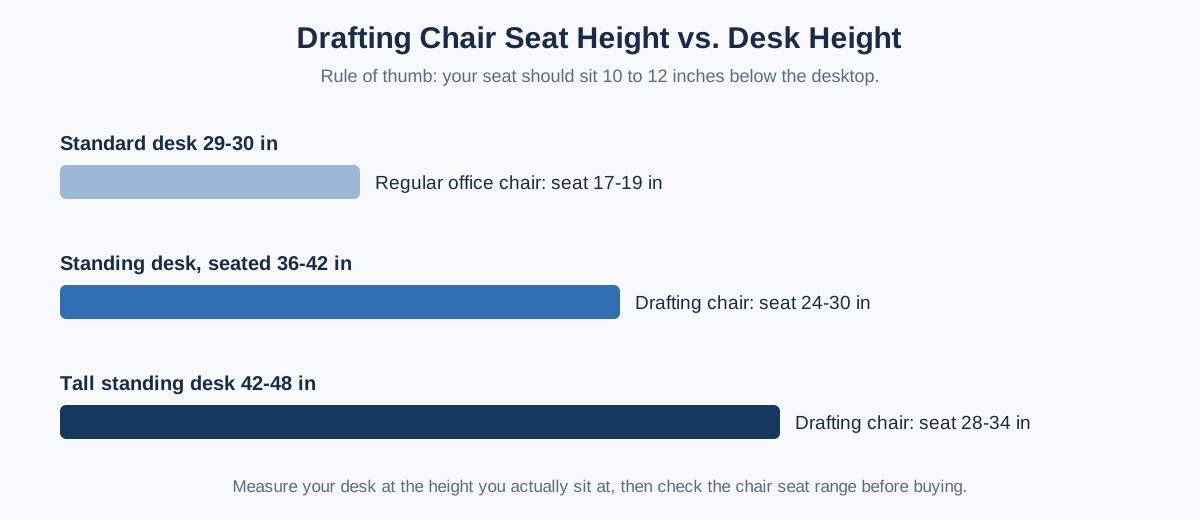
A desk at 36–40 inches pairs with a seat at 24–28 inches; a desk at 42–48 inches needs a seat at 28–34 inches. Buy a chair whose range covers your number with room to spare on both ends — a cylinder at its maximum extension is less stable than one in the middle of its travel.
What should you check before buying a drafting chair?
Four specs decide whether a drafting chair will work for you, and they matter more than the brand name on the box.
- Seat-height range. The single most important number. Match it to your desk using the 10–12-inch rule above, and remember that the advertised maximum is usually measured to the top of the seat cushion.
- Weight rating. Most drafting chairs in this guide are rated for 250–330 pounds. The rating is set by the gas cylinder class, so a chair rated at 250 pounds will feel wobbly sooner under a heavier user than one rated at 300-plus.
- Footring adjustability. A fixed footring is fine if it lands at your shin height; an adjustable ring is better, because it lets you set the ring where your feet actually fall.
- Backrest and armrests. A mid-back or high-back mesh back keeps you cool and supports your lower back during long sessions. Flip-up armrests are worth having if you slide the chair under the desk when you stand — fixed arms catch on the desktop edge.
One more check: casters. Dual-wheel hooded casters roll smoothly on both hardwood and low-pile carpet and resist hair and dust buildup.
The 5 best drafting chairs for standing desks
Every chair below is a real product sold on Amazon, with its seat range, weight limit, and price as of October 2026.
| Chair | Price (Oct 2026) | Seat height | Weight limit | Best for |
|---|---|---|---|---|
| BestOffice Tall Drafting Chair | Under $70 | ~22–28 in | 250 lb | Tight budgets |
| Boss B16245-BK | ~$120–$140 | 28–34 in | 275 lb | Daily all-day use |
| Modway Thrive | ~$150–$170 | Tall cylinder | 330 lb | Heaviest users, mesh back |
| COSTWAY Drafting Chair | ~$85–$100 | 22.5–30.5 in | 300 lb | Flip-up arms |
| Union & Scale Drafting Stool | ~$150–$200 | High-back tall | 275 lb | Big-box brand, high back |
1. BestOffice Tall Drafting Chair — best budget pick
The BestOffice is the cheapest drafting chair worth buying, and the sales volume backs that up: roughly 1,900 buyer reviews averaging 4.2 stars. The mid-back mesh backrest keeps you cool, the seat adjusts from about 22 to 28 inches on a single lever, and the 360-degree swivel and rolling casters work smoothly on hardwood and low-pile carpet.
The compromises are what you would expect under $70. The backrest is fixed — no tilt or height adjustment — and the 15-inch-wide back runs narrow for broader users. The seat-height range also tops out lower than the other chairs here, so it suits desks up to about 40 inches. For a spare chair, a home office on a budget, or two-to-three-hour daily sessions, it is hard to beat. The BestOffice Tall Drafting Chair is the pick if price is the priority.
2. Boss Office Products B16245-BK — best for daily all-day use
The Boss B16245-BK has been the default drafting stool in offices and workshops for years, and it shows in the spec sheet: a 4-inch thick molded foam seat in antimicrobial vinyl, a plush back cushion, a 20-inch chrome footring, and a 275-pound weight limit backed by a 6-year limited warranty. The seat adjusts from 28 to 34 inches, which covers desks up to about 46 inches — the tallest range in this guide.
The vinyl seat wipes clean with a damp cloth, which matters if the chair doubles as a workshop or craft stool, and the hooded double-wheel casters roll smoothly without picking up hair and dust. The tradeoff is breathability: black vinyl is not as cool as mesh on a hot afternoon, and the 16-by-16-inch seat is compact for larger users. If you want one chair to buy once and forget about, the Boss B16245-BK Drafting Stool is it. If you are furnishing the whole setup on a budget, our best standing desk under $500 guide pairs well with this chair.
3. Modway Thrive Drafting Chair — sturdiest mesh option
The Modway Thrive is the heavy-duty pick: a 330-pound (150 kg) weight rating, the highest in this roundup, on a nylon frame with a breathable mesh back and a densely padded mesh seat. The spiraling armrests give it a distinctive look, the passive lumbar support in the mesh back keeps your lower back supported without a separate lumbar pad, and the adjustable foot ring and one-touch height adjustment cover the full drafting range.
Thrive’s mesh back is the real advantage over the vinyl Boss for long sessions in a warm room — air moves through it instead of pooling against your back. The armrests are fixed in place, so if you plan to slide the chair fully under the desk when you stand, measure the arm height against your desktop first.
4. COSTWAY Drafting Chair — best flip-up arms
The COSTWAY drafting chair is the most adjustable chair in this guide for the money. The seat moves from 22.5 to 30.5 inches — an 8-inch range — the footrest ring adjusts from 7.5 to 13 inches off the floor, the lumbar support adjusts to your back, and the armrests flip up so the chair slides under the desk when you stand. The S-curved mesh back is shaped to support the lower back, and the 300-pound weight limit sits comfortably above the budget picks.
At about $85–$100 as of October 2026, it costs only slightly more than the BestOffice while adding the flip-up arms, the adjustable lumbar support, and a wider seat range. The main thing to watch is the footring: some buyers report it sliding down over time, so check the ring height when you first assemble it and tighten it firmly. The COSTWAY Drafting Chair is the best value if you want maximum adjustability without paying for a premium brand.
5. Union & Scale Drafting Stool — best high-back mesh from a big-box brand
Union & Scale is Staples’ house brand, and its drafting stool is the high-back option in this roundup: a tall mesh back with fabric seat, adjustable footring, and tilt-tension control, rated to 275 pounds. It measures 28.6 inches deep by 28.5 inches wide and 47.1–52.5 inches tall overall, so it reads as a proper tall chair rather than a stool with a backrest bolted on. The small review pool on Amazon — 12 reviews averaging 4.6 stars — is thin, but the chair itself is a Staples staple with a long retail history.
The appeal here is the buying experience: easy returns at any Staples store, no waiting on a marketplace seller, and a design that looks at home in a corporate office as well as a home setup. At about $150–$200 as of October 2026, it is the priciest pick here, and you are paying partly for that retail safety net. The Union & Scale Drafting Stool is the right choice if you want a high-back mesh chair and prefer buying from a brand with stores behind it. Taller users comparing options should also see our best office chair for tall people guide.
How much should you spend on a drafting chair?
A usable drafting chair costs $65–$200 as of October 2026, and the price bands map cleanly to what you get. Under $70 buys a solid occasional-use chair with a mesh back and a 250-pound limit. The $85–$140 band adds a wider seat range, flip-up arms, adjustable lumbar support, or a thicker foam seat. Above $150 you get higher weight ratings, high-back mesh designs, and retail-brand support.
If you are not in a hurry, Black Friday week (Nov 27–30) is when chair prices hit their yearly floor — our Black Friday drafting chair deals guide tracks the discount bands to expect. Chairs in this category typically drop 15–30% during the sale, which can move a $160 chair into the $115–$135 range.
How do you set up a drafting chair correctly?
Getting the chair is half the job; setting it up is the other half. Do it in this order and it takes about ten minutes.
- Set the desk height first. Lower the desk to your seated working height — usually 36–42 inches — and lock it there before touching the chair.
- Raise the seat until your elbows hit 90 degrees. Sit on the chair and lift the seat until your forearms rest flat on the desktop with your elbows at roughly a right angle. Your thighs should be about parallel to the floor.
- Set the footring to your feet, not the other way around. Slide the ring up or down until the balls of your feet rest flat on it with your knees at a comfortable angle.
- Check the monitor height. Your eyes should land on the top third of the screen. A drafting chair raises you several inches, so a monitor arm or riser that worked with a standard chair may now sit too low.
- Test the slide-under. If you stand at the desk during the day, check that the chair — arms included — slides under the desktop or parks neatly beside it.
Re-check the setup after a week. Gas cylinders settle slightly in the first days, and the footring on some models creeps down — a quick re-tighten fixes both.
Drafting chairs for standing desks — FAQ
What seat height do I need for a 42-inch standing desk? A seat height of about 30–32 inches, which leaves the recommended 10–12 inches between the seat and the desktop; look for a drafting chair with a seat range that covers 30 inches, such as the Boss B16245-BK (28–34 inches).
Can I use a regular office chair with a standing desk? Only if you lower the desk to standard height (29–30 inches) while sitting; a regular chair tops out at about 19–21 inches of seat height, which is too low for a desk set at 36 inches or higher.
Do drafting chairs work on carpet? Yes, if they have dual-wheel casters — all five chairs in this guide do — though very thick pile carpet can slow rolling, in which case a hard chair mat helps.
Are drafting chairs comfortable for 8 hours? A good one is, provided the seat is thick enough and the footring is set correctly; thin seats and dangling feet are the two things that make long sessions painful.
What is the difference between a drafting chair and a drafting stool? A drafting stool is usually backless or has a small backrest, while a drafting chair has a full mid-back or high-back with lumbar support; for full workdays, the chair version is the more comfortable choice.