
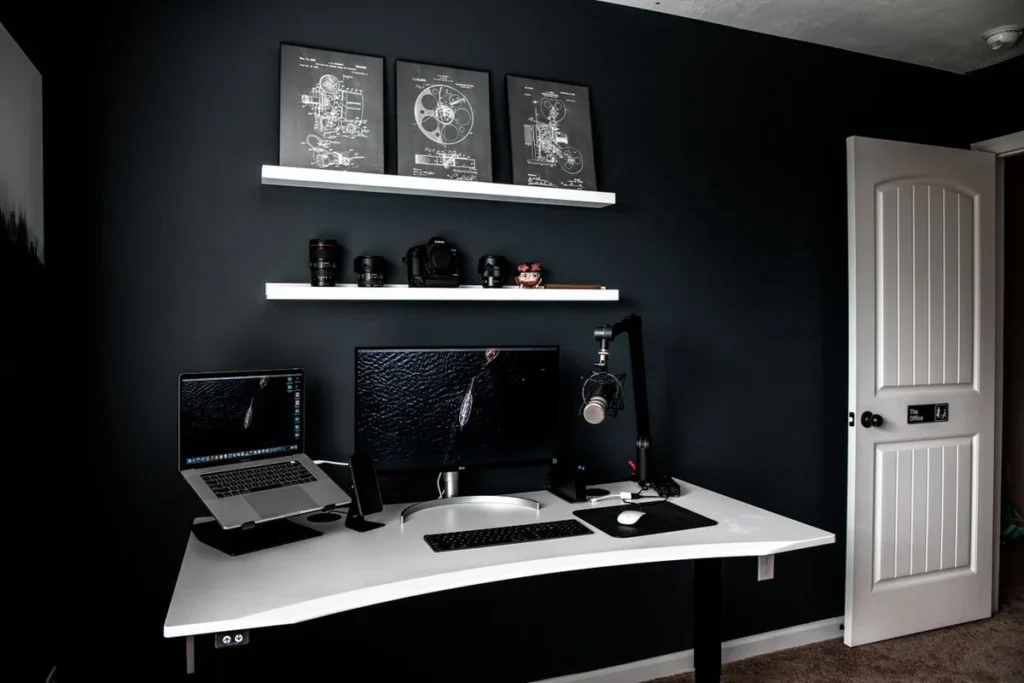
Electric vs Manual Standing Desks: Is the Motor Worth It? (2026)
An electric standing desk is worth the extra money if you will switch between sitting and standing more than once or twice a day — the motor cuts a 60-to-90-second crank session to about 15 seconds with one button. If you will move the desk once a day or less, a manual crank desk does the same job for roughly half the price.
As an Amazon Associate I earn from qualifying purchases.
TL;DR — Electric vs manual standing desks at a glance
- Cost: Manual crank desks run $150–$300; electric desks run $450–$900 for comparable tops (as of November 2026).
- Speed: Electric moves 20 inches in 13–17 seconds; a hand crank takes 60–90 seconds.
- Stability: Heavy dual-motor frames are the most stable at full height; budget electrics and crank desks can wobble above 44 inches.
- The verdict in one line: buy the motor for the habit, buy the crank for the budget.
Method: we compared published specs, November 2026 street prices, and verified owner feedback. No hands-on lab testing.
Electric vs manual standing desks: the head-to-head verdict
| Electric standing desk | Manual crank standing desk | |
|---|---|---|
| Typical price (Nov 2026) | $450–$900 for a quality dual-motor desk | $150–$300 for a full crank desk |
| Height-change time | 13–17 seconds per 20-inch travel, one button | 60–90 seconds of hand cranking |
| Stability at max height | Best on heavy dual-motor frames (355–440 lb capacity) | Good on wide frames, more wobble near the top end |
| Noise | ~45–52 dB during adjustment (a few seconds) | Silent except for the crank clicking |
| Height range | Typically 22.5–51.6 inches | Typically 27.5–48 inches |
| Reliability | Controllers/motors can fail out of warranty; parts $80–$150 | Almost nothing to break |
| Best for | Switching positions 2+ times a day | Budget buyers and once-a-day adjusters |
How much does each type really cost over time?
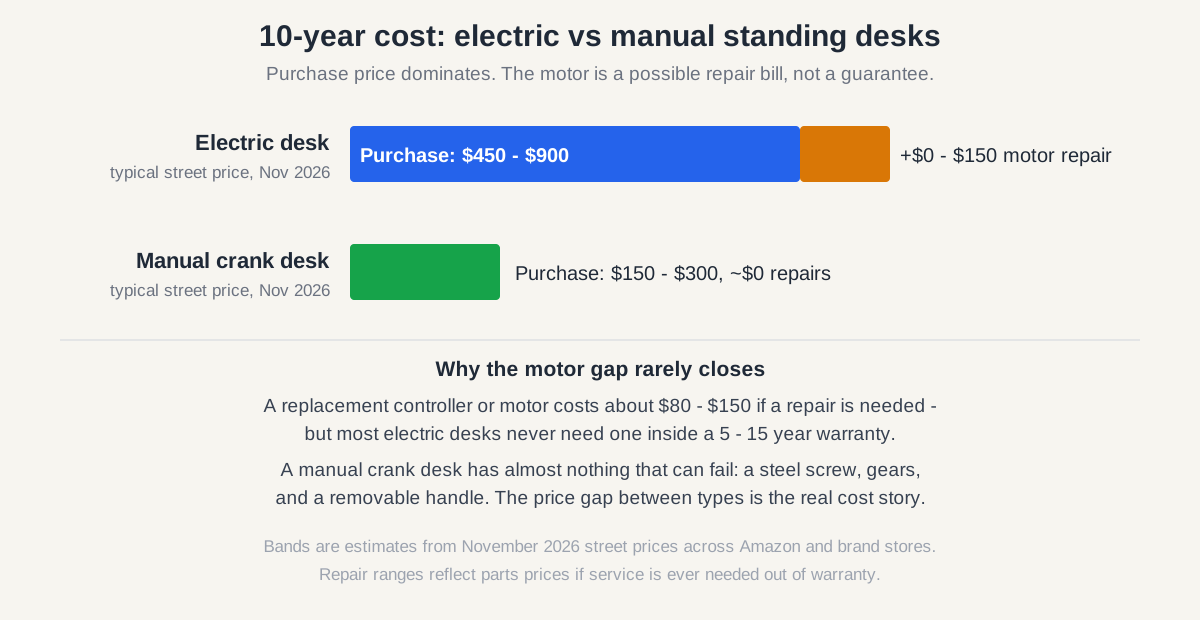
The upfront price gap is the whole story — the motor rarely adds a surprise bill later. A manual crank desk costs $150–$300 complete. An electric desk of comparable size starts around $450 for a quality dual-motor frame-with-top and runs to $900 for premium configurations.
Over 10 years, the electric desk only gets more expensive if something breaks outside warranty — a replacement controller or motor runs roughly $80–$150 in parts. Inside a 5-to-15-year frame-and-motor warranty (UPLIFT covers 15 years; FlexiSpot covers 15 years on direct-purchased frames), repairs are unlikely to ever be your bill.
Bottom line on cost: you are paying roughly $200–$400 extra so changing height takes 15 seconds instead of 90 — a behavior purchase, not a durability one.
Time your purchase if you can. Black Friday week (Nov 27–30) is when desk prices hit their yearly floor — our Black Friday standing desk deals guide tracks the discount bands to expect, and the savings usually erase most of the electric-versus-manual price gap.
How long does it take to change height — and does that matter?
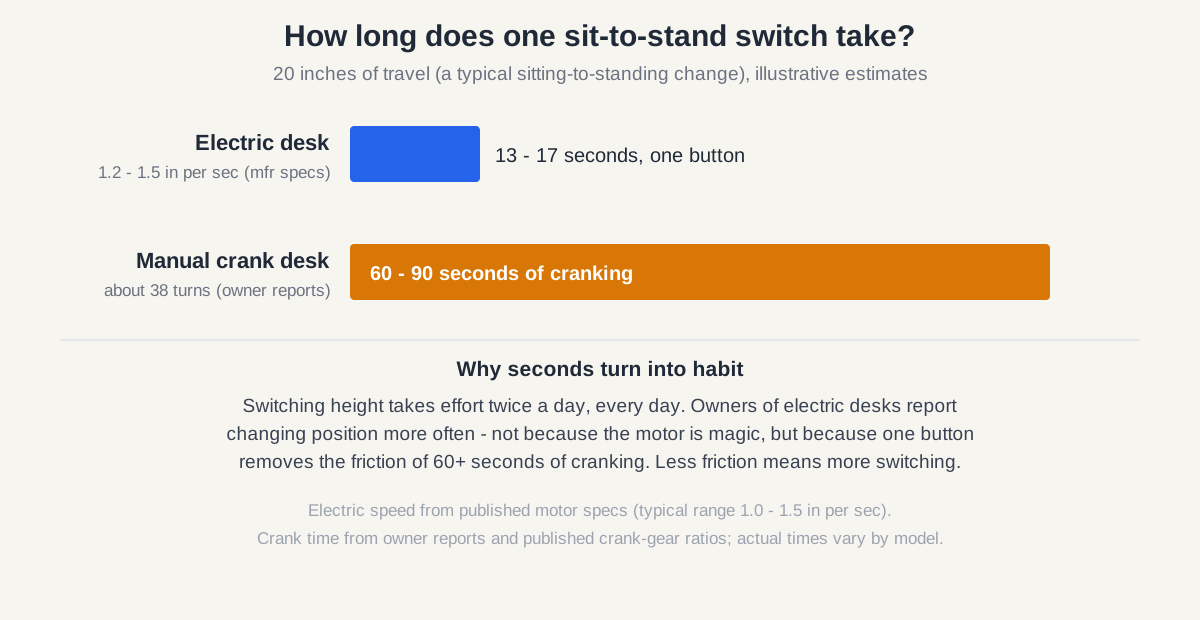
Yes — height change is a twice-a-day habit, and friction kills habits. Electric desks travel at roughly 1 to 1.5 inches per second: 13–17 seconds and one button press for a 20-inch sit-to-stand trip. A manual crank needs about 35–40 full turns, roughly 60–90 seconds, per owner reports and published gear ratios.
Twice a day, every workday, that is 12–15 minutes a month of winding a handle. Owner reviews of crank desks repeat one pattern: people set the desk to standing once, then get tired of cranking it back down for video calls and leave it wherever it landed.
The quotable version: a standing desk you don’t adjust is just a desk, and the motor’s real job is making adjustment effortless enough to become a habit. A Cochrane review of workplace interventions found sit-stand desks cut sitting time by roughly 84–116 minutes per day — but only when workers actually changed position, which is precisely the behavior the motor is buying you.
Which frame is more stable at full height?
Stability follows frame weight and leg design, not the presence of a motor. The heaviest dual-motor electric desks — FlexiSpot E7 Pro (440 lb capacity), UPLIFT V3 (355 lb) — are also the most stable at full standing height: thick three-stage steel legs, heavy bases, and roughly 0.5–0.7 inches of sway at maximum extension in independent tests.
The wobble risk sits at the budget end of both types: single-motor electrics ($250–$400) and manual crank desks share a one-motor/shared-drive-shaft design with lighter-gauge steel, and can rack side to side under a heavy monitor-arm load at 46+ inches. Both are solid for a laptop and one monitor; a triple-monitor arm setup deserves dual motors.
Two frame features matter more than the lift type: a crossbar between the legs adds lateral rigidity, and three-stage legs overlap more than two-stage legs, reducing wobble at tall extensions. Our best standing desks under $500 scores each pick on both.
What breaks first? Reliability and warranty compared
On a manual crank desk, almost nothing breaks. The mechanism is a steel screw drive, a few gears, and a removable crank handle — the handle itself a $15–$20 replacement part. Failure reports are rare; the complaint pattern is boredom and dust on the crank, not broken gears.
On an electric desk, the electronics are the failure point — control box first, then a motor, then the handset. So the motor warranty is the number that matters: UPLIFT V3 covers 15 years on frame, motors, and electronics; FlexiSpot E7 Pro covers 15 years bought direct (5 years frame/motor plus 2 years electronics on the Amazon listing); budget electrics typically carry 3–5 years; crank desks typically 3 years — plenty for a device with no electronics.
The crank desk’s other edge: it works during a power outage or wherever outlets are spoken for. No cord, no standby draw, no controller box to reset after unplugging.
Who should buy electric?
Choose an electric standing desk if most of these describe you:
- You will change height at least twice a day. Below this frequency, the 15-second change is a luxury — save your money.
- You share the desk. One-button memory presets make different-height swaps painless.
- You run a heavy setup — two monitors on arms plus a desktop tower. Premium electric frames rate 355–440 lbs for exactly this.
- You are under 5’4″ or over 6’1″. Electric desks reach wider ranges (down to ~22.5 inches); crank desks bottom out near 27.5 inches. OSHA’s workstation guidance puts elbows near 90 degrees with the monitor top at or below eye level — hard to hit on a crank desk if you are petite.
Who should buy manual?
Choose a manual crank desk if most of these describe you:
- Budget is the deciding factor. At $150–$300, a crank desk costs less than the motor alone on a premium frame — and our worth-it analysis shows the health case for standing rests on alternating positions, which a crank desk handles just as well.
- You will set the height once a day or less. One morning switch, one evening switch — the crank tax is two minutes a day.
- Your workspace lacks a free outlet — a garage bench, a shared studio corner. The crank desk needs zero power.
- You keep setups for a decade. No electronics means no obsolete parts, no firmware, nothing to unplug during thunderstorms.
The best electric and manual standing desks for 2026
We compared published specs, November 2026 street prices, and verified owner feedback to pick these.
Electric pick 1: SHW 55 x 28 Electric Standing Desk — Best budget electric
The SHW 55×28 is the perennial budget electric: a 55-by-28-inch top with a drawer, single motor, and 4-position memory presets, under $200. The amazon.com listing showed $188.87 with 21,678 ratings averaging 4.4 out of 5. Height adjusts 28 to 45 inches — fine for average users, slightly high for petite sitters.
Check the SHW 55×28 Electric Standing Desk price on Amazon
Electric pick 2: FlexiSpot E7 Pro — Best premium electric
The E7 Pro is the dual-motor heavyweight here: 440 lb capacity, 25-to-50.6-inch range, four memory presets, and three-stage legs measured at roughly 0.7 inches of sway at maximum extension. Motor noise is about 50–52 dB — a quiet-refrigerator hum that lasts seconds. TechRadar’s October 2026 deals coverage listed it at $530 at FlexiSpot (Target’s 48-inch black: $475.99). The 15-year frame-and-motor warranty applies to direct purchases; the Amazon listing carries 5 years frame/motor plus 2 years electronics. No verified Amazon ASIN, so no Amazon link — buy it at flexispot.com.
Electric pick 3: UPLIFT V3 — Best warranty electric
UPLIFT’s V3 replaced the V2 in late 2025 and leads on specs: dual motors, three-stage legs, 22.6-to-48.7-inch range (the lowest minimum here, genuinely fitting short users), 355 lb capacity, ~2 in/sec lift at under 50 dB, and a 15-year warranty covering frame, motors, electronics, and desktop.
Pricing starts at $599 for a frame with a basic top; typical builds land closer to $650–$1,100. UPLIFT sells direct through uplift.com, so there is no Amazon link.
Manual pick: VIVO DESK-M55TW — Best manual crank desk
VIVO’s 55-by-24-inch crank desk is the manual category’s value anchor: a solid one-piece top, telescopic steel legs with a crossbar, and a 27.6-to-46.2-inch range holding up to 88 lbs — plenty for a monitor-arm setup or two screens. The removable crank stows on the frame. The 24-inch depth is the spec to check: slightly narrower than 28-to-30-inch tops, so measure your monitor-stand footprint.
Check the VIVO 55×24 Manual Crank Desk price on Amazon
What should you check before buying either one?
Measure your sitting elbow height first. Sit in your chair, relax your shoulders, measure floor to elbow — that is your sitting desk height. Crank desks bottom out around 27.5 inches (users from ~5’4″ up); shorter users need an electric desk’s ~22.5-inch minimum or a keyboard tray.
Match weight capacity to your setup, not your body. A 100 lb rating covers a laptop and monitor; add a second monitor, an arm, a tower, and speakers and you are at 130–150 lbs. That is why 176 lb budget ratings are real constraints and 355–440 lb premium ratings are genuine headroom.
Check the noise figure if you take calls. Electric motors run 45–52 dB — audible on a sensitive microphone. Change height before the meeting, or use a headset with a noise gate.
On electric desks, presets are the habit mechanism. Two presets (sit + stand) are the minimum; four is nice for a shared desk. Avoid no-name electrics whose handsets forget presets after a power blip — the classic 3-star budget complaint.
Verify desktop depth against your monitor setup. A 24-inch-deep top works with a monitor on its factory stand; a clamped monitor arm at the back of a 24-inch top leaves little room for a keyboard. For deep arms, 28–30 inches of depth is worth the price step.
FAQ: electric vs manual standing desks
Is an electric standing desk worth the extra money?
Yes, if you will switch positions at least twice a day — the motor turns a 60-to-90-second crank into a 15-second button press.
How long does it take to crank a manual standing desk up?
About 60–90 seconds for a typical 20-inch sit-to-stand change — roughly 35–40 full turns of the handle, per owner reports and published gear ratios.
Can a manual standing desk hold as much weight as an electric one?
Roughly yes at the budget level: crank desks rate 88–176 lbs, comparable to single-motor electrics — but neither matches the 355–440 lb ratings of premium dual-motor frames.
Which lasts longer, electric or manual?
The crank desk usually lasts longer with zero maintenance since it has no electronics — but a premium electric under a 15-year frame-and-motor warranty is engineered for a comparable working life.
Are crank desks bad for short or tall users?
They run narrower ranges: most bottom out near 27.5 inches and top out near 46–48, so users under about 5’4″ may not get low enough to sit correctly — electric desks reaching 22.5 inches solve that.
The bottom line
Buy electric if you will move the desk twice a day or more, or share it — the motor’s job is removing friction from a habit. Buy manual if the budget is tight or you want the simplest, most repairable desk in the room. Either way, the desk only helps when you actually switch positions.